One name for a card issued under many
On 16 December 1976, the organisation behind BankAmericard announced that the card would become Visa.1 Replacement cards began to reach holders on 1 March 1977, at first carrying both names, and the Bank of America cards issued around the world were to be phased out by the end of October 1979.1 Visa sums up the change in one line on its own history page: BankAmericard became Visa, "a name that sounds the same in all languages".2
By then the card no longer belonged to a single bank. Bank of America had launched it in Fresno, California, in 1958 and began licensing it to other banks in 1966.1 In 1970 the issuing banks took control through National BankAmericard Inc., with Dee Hock as its first president and chief executive.1 Outside the United States, Bank of America sold its card operations in 1974 to IBANCO, a multinational corporation formed by licensee banks; before the sale the card was issued in over 15 countries.3
A family of cards under different names
Abroad, the licensees did not all use the BankAmericard name. In Canada, a group of banks led by the Canadian Imperial Bank of Commerce issued the card from 1968 as Chargex, a name chosen from over 1,000 entries in a public contest.4 In Britain, Barclays had launched Barclaycard on 29 June 1966, with a reciprocal arrangement under which BankAmericard merchants accepted it.5
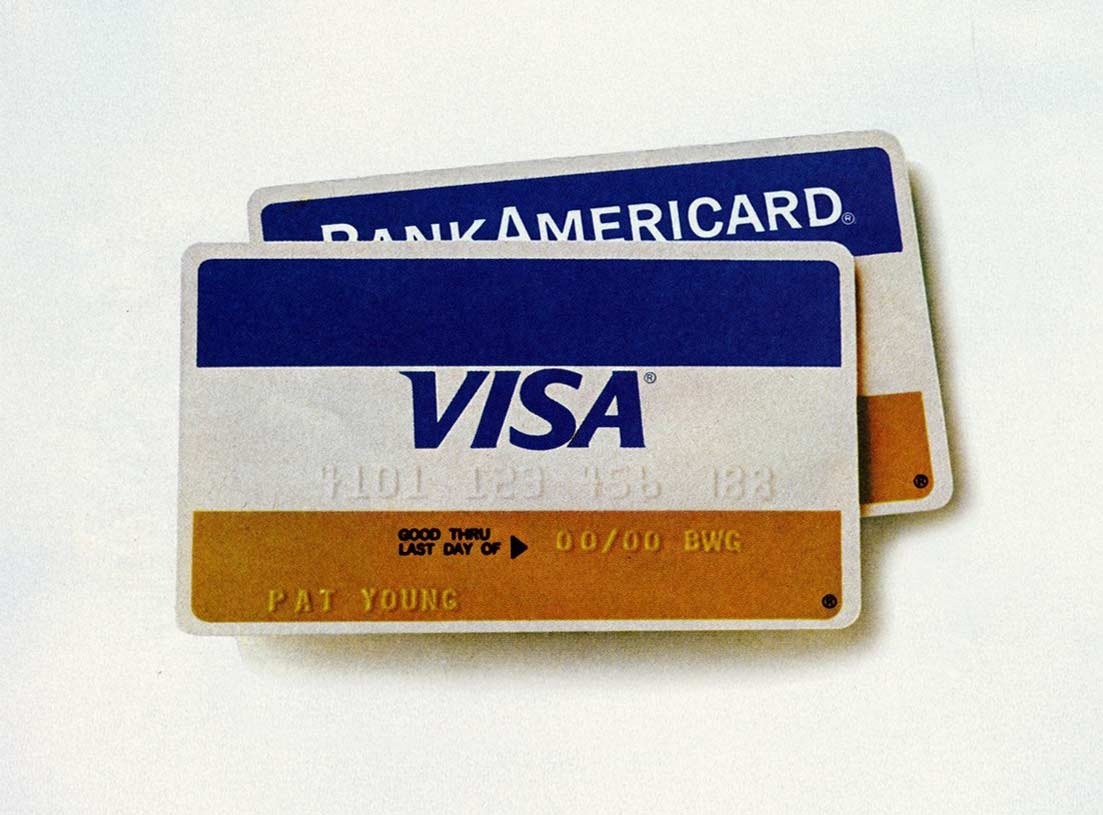
What held these cards together was not a name but a look. The first Chargex cards adopted BankAmericard's gold, white and blue colour scheme, and Barclaycard carried the same three colours.4,5 The bands told a shop in Toronto or London that the card on the counter belonged to the same system as a BankAmericard from California. The words in the middle changed with the country and the bank, so the network was recognisable by its colours but had no single name to advertise.
Why a name without a bank or a country
The BankAmericard name said two things the network no longer wanted to say. It named one bank, and it named one country. Many foreign banks resisted issuing a card linked to Bank of America, "despite the fact that the association was nominal only", according to the International Directory of Company Histories.3 The Pantagraph reported in December 1976 that the company had decided the name BankAmericard "would not be well accepted in Europe" because of the "America" in it.6
Hock chose Visa, the same directory records, "because it implied no national identification" and because "it was relatively easy to pronounce in any language".3 The word also had a meaning that suited a card for travellers: according to the Pantagraph, it was picked for "its almost universal meaning as a travel document".6 Alfred F. Kelly, Jr., Chairman and Chief Executive Officer of Visa, later wrote that Hock "turned to his internal team, via a contest, to surface Visa".7 The word was not entirely free. McLean County Bank in Bloomington, Illinois, had run a savings programme called VISA since 1972 and registered the name in 1974; it was paid for the name and kept the right to use it in its own way.6
New words on familiar colours
The renaming changed the words and kept the colours. The new network retained the blue, white and gold flag.1 When Barclaycard took the new Visa network symbol in April 1977, Barclays kept "the familiar blue, white and gold colour scheme".5 In Canada the new name and logo were phased in over a couple of years, until Visa replaced the Chargex brand.4 For cardholders the object stayed familiar. What changed was the word printed across the bands, and with it the claim the card made.
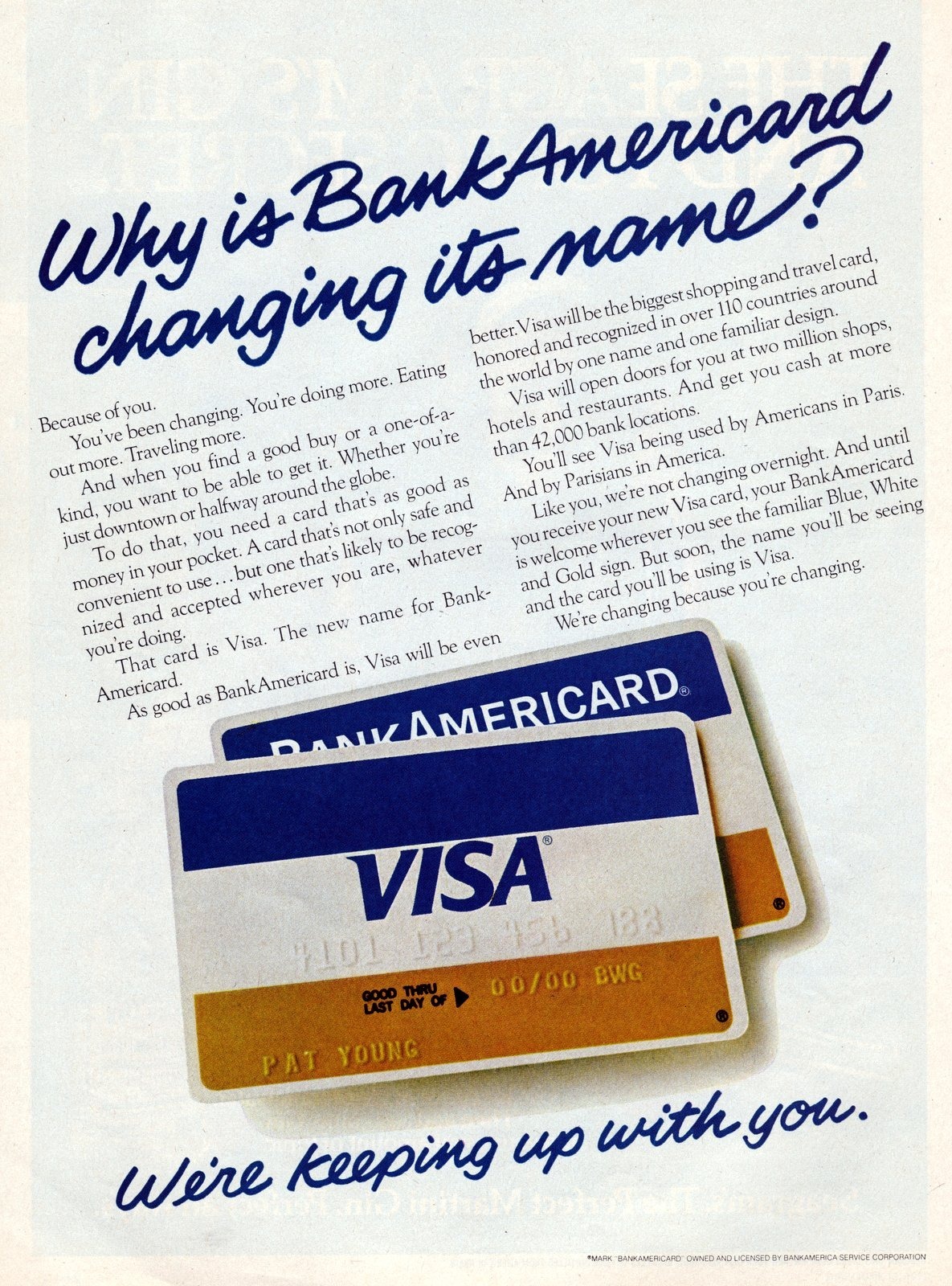
That claim was the one the launch advertising made. A 1977 advertisement in Time presented the card as "honored and recognized in over 110 countries around the world by one name and one familiar design".6 The Pantagraph put the advertising programme scheduled for 1977 at $8.15 million.6 For the first time, banks in many countries could buy media for the same word.
What the name made possible
Visa did not introduce a new product in 1976. It gave an existing network one identity that no member bank owned and no country claimed. That neutrality let Barclays, the Canadian banks and Bank of America carry the same mark without promoting one another, while Barclaycard kept its own name next to the new symbol.5 Hock, in words Kelly quoted, wanted a system that "would transcend language, culture, currency".7 The name was the first piece of that idea a customer could see. With it, the brand stopped describing who issued the card and started describing where the card worked.
Written with AI assistance, edited by a human. Find out more about our Use of AI.
1. Wikipedia, "Visa Inc.", read 18 October 2026, for the announcement on 16 December 1976, replacement cards from 1 March 1977 initially carrying both names, the phase out of Bank of America issued cards by the end of October 1979, the 1958 launch in Fresno, licensing from 1966, National BankAmericard Inc. in 1970 with Dee Hock as president and CEO, and the retained blue, white and gold flag. https://en.wikipedia.org/wiki/Visa_Inc.
2. Visa, "History of Visa", corporate history page, undated, read 18 October 2026, for the quoted description of the 1976 change, cited after the dash in the original. https://africa.visa.com/about-visa/our_business/history-of-visa.html
3. International Directory of Company Histories via Encyclopedia.com, "Visa International", undated, read 18 October 2026, for the 1974 sale of foreign card operations to IBANCO, issue in over 15 countries, resistance of foreign banks, and the quoted reasons for Hock's choice of the name. https://www.encyclopedia.com/social-sciences-and-law/economics-business-and-labor/businesses-and-occupations/visa-international
4. David Bergeron, Bank of Canada Review, "Chargex", Winter 2008 to 2009, read 18 October 2026, for the licence bought by the Canadian Imperial Bank of Commerce, the Chargex cards from 1968 in BankAmericard's gold, white and blue, the public naming contest with over 1,000 entries, and the phase in of Visa over a couple of years. https://www.bankofcanada.ca/wp-content/uploads/2010/06/review_winter08-09.pdf
5. Barclays Group Archives, "Barclaycard", archive story, undated, read 18 October 2026, for the launch on 29 June 1966, the reciprocal arrangement with BankAmericard merchants, the new Visa network symbol in April 1977, and the quoted retention of the colour scheme. https://home.barclays/archive-barclays/stories/Barclaycard
6. Click Americana, "How the Visa credit card was born back in the 1970s", undated, read 18 October 2026, reprinting Kathy McKinney, The Pantagraph, "Visa passport to bank windfall", 16 December 1976 (for the quotations on Europe and on the travel document meaning, McLean County Bank's VISA savings programme from 1972, the 1974 registration, the agreement and the $8.15 million advertising programme), and a Time advertisement of 13 June 1977 (for the quoted line on 110 countries). https://clickamericana.com/topics/money-work/visa-card-debuts-1976-1977
7. Alfred F. Kelly, Jr., Visa, "Dee Hock: In memoriam", 20 July 2022, read 18 October 2026, for the internal contest that produced the name and Hock's quoted aim. https://corporate.visa.com/en/sites/visa-perspectives/company-news/dee-hock-in-memoriam.html