
A melody rewritten for the fifteenth time
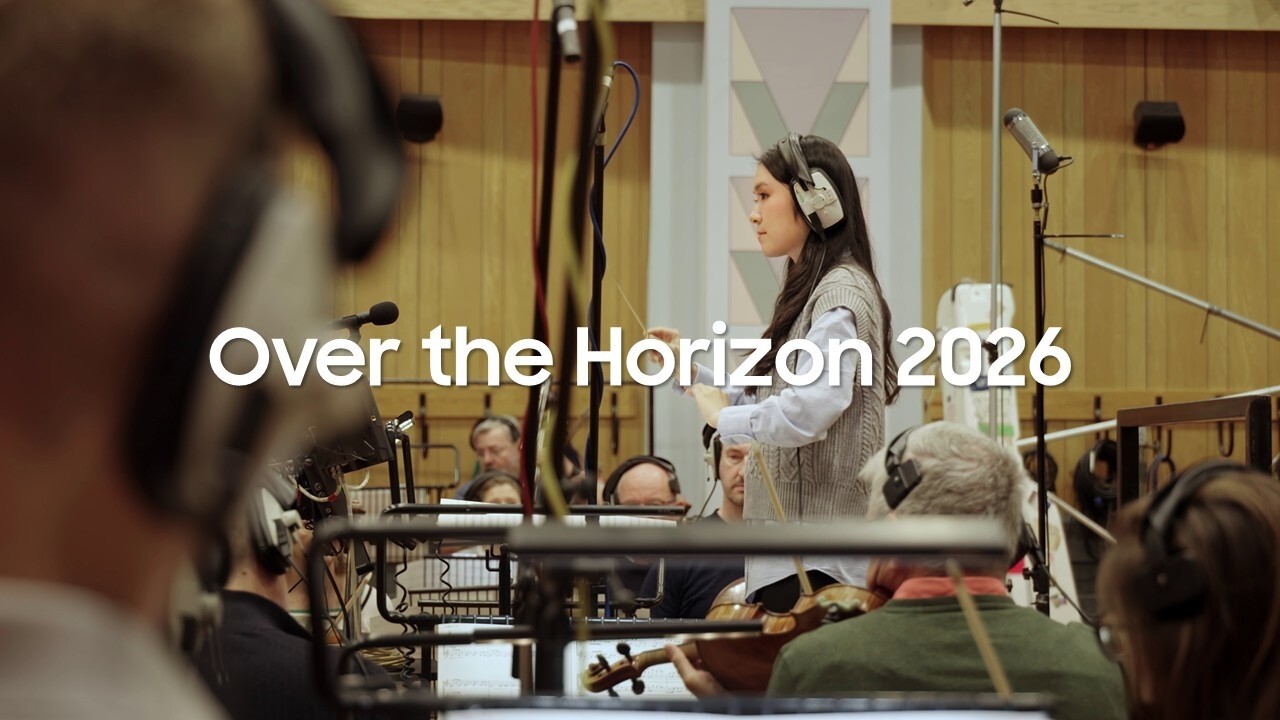
In February 2026 Samsung releases the newest arrangement of Over the Horizon, its mobile brand theme, recorded by the composer Eunike Tanzil with the Royal Philharmonic Orchestra at Abbey Road Studios under the title "A Soundtrack of the Earth".1 Tanzil describes the task as a question of casting: "Blending instruments with different identities was an enjoyable challenge."1
It is the fifteenth annual version of a melody that has shipped on Galaxy phones since 2011. Six notes stay fixed. Everything around them is rebuilt each year, released alongside the new flagship, with a stated theme attached. Fifteen years of that practice make Over the Horizon one of the longest continuously governed sonic identities in consumer electronics, and one of the very few that is deliberately not left alone.
Six notes chosen by ballot
Samsung published the account of how the theme was made in April 2015, four years after it first shipped.2 The work had been assigned to Joong-sam Yun, a senior designer in the company's IT and Mobile Communications division.2 His brief was to give audible form to the corporate vision of the period, "Inspire the World, Create the Future".2 His team drafted several candidate tunes and then put the options to a vote. Roughly 900 employees of Samsung's Global Design Center were surveyed, and the six-note melody that won became the theme.2
Yun described the intent note by note. "Each note has its own special purpose. The introduction provides a friendly and well-balanced ambiance. The syncopation of the leap of the tune in the following notes conveys passion with a futuristic sound. The last note represents the ceaseless challenging spirit of Samsung Electronics."2
A theme with a new brief every year
Each version carries its own message. The first arrangement was released under "Beyond Smart Experience", the 2012 version under "Designed for Humans", the 2013 one under "Life Companion".2 The 2015 recording gives a sense of the resources involved: it was performed by the Nashville String Machine, a forty-piece orchestra, and mixed by the engineer Al Schmitt at Capitol Studios in Los Angeles.2 A ringtone was being produced with the apparatus of a record.
An expanding list of collaborators
From 2016 Samsung began handing the melody to outside musicians. The Swedish group Dirty Loops reworked it for the Galaxy S7.3 Jacob Collier followed for the Galaxy S8 in 2017.3 In 2018 a group of Dutch primary school pupils rebuilt it digitally.3 The tenth anniversary of the Galaxy series in 2019 produced a crossover of rock and classical pop.3
The pianist Yiruma took it in January 2021, and SUGA of BTS produced versions later that year and again in 2022, which moved the theme from the phone into music release cycles.4 Yaeji arranged the 2023 version.4 In 2024 the Seoul National University Gugak Orchestra recorded it with traditional Korean instrumentation under music director Won il, who described the aim as capturing "the concept of embracing tradition, modernity and the future".5 A big band jazz arrangement followed in 2025, before this year's orchestral recording.4
The list also shows the theme working as a distribution device. A new arrangement gives Samsung a reason to publish, a partner to co-promote with and an asset that travels through streaming services rather than through advertising inventory. The melody arrives on the phone as a default, and the same recording circulates independently of it.
Source: 삼성전자 뉴스룸 [Samsung Newsroom] Youtube
A second melody for the home
The mobile theme is not the only one. Since 2015 Samsung has run a separate brand melody for its home appliances, Beyond the Horizon, built on an ascending line intended to signify possibility.6 The company set out the reasoning in a design story published in November 2016: "No two are the same. Likewise, a brand should have its own unique acoustics. The sonic experience with a brand is a vital asset and an intricate part of the total brand experience."6
Why a sound holds where a picture cannot
Samsung's brand system has never rested on a single symbol. It is built from assets that can be applied independently, among them the SamsungOne typeface released in 2016 and the visual identity system later developed for the Galaxy portfolio.7 A melody belongs to that logic. It reaches the user in the moments a logo cannot, when the phone is in a pocket, when a screen is off, when a device is being switched on for the first time.
The annual rewrite is what separates the approach. Most sonic identities are protected by keeping them unchanged, on the argument that recognition depends on repetition. Samsung takes the opposite view and protects only the interval structure, treating genre, instrumentation and performer as variables. Fifteen versions later the melody is still recognisable, which suggests the six notes were carrying the recognition on their own.
One inconsistency survives in Samsung's own material. The 2015 account dates the theme to 2011 and the Galaxy S II, while a 2016 design story says the company has used it since 2012.2, 6 The earlier date is the one Samsung uses when it tells the story in full, and it is the one recorded here.
Source: 삼성전자 뉴스룸 [Samsung Newsroom] Youtube
Written with AI assistance, edited by a human. Find out more about our Use of AI.
1. Samsung Global Newsroom, "[Video] Reimagined for Orchestra, 'Over the Horizon 2026' Captures Earth's Melody", 20 February 2026, for the February 2026 release of the newest arrangement, its recording by the Los Angeles based composer Eunike Tanzil with the Royal Philharmonic Orchestra at Abbey Road Studios, the title "A Soundtrack of the Earth", and the quoted words of Tanzil. The release carries her sentence in full as "Blending instruments with different identities was an enjoyable challenge and became a meaningful chapter in my musical journey." https://news.samsung.com/global/video-reimagined-for-orchestra-over-the-horizon-2026-captures-earths-melody
2. Samsung Global Newsroom, "Over the Horizon: The Evolution of the Samsung Galaxy Brand Sound", 18 April 2015, for Samsung's first full published account of the theme's creation and its April 2015 date, for the assignment to Joong-sam Yun, there titled Senior Designer at IT and Mobile Communications, for the brief of giving form to the corporate vision "Inspire the World, Create the Future", for the survey of approximately 900 employees of the Global Design Center and the six-note melody that won it, for the note-by-note quotation from Yun, for the theme first shipping in 2011 with the Galaxy S II, for the annual titles "Beyond Smart Experience" (Galaxy S II, 2011), "Designed for Humans" (Galaxy S III, 2012) and "Life Companion" (Galaxy S4 and S5, 2013), for the 2015 recording by the Nashville String Machine as a 40-piece orchestra mixed by the engineer Al Schmitt at Capitol Studios in Los Angeles, and for the 2011 dating in the closing paragraph. https://news.samsung.com/global/over-the-horizon-the-evolution-of-the-samsung-galaxy-brand-sound
3. Samsung Global Newsroom, the announcements of the 2016 to 2019 arrangements, one page per collaboration. "Dirty Loops Remake of 'Over the Horizon' Comes to the Galaxy S7 and S7 edge", 10 March 2016, for the Swedish group Dirty Loops and the Galaxy S7. "Samsung and Jacob Collier Collaborate on New Galaxy Smartphones' 'Over the Horizon'", 26 March 2017, for Jacob Collier as the 2017 collaborator, with "[Design Story] How Samsung's Sound Design Creates a Harmonized Galaxy S8 User Experience", 14 April 2017, for the tie to the Galaxy S8, which the announcement itself does not name. "Samsung's 'Over the Horizon' Gets Digitally Re-Worked by Elementary School Students in the Netherlands", 5 July 2018, for the Dutch elementary school pupils rebuilding the melody with digital composition tools. "From Rock to Classical-Pop Crossovers: New Ocean-Inspired 'Over the Horizon' Celebrates 10th Anniversary of Galaxy Series", 14 February 2019, for the tenth anniversary version. https://news.samsung.com/global/dirty-loops-remake-of-over-the-horizon-comes-to-the-galaxy-s7-and-s7-edge https://news.samsung.com/global/samsung-and-jacob-collier-collaborate-on-new-galaxy-smartphones-over-the-horizon https://news.samsung.com/global/design-story-how-samsungs-sound-design-creates-a-harmonized-galaxy-s8-user-experience https://news.samsung.com/global/samsungs-over-the-horizon-gets-digitally-re-worked-by-elementary-school-students-in-the-netherlands https://news.samsung.com/global/from-rock-to-classical-pop-crossovers-new-ocean-inspired-over-the-horizon-celebrates-10th-anniversary-of-galaxy-series
4. Samsung Global Newsroom, the announcements of the 2021 to 2025 arrangements, one page per collaboration. "Pianist Yiruma Reimagines 'Over the Horizon' To Inspire Hope and Optimism", 29 January 2021, for Yiruma's grand piano version for the Galaxy S21 series. "[Video] Get an Inside Look at How SUGA of BTS Has Reimagined Samsung's 'Over the Horizon'", 12 August 2021, and "Samsung Releases New 'Over the Horizon 2022 Produced by SUGA of BTS'", 17 August 2022, for the two SUGA versions and their release as music in their own right. "New 'Over the Horizon' Theme Celebrates Positivity and Optimism in an Evolving World", 1 February 2023, for Yaeji and the Galaxy S23 version. "[Video] 'Over the Horizon' 2025: Capturing the Rhythm of the Day With Big Band Jazz", 17 January 2025, for the big band jazz arrangement, written by the pianist Jacob Mann. https://news.samsung.com/global/pianist-yiruma-reimagines-over-the-horizon-to-inspire-hope-and-optimism https://news.samsung.com/global/video-get-an-inside-look-at-how-suga-of-bts-has-reimagined-samsungs-over-the-horizon https://news.samsung.com/global/samsung-releases-new-over-the-horizon-2022-produced-by-suga-of-bts https://news.samsung.com/global/new-over-the-horizon-theme-celebrates-positivity-and-optimism-in-an-evolving-world https://news.samsung.com/global/video-over-the-horizon-2025-capturing-the-rhythm-of-the-day-with-big-band-jazz
5. Samsung Global Newsroom, "A Harmonious Blend of Nature and Tradition: Behind the Scenes of 2024's 'Over the Horizon'", 19 January 2024, for the 2024 recording by the Seoul National University Gugak Orchestra with traditional Korean instrumentation, for music director Won il, and for his quoted words, which the page carries as "In this version of 'Over the Horizon,' we tried to capture the concept of embracing tradition, modernity and the future." https://news.samsung.com/global/a-harmonious-blend-of-nature-and-tradition-behind-the-scenes-of-2024s-over-the-horizon
6. Samsung Global Newsroom, "[Design Story] Joy of Listening: Sound Design at Samsung", 10 November 2016, for Beyond the Horizon as the brand melody for home appliances since 2015 and for its ascending line, the page reading "Beyond the Horizon has been our signature brand melody for home appliances since 2015. It represents positivity and unlimited possibilities in ascending melody.", for the quoted passage on brand acoustics reproduced in the body, and for the second date in the closing paragraph, the page stating that "Over the Horizon has been the sound for Samsung Electronic mobile devices since 2012". https://news.samsung.com/global/design-story-joy-of-listening-sound-design-at-samsung
7. Samsung Global Newsroom, "[Design Story] SamsungOne, the New Universal Typeface for Samsung", 22 July 2016, for the SamsungOne typeface having been released in 2016 as a universal typeface for the brand, covering 26 writing systems, more than 400 languages and over 25,000 glyphs. Added during the footnote retrofit of 17 September 2026, because no source listed for this verse covered the typeface. https://news.samsung.com/global/design-story-samsungone-the-new-universal-typeface-for-samsung