
A brand that has changed what it stands for
Bespoke began as a promise about surfaces. When Samsung launched the appliance brand, the differentiating idea was customisation: interchangeable colour panels, modular configurations, a refrigerator that could be specified to a kitchen rather than imposed on one.1 The word bespoke was chosen for exactly that meaning.
In its 2026 line, presented at CES in January 2026, the brand carries a different argument.2 Bespoke AI appliances are positioned as home companions, devices that see, hear and interpret what is happening in a household through integrated screens, cameras and Bixby voice recognition, connected through SmartThings into a single system.3 The name has stayed. What it denotes has moved from personalisation of form to personalisation of behaviour.
The positioning statement
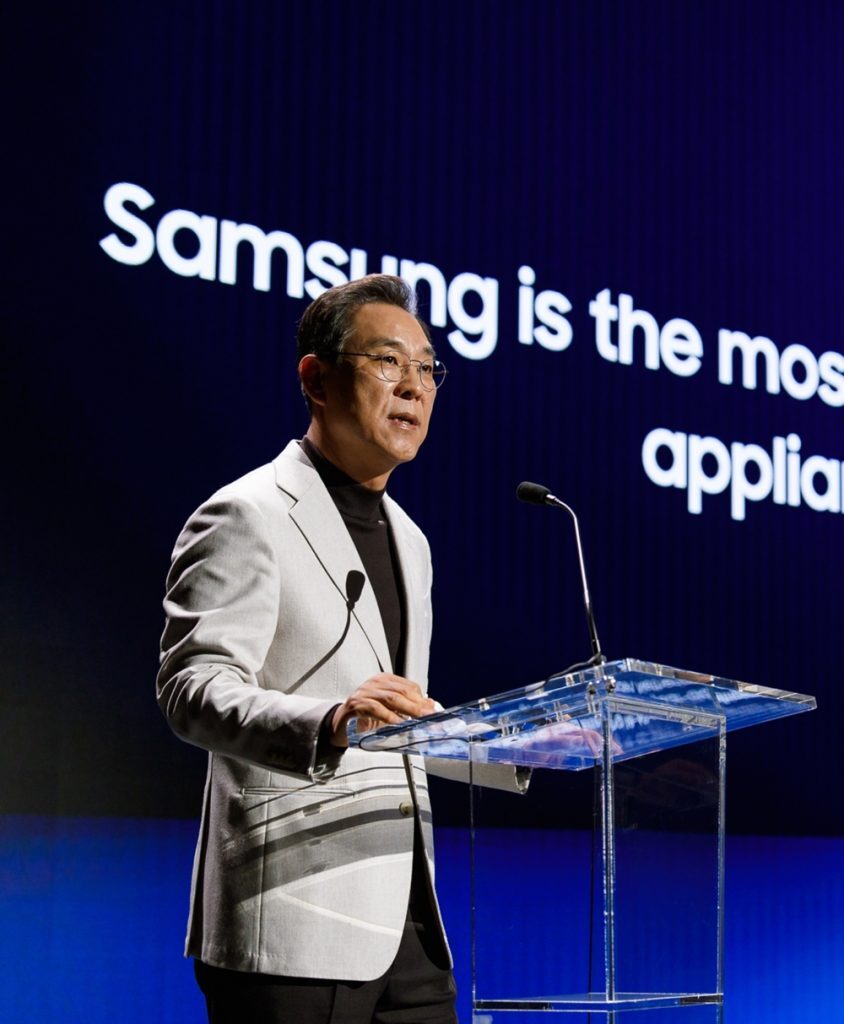
Cheolgi Kim, head of Samsung's digital appliances business, puts the ambition in plain terms: Samsung's ultimate goal, he says, is to enable a better living through Bespoke AI.3 The mechanism he describes is cross-category connectivity, with mobile devices, televisions and appliances sharing context so that each can deliver something none of them could alone.3
That framing is a brand architecture decision, meaning a decision about how a company organises its portfolio of brands, as much as a product one. Samsung is using Bespoke as the endorsement layer that ties appliances to the rest of the company's AI programme rather than creating a separate AI sub-brand for the home.4 The alternative, spinning up a new name for the intelligence layer, would have given Samsung a cleaner story but would have detached it from a brand customers already associate with premium appliances.
The word companion is doing specific work. An appliance is a tool: it is operated, it performs a task, and the relationship ends there. A companion is a party to the household, which implies presence, memory and initiative. Samsung is describing devices that hold context between uses and act on it, and the vocabulary prepares customers for products that behave in ways an appliance is not expected to behave. It also sets an expectation the hardware has to meet, since a device presented as a companion is judged by how well it anticipates rather than by how reliably it runs a cycle.
One brand, four regional arguments
The 2026 material is notable for how differently Samsung pitches the same brand by region, which is unusual for a company that has spent a decade consolidating its identity.
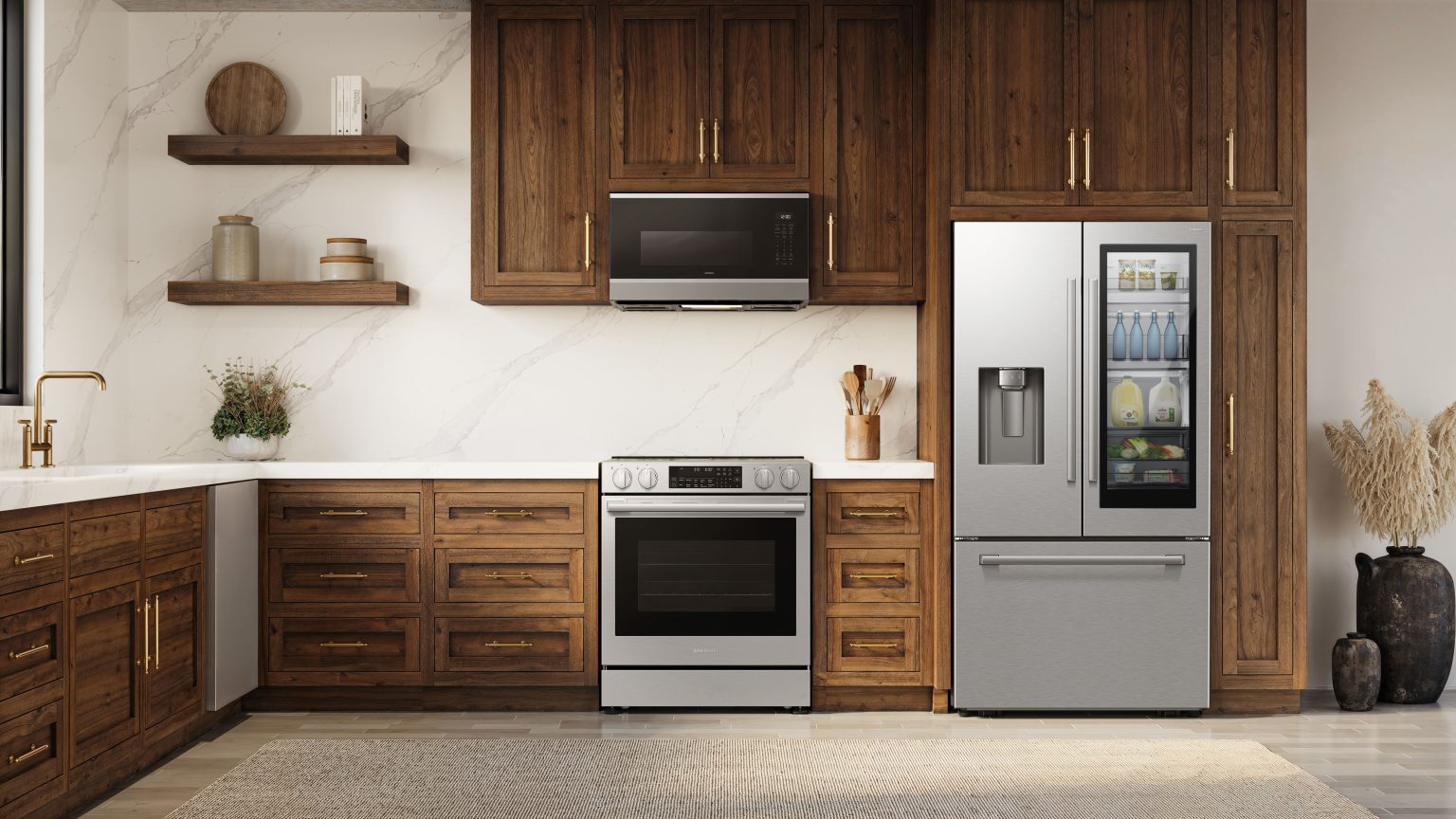
In North America, the Bespoke AI Laundry Combo leads growth, and Samsung has added unified stainless steel kitchen packages responding to a regional preference for matched suites.3, 5 In Europe the argument is energy: Samsung cites a Bespoke AI washer running 65 percent more efficiently than the minimum for energy class A, alongside advanced HVAC and built-in kitchen solutions.3, 6 Latin America is described in terms of momentum in laundry and air conditioning.3 In Asia, Samsung points to growing smart home adoption, localised AI features, regional language support and AI Energy Mode extended across price tiers.3
The through line is that AI is sold as an outcome rather than a feature. Efficiency in Europe, convenience in North America, accessibility in Asia. The technology is constant, the benefit claim is localised, and Bespoke is the container that holds them together. It is a departure from how Samsung has usually operated. The company spent the 2010s consolidating a single global message, and regional variation was largely a matter of media and casting rather than of the proposition itself. Here the proposition itself moves, and the brand name is what stays fixed.
How far the name can stretch
Samsung has signalled that Bespoke AI will extend beyond appliances in the conventional sense, into HVAC, modular homes, insurance-based care services and further connectivity domains.3 That is a substantial widening for a name introduced to describe interchangeable refrigerator panels.
It is also the point at which the positioning gets tested. A brand extension works when the new category is plausible under the existing promise. Customisation stretched comfortably from refrigerators to washing machines. Companionship stretches further still, which is what makes modular homes and care services arguable additions. The risk is the one every umbrella brand faces: a name asked to mean personalisation, intelligence, energy efficiency, care and connectivity at once eventually means competence rather than anything specific.
What Samsung has built in its favour is consistency of system. Its approach across the Galaxy portfolio has been to unify a widening range of products under one design grammar rather than fragmenting into sub-brands, and the Bespoke AI decision applies the same logic to the home. Whether the appliance business can hold a promise as broad as companionship is the question the 2026 line puts on the table.
Source: Samsung US Youtube
Written with AI assistance, edited by a human. Find out more about our Use of AI.
1. Samsung Electronics, "Samsung Globally Launches Bespoke: A Customizable Refrigerator that Caters to Various Consumer Lifestyles", 15 June 2020, for what the Bespoke name originally promised: a refrigerator whose owner could "tailor their own configurations by material, color, and module", offered in up to 11 colours across three textures, and a modular range to which a further unit could be added "without the need to discard or replace the current model". Added during the footnote retrofit of 18 September 2026, because none of the sources listed with the article covers the brand's starting point. https://news.samsung.com/global/samsung-globally-launches-bespoke-a-customizable-refrigerator-that-caters-to-various-consumer-lifestyles
2. Samsung Global Newsroom, "Samsung To Unveil New AI-Connected Living Lineup at CES 2026", 18 December 2025, for the 2026 Bespoke AI line being shown at CES in Las Vegas from 6 to 9 January 2026, and for the Bespoke AI Laundry Combo, AirDresser, WindFree Pro air conditioner and Jet Bot Steam Ultra being the appliances presented there. https://news.samsung.com/global/samsung-to-unveil-new-ai-connected-living-lineup-at-ces-2026
3. Samsung Global Newsroom, "Home Companion: Comprehension of Samsung Bespoke AI 2026", 7 January 2026, for the positioning of the 2026 Bespoke AI appliances as home companions, "equipped with Bixby voice recognition technology, screens, and cameras that allow them to see, hear and understand to proactively respond to users", connected through SmartThings; for Cheolgi Kim, named there as Head of the DA Business, and his statement that "Samsung's ultimate goal is to enable a better living through Bespoke AI. Through our extensive ecosystem that connects devices across DX products, including mobile phones and TV, and our appliances' unique form factors, we are providing differentiated experiences to our consumers and creating more value through those experiences." (the release sets the phrase "including mobile phones and TV" between em dashes, replaced here with commas under the house rule); for the four regional arguments, that is the Bespoke AI Laundry Combo and the new kitchen packages in unified stainless steel in North America, the Bespoke AI washer described as "up to 65% more energy efficient than energy efficiency class A minimum requirements" in Europe, laundry and air conditioning in Latin America, and localised AI features, regional language support and expanded AI Energy Mode in Asia; and for the stated commitment to expand "beyond traditional appliances into areas such as HVAC, modular homes, insurance-based care extending the value of AI, and connectivity in new aspects of daily life". https://news.samsung.com/global/connected-comprehension-inside-samsungs-2026-ai-home
4. Samsung Global Newsroom, "Samsung To Unveil AI Vision Built With Google Gemini at CES 2026", 22 December 2025, for the 2026 home intelligence being announced under the existing Bespoke AI name, with the upgraded AI Vision built with Google Gemini presented as a capability of the Bespoke AI refrigerator and the new Bespoke AI Wine Cellar rather than under a separate AI brand for the home. https://news.samsung.com/global/samsung-to-unveil-ai-vision-built-with-google-gemini-at-ces-2026
5. Samsung Newsroom U.S., "2026 Samsung Bespoke AI Kitchen Appliances are Available Now", 9 April 2026, for the North American half of that argument reaching the market, with the Bespoke AI 3-Door French Door refrigerators and the Bespoke Smart Slide-in ranges "available for purchase at select retailers nationwide and on Samsung.com", stainless steel among the finish options, and the ranges built to pair with the Bespoke Over-the-Range Microwave with Air Fry Max. The page does not mention the Bespoke AI Laundry Combo. https://news.samsung.com/us/2026-samsung-bespoke-ai-kitchen-appliances-available-now
6. Samsung Newsroom U.K., "Enabling Better Living: Samsung Showcases New Bespoke AI Kitchen and Living Appliances For 2026", 21 April 2026, for the European lineup that carries the energy argument, the Bespoke AI washer "consuming 65% less energy than the minimum energy efficiency requirements for a Class A rating", the extractor induction hob that combines cooking and ventilation in one appliance and so removes the need for a separate hood, the built-in Bespoke AI dishwasher, and Samsung's own description of these appliances as "home companions". https://news.samsung.com/uk/samsung-showcases-the-new-bespoke-ai-kitchen-and-living-appliances-at-eurocucina-2026