One name for a house full of devices
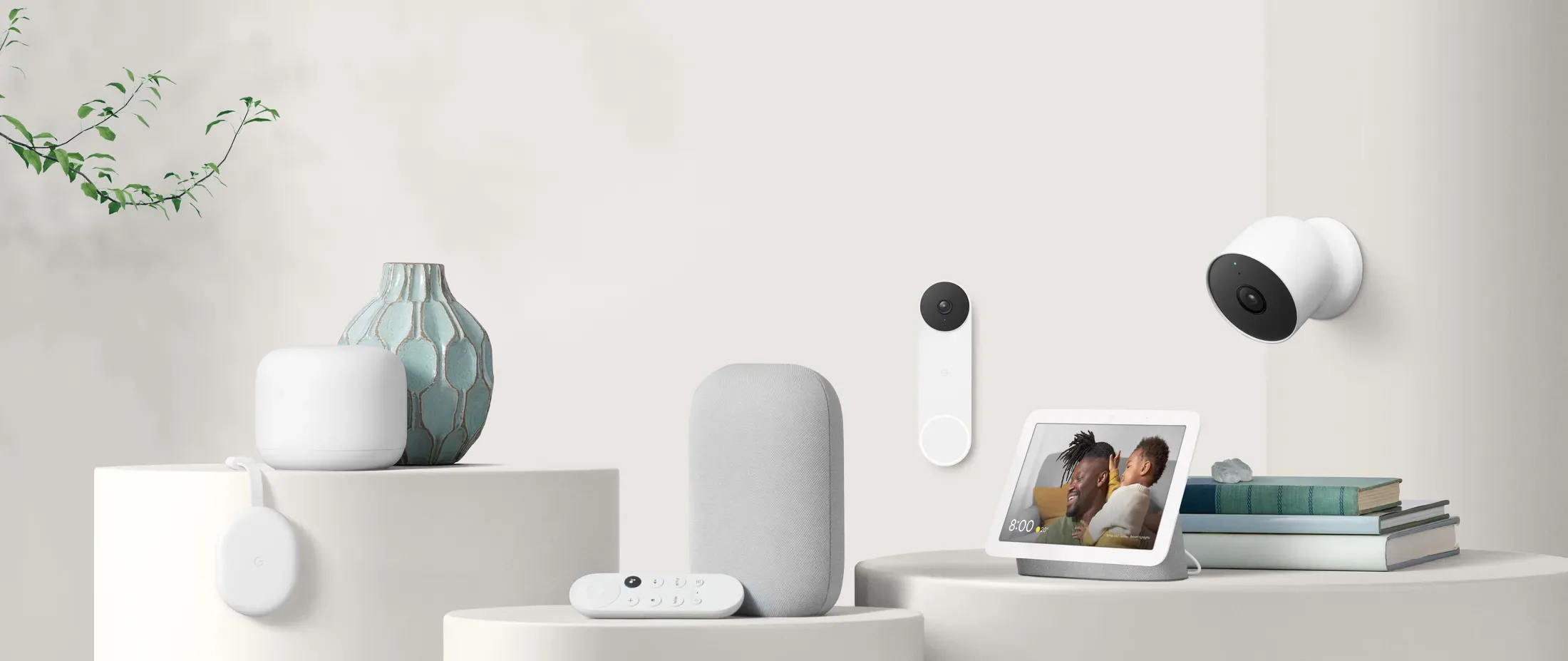
In May 2019, at its annual I/O developer conference in Mountain View, Google announced that its entire range of connected home products would be sold under a single name: Google Nest. The Google Home Hub smart display, launched only seven months earlier, was renamed the Google Nest Hub, and a larger ten-inch model arrived as the Nest Hub Max. Speakers, cameras, thermostats, doorbells and routers were all folded into the same family.
The move ended one of the more visible brand-architecture problems in consumer technology. Brand architecture describes how a company organises its portfolio of brands, and Google had spent five years running two of them in parallel inside the same product category, with customers left to work out how they related to each other.
How two home brands came to exist
Nest Labs was founded in 2010 by Tony Fadell and Matt Rogers, both former Apple engineers, and made its name with the Nest Learning Thermostat in 2011 and the Nest Protect smoke alarm in 2013. It was a hardware brand with a specific promise: unremarkable household objects, redesigned with care, that quietly looked after the building around you. Google acquired the company in January 2014 for 3.2 billion US dollars and initially left it to operate on its own.
When Google restructured under the holding company Alphabet in August 2015, Nest was placed alongside Google rather than inside it, which formalised the separation. Google meanwhile built a second home business of its own, launching the Google Home speaker in 2016 around the Google Assistant. By 2017 the company was selling thermostats and cameras branded Nest and speakers and displays branded Google Home, through separate apps, separate accounts and separate support paths.
Nest was merged back into Google's hardware division in February 2018, and the leadership question was settled that summer when the home teams were consolidated under Rishi Chandra. The naming question took another year.
Why Nest won
Choosing Nest over Home was not the obvious decision. Home was the newer brand, it carried the Assistant, and it sat closer to Google's own identity. Nest was an acquired name attached to a company Google had once kept at arm's length.
What Nest had was meaning. The word describes a place of shelter, and the brand had spent nearly a decade attaching itself to safety, warmth and care inside the house. Google Home, by contrast, was descriptive rather than distinctive. It named a category instead of claiming a position within it, and it collided awkwardly with the Google Home app, the Google Home speaker and the general idea of a home page.
Trust also mattered. Cameras, microphones and door locks are the most privacy-sensitive products a technology company can sell, and Google was aware that its own name carried associations with data collection that a thermostat brand did not. Placing the corporate name in front of the acquired one, as Google Nest, was a compromise between the reassurance of Nest and the endorsement of the parent brand.
What the consolidation cost
The transition was not tidy. Existing Nest owners were asked to migrate their accounts to Google accounts, a change that altered how their devices worked with third-party services and drew criticism from long-standing customers. For a period the Home app and the Nest app continued to exist side by side, so a household could own two Google Nest products that could not be managed in the same place. Retail packaging lagged behind the announcement, and some boxes reached shelves with the new name applied as a sticker.
The naming itself also produced its own confusion, since products such as the Nest Learning Thermostat kept a name that predated Google while newer devices arrived as Google Nest Audio or Google Nest Doorbell. The portfolio was consistent in principle before it was consistent in practice.
What Google gained in exchange was legibility. A shopper looking at a shelf could now see one family instead of two, and the endorsement structure, corporate name followed by category name, matched what the company was already doing elsewhere with Google Pixel and Google Workspace.
Even so, the direction was clear, and by the early 2020s Nest had become the settled name for Google in the home. The Google Home brand survived only as the app that controls the devices, an inversion of the original arrangement. For a company that had bought a brand, sidelined it, then rebuilt around it, the episode is a compact lesson in what an acquired name is actually worth.
Written with AI assistance, edited by a human. Find out more about our Use of AI.