A new company above Google
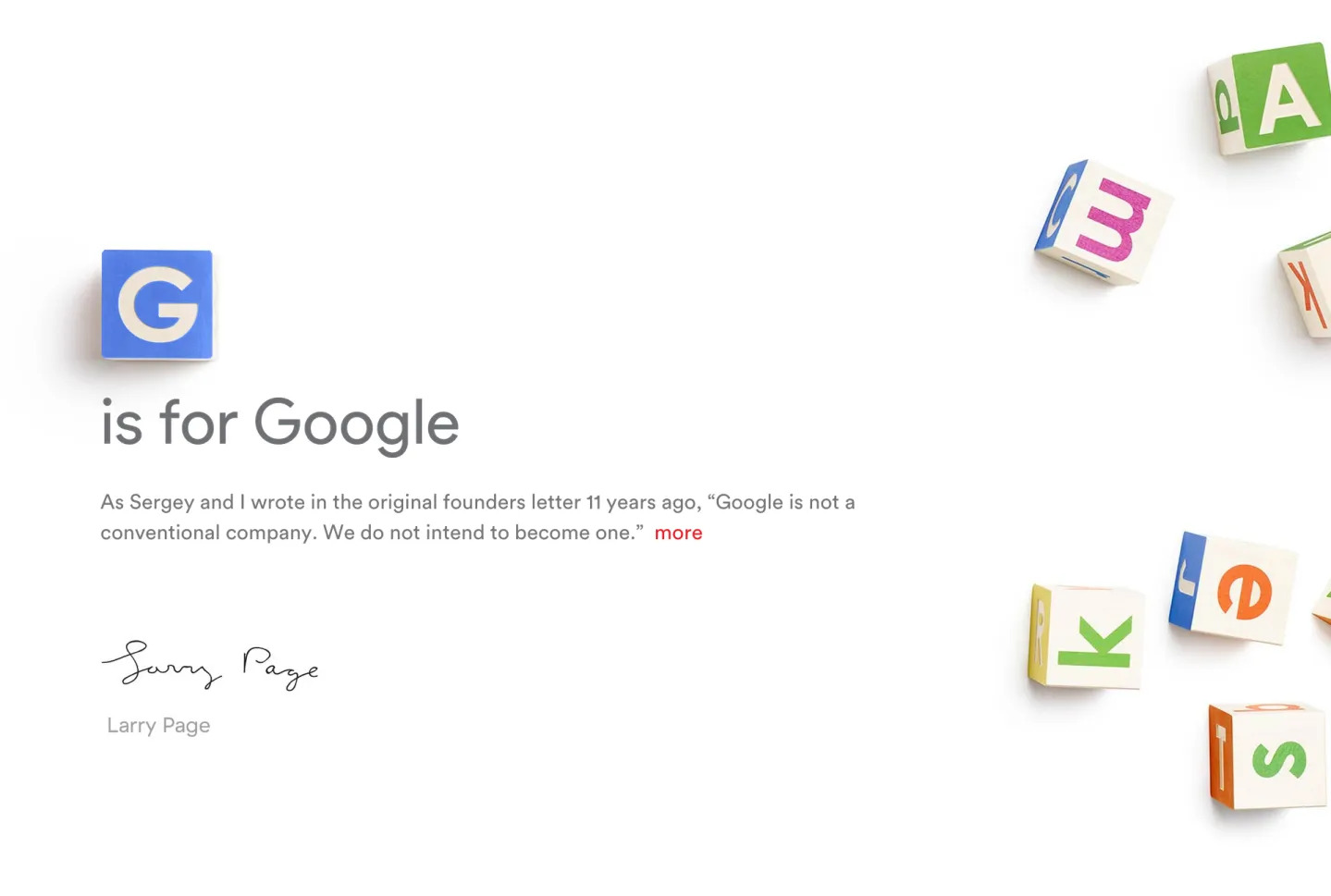
On 10 August 2015, Google announced one of the most significant structural changes in its history. The company would create a new holding company called Alphabet, and Google as the public had known it, search, advertising, Android, YouTube, Maps and related products, would become a subsidiary of that parent. Larry Page and Sergey Brin, Google's co-founders, moved up to run Alphabet, while Sundar Pichai was named chief executive of the newly narrowed Google.
The move was primarily a question of corporate structure and investor clarity, but it was also, unavoidably, a branding decision. It reshaped the architecture of one of the world's most valuable brands and forced a set of questions about names, hierarchy and meaning that most companies never face at that scale.
Why separate Google from its bets
By 2015, the entity called Google had expanded far beyond its origins as a search engine. It housed self-driving car research, life sciences work, venture capital arms, home automation through Nest and a range of long-horizon research projects the company referred to as moonshots. These ventures had little in common with the advertising business that generated almost all of the group's revenue, and bundling them together made the company harder to understand from the outside.
Alphabet was designed to solve that problem. By creating a holding company, Google could report the performance of its core internet business separately from its more speculative bets, giving investors a clearer view of where money was made and where it was being invested. Each major venture could operate as its own company under the Alphabet umbrella, with its own leadership and identity, rather than sitting awkwardly inside the Google brand.
From a brand-architecture perspective, this was a shift from a single, stretched masterbrand toward a house of brands. Google would stand for the products most people used every day, while Alphabet would be the parent that held everything, including Google itself, allowing the more experimental ventures to develop their own identities without diluting or confusing the Google name.
The thinking behind the name
In the founding letter that accompanied the announcement, Larry Page explained the choice of name directly. Alphabet appealed to the founders as a collection of letters that represent language, one of humanity's most important innovations, and as the foundation of how knowledge is indexed, which connected neatly to Google's original mission of organising information. Page also noted a play on words, alpha-bet, referring to investment returns above a benchmark, which he framed as something the company aimed to deliver.
The name was deliberately neutral and abstract. Where Google was a distinctive, ownable coinage derived from googol, the mathematical term for a very large number, Alphabet was an ordinary word chosen for its associations rather than its novelty. That restraint suited its role. A holding company does not need to market itself to consumers, so its name could afford to be quiet, letting the operating brands underneath do the work of connecting with the public.
What changed and what stayed the same
For most users, the practical effect of the restructuring was minimal. People continued to search on Google, watch YouTube and use Android without noticing that a new parent company had been placed above them. The Google brand, refreshed weeks later with its 2015 logo redesign and the custom Product Sans typeface, remained the public face of the group and lost none of its prominence.
The change was felt more in how the company presented itself to investors, employees and regulators. Alphabet became the entity whose shares traded on the stock market and whose results defined the group's financial story, while Google was reframed as the largest and most important business within a broader portfolio. Over time, ventures such as the self-driving unit Waymo and the life sciences arm Verily emerged as distinct Alphabet companies with their own names and brands.
Seen a decade on, the creation of Alphabet reads as a moment when Google formalised what it had already become: not a single product but a group of businesses of very different kinds. The restructuring gave that reality a clear brand architecture, one that separated the everyday utility of Google from the long-term ambition of its parent, and it has framed how the company has been understood ever since.
Written with AI assistance, edited by a human. Find out more about our Use of AI.