A system built to move like a flock
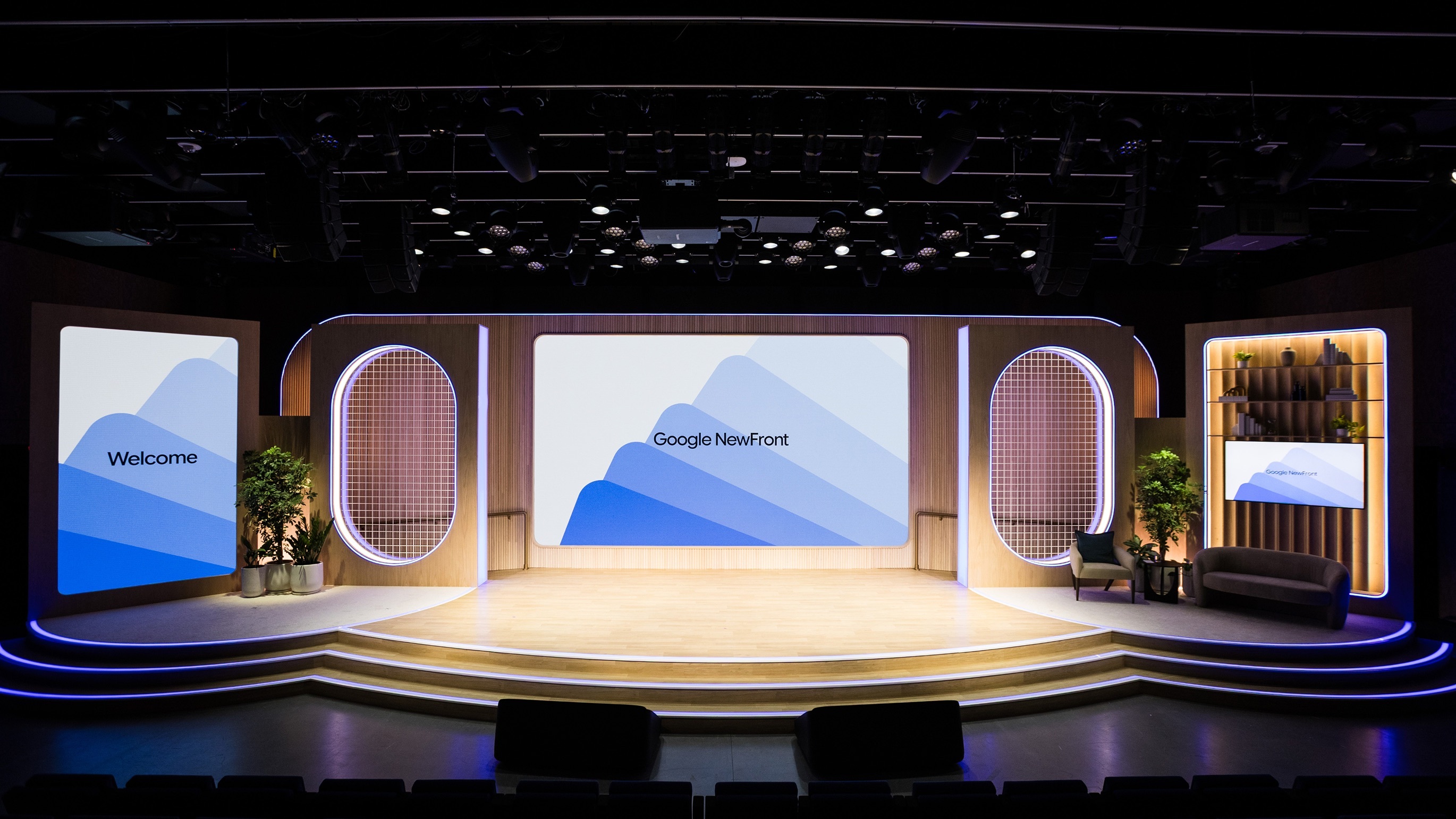
On 23 March 2026, Google staged NewFront, its annual showcase for the Google Marketing Platform, at Pier 57 in New York.1, 2 Billed internally as a "Super Bowl" moment for the platform, the event's purpose was to present a spread of separate advertising and analytics tools as one unified system, now powered throughout by Gemini, Google's AI model.1 For the identity behind the event, Google worked with the London-based design agency Human After All, which built the entire system from the ground up around a concept it named Amplified Flow.1
Amplified Flow was designed to move the way a flock of starlings shifts as a single body: layouts and content containers that repeat and link together, carrying a sense of momentum across every screen and surface in the building, from a keynote wall the size of a stage backdrop down to signage at a boba tea station.1 When the first assets went live ahead of the event, 4,500 people registered for the livestream within 24 hours.1
Google has taken part in the NewFront circuit for years, historically using the event to preview updates to Display & Video 360 and the wider Google Marketing Platform stack.3 The 2026 edition marked a departure from that pattern: rather than reusing templates built for Ads or Cloud communications, Google commissioned an identity system designed specifically for this single event, built to hold together a presentation spanning a keynote, partner showcases and a full building's worth of physical signage.
Finding the concept in nature
The route to Amplified Flow began in an internal workshop, where Human After All deliberately paired junior team members with creative directors, motion specialists and account staff to work out what the brief was really asking before any visual work began.1 The team's brief was to shift perception of the Google Marketing Platform away from a technically strong but fragmented set of tools and toward something felt as unified and emotionally compelling. Design director James Woods and the team looked to patterns of movement in nature for a way to visualize that shared direction: starling murmurations, chladni plates, on which sand forms geometric patterns under vibration, and ocean currents.1 Amplified Flow emerged from that research as a system built at the level of an overall framework rather than as surface decoration, allowing content to lead while design amplified it through repetition and scale.1
One typeface, one restrained palette
To keep the system legible across the many launches and narratives running through the day, Human After All narrowed its typographic choices to a single weight, Google Sans Flex Medium, selected from Google's much wider type family so the visual direction could carry its personality through animation rather than typographic variety.1 Color followed the same restraint: the full spectrum of Google's current brand palette, including the brighter gradient tones the company had extended company-wide the previous year, ran across every touchpoint so that even still, unmoving assets carried a sense of natural movement.1, 4
A site visit to Pier 57 while the identity was still in development shaped how the system was finally staged. Registering the scale of the venue's screens, and drawing on the example of Mark Rothko and James Turrell's use of bold simplicity, the team split the identity into two registers: "high volume" takeovers, full-screen moments built from bold color and motion that hinted at the performance to come, and a flatter, vector-based "low volume" register that controlled the rhythm of the day and gave wayfinding, lanyards and printed collateral a functional logic to build from.1
Sound, partners and the Gemini thread
Human After All developed the event's sonic identity with the audio studio Zelig Sound, tuning music and sound cues to match the visuals and ground the energy of the day, including a series of on-stage pep-rally moments.1 Between the larger keynote announcements, the agency also produced a run of scripted, animated case study videos for partners including ESPN and PepsiCo, each one built end to end to tell a specific story about what Gemini made possible inside the Google Marketing Platform.1 The studio, which has worked with Google for more than a decade across Ads, Cloud, Social and Gemini teams, notably used Gemini itself to help write a custom expression inside After Effects, allowing the team to develop the flowing motion more quickly while keeping it organic rather than mechanical.1
The result was an identity built specifically to avoid the visual clichés often associated with AI, advertising technology and enterprise software.1 Rather than illustrating the technology under the hood of the Google Marketing Platform, Human After All built Amplified Flow around the emotional effect of what the platform's upgrades made possible for the marketers using it.
Written with AI assistance, edited by a human. Find out more about our Use of AI.
1. The Brand Identity, "Inside Human After All's event identity for Google NewFront 2026", 12 June 2026, for Pier 57 in New York as the venue and the event being billed as a "Super Bowl" for the product, for the aim of presenting the Google Marketing Platform as one system supercharged by Gemini rather than a spread of separate tools, for London studio Human After All having built the identity from the ground up around the concept Amplified Flow and its murmuration logic of repeating, linked containers carrying momentum across every screen and surface from a keynote screen to a boba tea station, for the 4,500 livestream registrations within 24 hours of the first assets going live, for the workshop that paired junior team members with creative directors, motion specialists and account people, for the brief to shift perception of a platform seen as powerful but fragmented toward something unified and emotionally compelling, for design director James Woods and the research into murmurations, chladni plates and ocean currents, for the system framework approach that lets content lead and design amplify through repetition and scale, for the single weight Google Sans Flex Medium and the decision to draw personality from animation, for the full spectrum of the Google palette carrying movement into still assets, for the Pier 57 site visit and the Rothko and Turrell reference behind the "high volume" and "low volume" registers and the wayfinding, lanyards and printed collateral, for the sonic identity developed with Zelig Sound and the on-stage pep-rally moments, for the partner case study videos including ESPN and PepsiCo, for the studio having worked with Google for well over a decade across the Ads, Cloud, Social and Gemini teams, for Gemini having been used to write a homebrew After Effects expression, and for the visual cliches of AI, advertising technology and enterprise software having been kept out of the work. https://the-brandidentity.com/project/inside-human-after-alls-event-identity-for-google-newfront-2026
2. ppc.land, Luis Rijo, "Google sets March 23 date for Gemini showcase on Google Marketing Platform", 1 March 2026, for the event date of Monday 23 March 2026 and for the announced programme, in which Bill Reardon, General Manager of Enterprise Platform, framed the session around the Gemini advantage in Google Marketing Platform and around Display & Video 360. https://ppc.land/google-sets-march-23-date-for-gemini-showcase-on-google-marketing-platform/
3. Google, Kristen O'Hara, Vice President, Agency, Platforms & Client Solutions, "Display & Video 360 updates from Google NewFront", 29 April 2024, for Google running NewFront as its own recurring event and using earlier editions to unveil Display & Video 360 and wider Google Marketing Platform updates. https://blog.google/products/marketingplatform/360/newfront-2024/
4. Google, "Google's 'G' gets a brighter look", 29 September 2025, for the brighter hues and gradient design of the four-colour G and for Google making it the company-wide G icon, rolled out across more products, platforms and services in the months before NewFront 2026. https://blog.google/company-news/inside-google/company-announcements/gradient-g-logo-design/