Christmas, made by hand
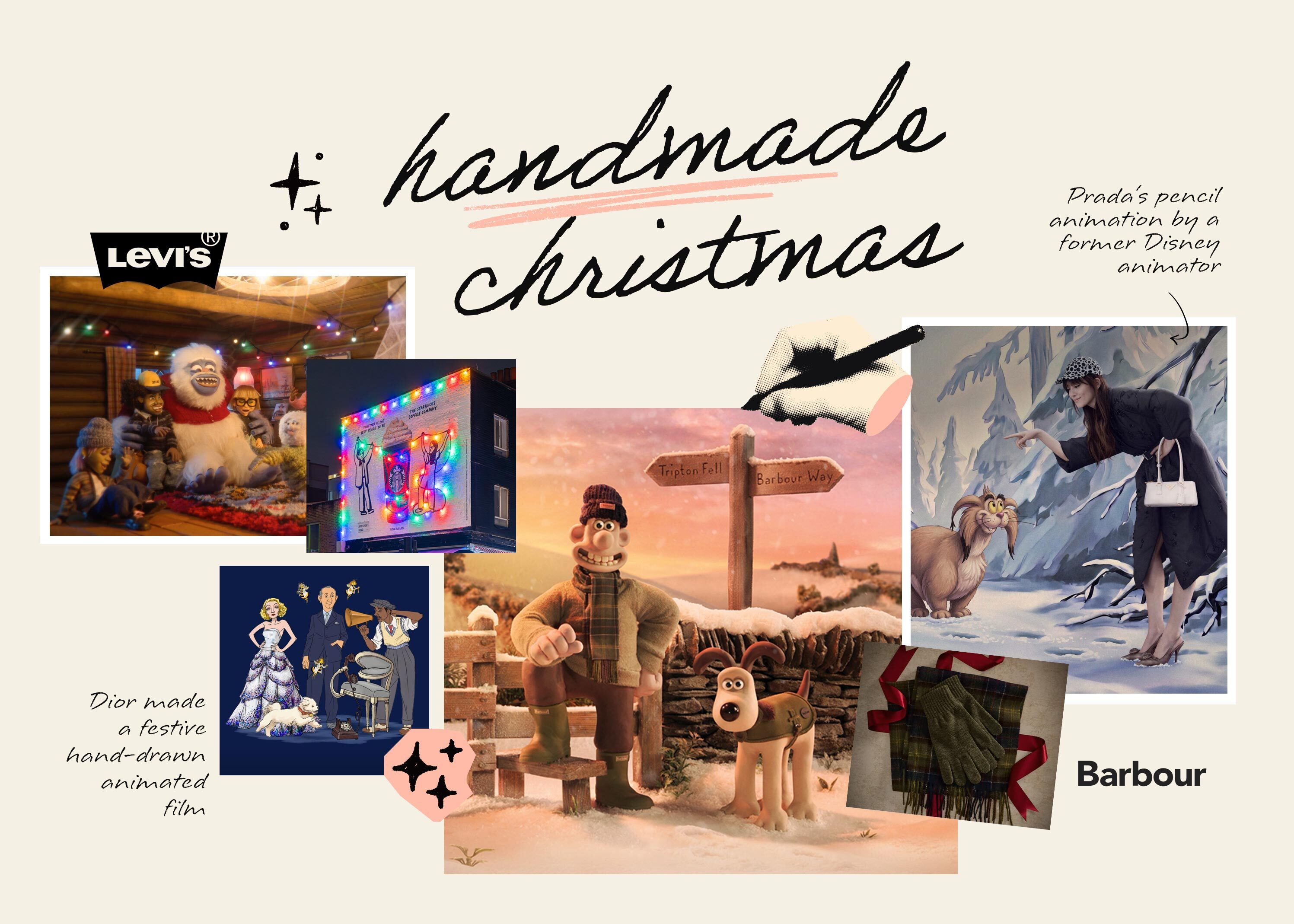
Within a single week at the turn of October and November 2026, four of the season's most visible holiday campaigns turned out to share one decision. Prada released "Drawing Prada", animated frame by frame in pencil by the former Disney animator John Pomeroy.1, 2 Dior premiered "Christian Dior's Night in Color", a six-minute film that Sylvain Chomet drew entirely by hand.3, 4 Levi's built a cabin in the woods out of clay for a stop-motion film.5, 6 Barbour brought back Wallace & Gromit in Aardman's stop-motion style.7
The movement did not begin this year. In 2025, Apple shot its holiday film "A Critter Carol" with puppets and puppeteers, and its director Mark Molloy said he "was really keen to go back to craftsmanship".8 In the same season, Starbucks built "Drawn Together" on hand-drawn illustrations by the artist Geoff McFetridge, animated across its red holiday cups.9 Apple has since carried the approach beyond Christmas. Its Apple TV ident of November 2025 was "built entirely from real glass and captured fully in-camera", and in October 2026 Apple Music made its new identity by sending musical notes through a shallow bath of mineral oil and filming the ripples.10, 11 Those are brand identities, not Christmas campaigns, but they follow the same logic. What is new in 2026 is that the idea has reached the season in which brands spend most on emotion, and that the houses adopting it are among the most visible in fashion.
The obvious reading is that brands are turning their backs on AI. Coca-Cola remade its "Holidays Are Coming" film with generative AI in 2024 and again in 2025, and was criticised both times.12, 13 McDonald's Netherlands pulled an AI-generated Christmas spot from YouTube in December 2025, three days after it went online.14 Against that background, a pencil looks like a protest.
I think that reading is too simple. Hardly any of these brands says a word against AI. What they do instead is show, in detail, how much work went into the film. That is the real change of this Christmas. Effort has become the message, because effort is the one thing that has become scarce.
The making-of is the campaign
Look at how the campaigns are presented, not only at the films. Prada released a behind-the-scenes film alongside the spot, in which Pomeroy explains: "There's a very distinct and purposeful reason to do hand-drawn animation."2 Levi's published its production figures: a six-person team at Blinkink spent more than 2,000 hours over six and a half weeks building and painting the sets, with three cabins at different scales, 400 miniature trees and four faces for every character, and each second of animation took four hours.6 Dior's producer Aton Soumache recalled that at first the teams at Dior "thought the drawings were too visible, that it looked very artisanal". The house left them visible anyway.4 In Prada's stills, the actors sit on top of the artist's sketches, so the drawing is never polished away.15
What is rarely said is the word AI. The newsletter Dux noted that brands "don't say no AI, it's more understated".16 Levi's is the exception: according to Marketing Dive, the brand stated that no AI was used in the filming, and its global CMO Kenny Mitchell called the film "the celebration of the craft and human creativity synonymous with the Levi's brand".5 The others let the hours speak for them.
Source: Levi's Youtube
Source: Barbour Youtube
Why effort works as a signal
There is an established logic behind this. In 1975 the zoologist Amotz Zahavi argued that a signal is only credible if it is costly to produce, because only a strong animal can afford the waste.17 Tim Ambler and E. Ann Hollier carried the idea into advertising in 2004: consumers read the apparent expense of a campaign as evidence of the brand's quality, and the part of advertising that looks like waste is the part that works.18 Psychology adds two findings. People judge a poem or a painting to be better when they believe it took longer to make, an effect Justin Kruger and colleagues called the effort heuristic.19 And Ryan Buell and Michael Norton showed that customers value a service more when they can see the work being done for them, even if it means waiting longer.20
Put together, these findings explain the Christmas campaigns. For decades, a beautiful, expensive-looking film was itself the costly signal. Generative AI has broken that link. A polished image can now be made for a fraction of what it once cost, so polish no longer proves anything. The signal has moved from the result to the process. This is why the making-of matters as much as the film, and why the credits read like a cast list: Pomeroy, Chomet, Blinkink, Aardman. A name is proof that a person spent time.
The audience has registered the shift. In a Gartner survey of 1,539 US consumers, published in March 2026, half said they would prefer to give their business to brands that do not use generative AI in their messages, advertising and content, and 68 percent said they frequently wonder whether the content they see is real.21 Creative Bloq drew the conclusion for advertisers: "Avoiding the embarrassment of an 'AI content' label isn't enough, they're taking steps to proactively signal that an advert was human made."6
The case for Coca-Cola
The counter-argument deserves a fair hearing, and Coca-Cola makes it openly. In November 2025, Islam ElDessouky, the company's global vice president for creative strategy and content, called the AI film "one of our top-tested ads in history, period", and added: "The masses, the audiences, do not necessarily look behind the technology. They just look at the story that they're receiving, and then they respond to it."22
He may well be right about the test scores. But a pre-test measures how people react to a story. It does not measure what a brand says about itself through the way it tells that story. This is where Coca-Cola's choice seems questionable to me. "Holidays Are Coming", first aired in 1995, is one of the most valuable seasonal assets any brand owns.13 Its value lies in memory and ritual, in the sense that Christmas has begun when the trucks appear. Using exactly this asset to demonstrate production efficiency works against what the trucks stand for. Prada does the reverse and spends the most effort where the emotional stakes are highest.
The McDonald's case shows the same mechanism from the other side. After the spot was pulled, its production company, The Sweetshop, defended it with a statement from its CEO: "AI didn't make this film. We did."14 The defence was an argument about effort. Even the makers of an AI film felt they had to prove that people had worked hard on it.
Source: Prada Youtube
Source: Dior Youtube
Why Christmas, and why luxury first
Christmas is the season in which effort counts most, because the gift itself is a costly signal. A present matters less for its price than for the thought and time it stands for. A brand that shows hours of handwork in December is speaking the language of the season.
Luxury houses move first because their prices rest on the same argument. Prada began in 1913 as a leather goods shop in Milan.23 Collater compared Chomet's hand-drawn process to haute couture, where the result is "the product of a multitude of gestures and attentions that often remain invisible".3 Barbour's global marketing director Jamie McCall named "a passion for craftsmanship" as what the brand shares with Aardman.7 Dayna Carney, founder of the agency Daynas House, put it more sharply: "Luxury fashion has always run on trust and taste, usually in that order."15 In these categories a handmade film does not compete with the product. It repeats the product's promise.
Where the signal ends
Signals that work get copied, and this one is easy to forecast. At the end of October, Famous Campaigns told its readers not to be surprised "to see a surge in stop-motion, hand-built sets, and proper credit to the humans involved".12 If every Christmas campaign in 2027 is drawn, knitted or moulded, the technique will no longer set anyone apart. What remains is the cost itself, and that cost only pays off for brands that can connect it to their own way of making things. Levi's can point to denim, Prada to its workshops, Dior to the atelier. A brand without that connection will look as if it is wearing a costume.
The second limit is credibility. Few large companies will keep AI out of product photography, e-commerce or media planning, and Dux is probably right that "AI augmented content is more likely to be the mass market consumer".16 That is not hypocrisy as long as no one claims purity. The risk lies in the explicit promise. A brand that announces "no AI" turns every later use into a broken promise. Showing the hands rather than condemning the machine is the safer route. Gartner's analyst Emily Weiss put it in a sentence that applies here too: "Marketers should treat GenAI as a trust decision as much as a technology decision."21
What this means for brands
The lesson of Christmas 2026 is not that brands should avoid AI. Once images are cheap, the value of a campaign shifts to whatever cannot be produced cheaply: time, skill and a name that stands behind the work. Apple and Starbucks tested this a year ago. This year, the strongest names in fashion have turned it into a season.
Handmade is not a nostalgic style but a signal of cost, and it works best where a brand has always made things by hand. The pencil does not argue against the machine. It simply shows that someone took the time.
Started of the Trend. Source: Starbucks Youtube
Written with AI assistance, edited by a human. Find out more about our Use of AI.
1. Prada, "Prada Holiday 2026 Campaign", Pradasphere campaigns page, read 2 November 2026, for the title "Drawing Prada", the hand-drawn animation and the credits including John Pomeroy as animation director. https://www.prada.com/at/en/pradasphere/campaigns/2026/holiday.html
2. Euronews, David Mouriquand, "Prada champions the human touch and not AI slop for their new Christmas campaign", 2 November 2026, for every frame being hand-drawn, the behind-the-scenes film and John Pomeroy's statement in it ("There's a very distinct and purposeful reason to do hand-drawn animation"). https://www.euronews.com/2026/11/02/prada-champions-the-human-touch-and-not-ai-slop-for-their-new-christmas-campaign
3. Collater.al, Arianna Maria Leva, "Dior presents Christian Dior's Night in color", 4 November 2026, for the film by Sylvain Chomet made over months through an entirely hand-drawn process, creative direction by Jonathan Anderson, and the comparison with haute couture, where the result is "the product of a multitude of gestures and attentions that often remain invisible". https://www.collater.al/en/dior-christian-diors-night-in-color-animated-film-sylvain-chomet/
4. Luxury Tribune, Aymeric Mantoux, "Dior and Prada Revive the Magic of Animation", 4 November 2026, for the six-minute film produced by Aton Soumache and directed by Sylvain Chomet, and Soumache's statement "At first, the teams at Dior even thought the drawings were too visible, that it looked very artisanal." https://www.luxurytribune.com/en/dior-and-prada-revive-the-magic-of-animation
5. Marketing Dive, Sara Karlovitch, "Levi's claymation holiday campaign celebrates handmade craft amid AI bloat", 3 November 2026, for the stop-motion claymation film "Let's Get Fuzzy", the statement that no AI was used in the filming process, per the brand, and the quotation from Kenny Mitchell, global CMO at Levi's ("Anchored by a film created entirely with stop-motion claymation, it's also the celebration of the craft and human creativity synonymous with the Levi's brand"). https://www.marketingdive.com/news/levis-claymation-holiday-campaign-celebrates-handmade-craft-amid-ai-bloat/873496/
6. Creative Bloq, Joe Foley, "Levi's stop-motion masterpiece is a lesson in Christmas advertising", 4 November 2026, for production by Blinkink, the six-person team spending more than 2,000 hours over six and a half weeks on the sets, three cabins at different scales, 400 miniature trees, four faces for each character, four hours of work for every second of animation, and the sentence "Avoiding the embarrassment of an 'AI content' label isn't enough, they're taking steps to proactively signal that an advert was human made." https://www.creativebloq.com/news/levis-stop-motion-masterpiece-is-a-lesson-in-christmas-advertising
7. TheIndustry.fashion, Tom Bottomley, "Barbour reunites with Wallace & Gromit for latest Christmas ad and limited-edition collection", 5 November 2026, for the film made in Aardman's stop-motion style, directed by Steve Harding-Hill, and the quotation from Jamie McCall, Global Marketing Director at Barbour, on "a passion for craftsmanship". https://www.theindustry.fashion/barbour-reunites-with-wallace-gromit-for-latest-christmas-ad-and-limited-edition-collection/
8. LBB Online, Laura Swinton Gupta, "Apple's Handmade Holiday Ad 2025 Keeps It Real with Singing Forest Puppets", 27 November 2025, for "A Critter Carol" by TBWA\Media Arts Lab, directed by Mark Molloy (Smuggler) with puppets and puppeteers, and Molloy's statement "I was really keen to go back to craftsmanship". https://lbbonline.com/news/Apple-christmas-ad-2025-critter-carol-puppets
9. Marketing Dive, Peter Adams, "Starbucks' animated holiday ads reclaim cozy coffeehouse image", 6 November 2025, for the 2025 holiday campaign "Drawn Together" by Anomaly, with animation created by Geoff McFetridge from characters drawn on the holiday cups, and the reference by Tressie Lieberman, global chief brand officer at Starbucks, to "the hand-drawn illustrations that animate on our iconic holiday cups". https://www.marketingdive.com/news/starbucks-animated-holiday-ads-reclaim-cozy-coffeehouse-image/804851/
10. Famous Campaigns, James Herring, "New Apple TV ident was built with glass and shot entirely on camera", 7 November 2025, for the identity "built entirely from real glass and captured fully in-camera", delivered by TBWA\Media Arts Lab. https://www.famouscampaigns.com/2025/11/new-apple-tv-ident-was-built-with-glass-and-shot-entirely-on-camera/
11. Famous Campaigns, James Herring, "Apple Music turns sound into a logo with Fred again..", 22 October 2026, for the new Apple Music identity created with Fred again.., NEST Acoustics and TBWA\Media Arts Lab by sending individual notes through a shallow bath of mineral oil and filming the ripples. https://www.famouscampaigns.com/2026/10/bts-apple-music-turns-sound-into-a-logo-with-fred-again/
12. Famous Campaigns, James Herring, "Dear Brand, all I want for Christmas is no AI", 27 October 2026, for Coca-Cola remaking "Holidays Are Coming" with AI in 2024 and again in 2025, the criticism of the films, and the forecast "Don't be surprised to see a surge in stop-motion, hand-built sets, and proper credit to the humans involved". https://www.famouscampaigns.com/2026/10/dear-brand-all-i-want-for-christmas-is-no-ai/
13. The Coca-Cola Company, "Coca-Cola Refreshes Givers of the Season, Embraces AI-Powered Storytelling in Global Holiday Campaign", 3 November 2025, for the AI-driven reimagination of the 1995 "Holidays Are Coming" spot. https://www.coca-colacompany.com/media-center/coca-cola-refreshes-givers-of-the-season-embraces-ai-powered-storytelling-in-global-holiday-campaign
14. TechRadar, Eric Hal Schwartz, "McDonald's pulls AI-generated Christmas ad after backlash over 'soulless' visuals and holiday chaos", 10 December 2025, for McDonald's Netherlands removing the spot from YouTube three days after launch, and the statement by The Sweetshop and its CEO Melanie Bridge, "AI didn't make this film. We did." https://www.techradar.com/ai-platforms-assistants/mcdonalds-pulls-ai-generated-christmas-ad-after-backlash-over-soulless-visuals-and-holiday-chaos
15. Fast Company, María José Gutiérrez Chávez, "As AI slop floods feeds, luxury brands are going all in on handmade ads", 30 October 2026, for Prada's stills placing the actors over the artist's sketches, and the quotation from Dayna Carney, founder of Daynas House ("Luxury fashion has always run on trust and taste, usually in that order"). https://www.fastcompany.com/91632291/prada-ad-luxury-brands-all-in-on-handmade-ads
16. Dux, Ben Young, "Hand crafted", 2 November 2026, for the observation that brands "don't say no AI, it's more understated" and the remark "AI augmented content is more likely to be the mass market consumer". https://duxnewsletter.substack.com/p/hand-crafted
17. Wikipedia, "Handicap principle", read 5 November 2026, for Amotz Zahavi's 1975 proposal that reliable signals must be costly to the signaller. https://en.wikipedia.org/wiki/Handicap_principle
18. Tim Ambler and E. Ann Hollier, "The Waste in Advertising Is the Part That Works", Journal of Advertising Research 44 (4), 2004, pp. 375-389, for perceived advertising expense as a signal of brand quality. https://www.cambridge.org/core/journals/journal-of-advertising-research/article/waste-in-advertising-is-the-part-that-works/AC1F6AA154674A407103D666879570A5
19. Justin Kruger, Derrick Wirtz, Leaf Van Boven and T. William Altermatt, "The effort heuristic", Journal of Experimental Social Psychology 40 (1), 2004, pp. 91-98, summarised in Wikipedia, "Effort heuristic", read 5 November 2026, for higher ratings of a poem and paintings when participants believed they took longer to make. https://en.wikipedia.org/wiki/Effort_heuristic
20. Ryan W. Buell and Michael I. Norton, "The Labor Illusion: How Operational Transparency Increases Perceived Value", Management Science 57 (9), 2011, pp. 1564-1579, for customers valuing a service more when the work done for them is made visible, even with longer waits. https://doi.org/10.1287/mnsc.1110.1376
21. Gartner, "Gartner Marketing Survey Finds 50% of Consumers Prefer Brands That Avoid Using GenAI in Consumer-Facing Content", press release, 16 March 2026, for the survey of 1,539 US consumers in October 2025, the 50 percent and 68 percent figures, and the quotation from Emily Weiss, Senior Principal Analyst in the Gartner Marketing practice ("Marketers should treat GenAI as a trust decision as much as a technology decision"). https://www.gartner.com/en/newsroom/press-releases/2026-03-16-gartner-marketing-survey-finds-50-percent-of-consumers-prefer-brands-that-avoid-using-genai-in-consumer-facing-content0
22. Marketing Dive, Chris Kelly, "Why Coca-Cola keeps pushing the limits of generative AI despite backlash", 5 November 2025, for the quotations from Islam ElDessouky, global vice president for creative strategy and content at Coca-Cola. https://www.marketingdive.com/news/why-coca-cola-keeps-pushing-limits-generative-ai-despite-backlash/804739/
23. Wikipedia, "Prada", read 5 November 2026, for the founding in 1913 by Mario and Martino Prada as a leather goods shop in Milan. https://en.wikipedia.org/wiki/Prada
About the author

Brands mentioned in Article
The originator of the blue jeans, building cultural authority through music, film, and the enduring symbol of the red tab since 1873.
16 Articles
British heritage apparel brand built on waxed cotton craftsmanship, balancing country lifestyle authenticity with contemporary cultural relevance.
7 Articles
Starbucks is the world's premier coffeehouse brand, dedicated to the craft of coffee and the concept of the third place between home and work.
10 Articles