
A print campaign that argued by understatement
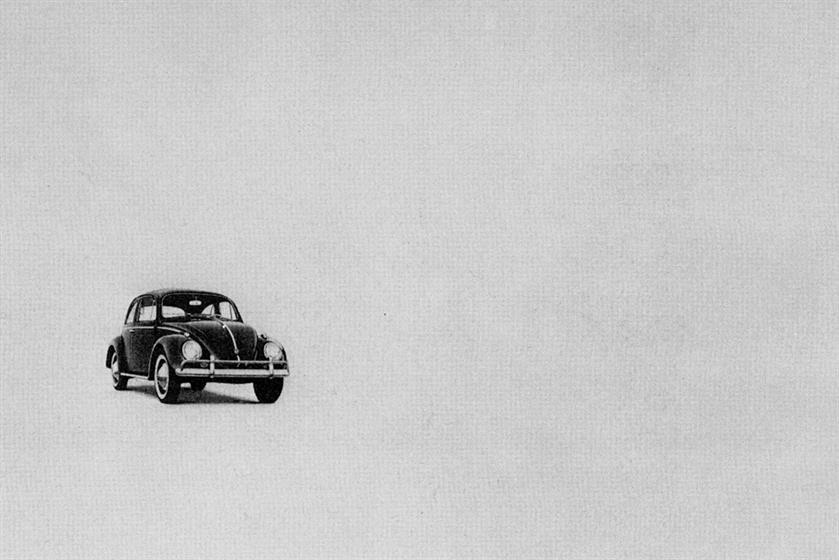
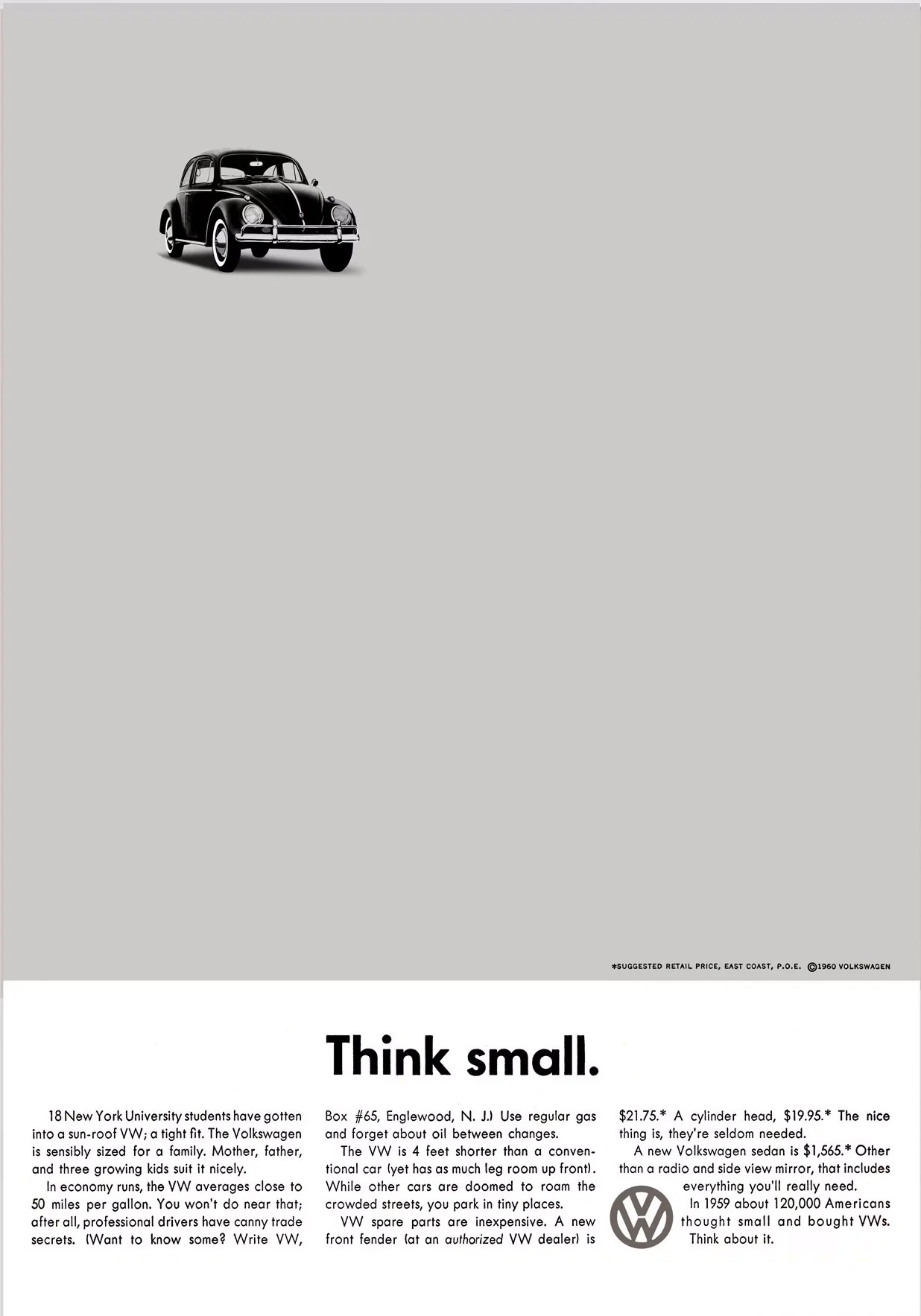
Volkswagen and Doyle Dane Bernbach launched the Think Small print campaign for the Volkswagen Type 1 Beetle in 1959. The campaign was art-directed by Helmut Krone, written by Julian Koenig, and overseen by William Bernbach as the founding creative director of the agency. The first execution placed a small black-and-white photograph of the Beetle in the upper-left quadrant of an otherwise empty white page and set the two-word headline Think Small in a clean sans-serif type. The body copy described the car in plain language, emphasised 50 miles to the gallon, five pints of oil, and a 1,565 United States dollar entry price, and closed with a single Volkswagen mark at the bottom of the page.
The brief Doyle Dane Bernbach had been handed by Volkswagen of America was structural. The German manufacturer had only re-entered the United States market in 1949, and the Beetle was an unfamiliar shape in a country where American cars of the late 1950s were defined by chrome, tail fins, and engine displacement. The car was small in a market that prized size, foreign in a market that prized domestic manufacture, and inexpensive in a market in which inexpensive usually meant inferior. The agency's response was to refuse every code that the American automotive category was using and to argue the Beetle in its own terms.
The strategic problem the campaign solved
The American automotive print of the 1950s relied on illustration rather than photography, on aspirational scenarios rather than product description, and on superlatives rather than measured claims. Cars were drawn rather than photographed because illustration allowed the artist to elongate the body and exaggerate the chrome. Headlines promised power, speed, status, or family success. Body copy was rarely concerned with engineering specification. Volkswagen could not compete on any of those codes. The Beetle was smaller than every comparable American car, less powerful, less ornamented, and produced in a single annual model rather than in a yearly facelift cycle.
Doyle Dane Bernbach therefore inverted the category vocabulary. The Beetle was photographed rather than illustrated, and was photographed honestly. The headline named the car's apparent disadvantage in two words rather than concealing it. The body copy listed the engineering claims with quiet specificity and without comparison to other brands. The signature treated the Volkswagen mark as a small logo at the foot of the page rather than as a brand banner. The result reframed the Beetle's apparent disadvantages as a coherent value proposition, with size, simplicity, fuel economy, and predictable model continuity collected into a single rational case.
The Lemon execution and the campaign system
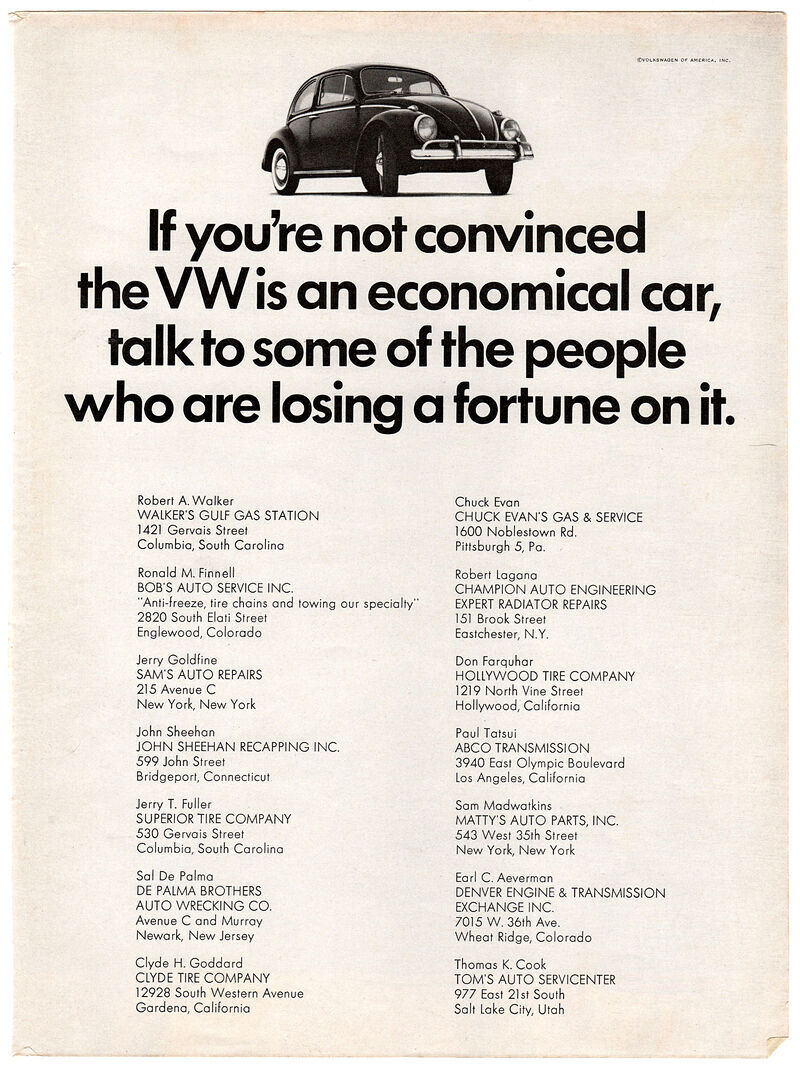
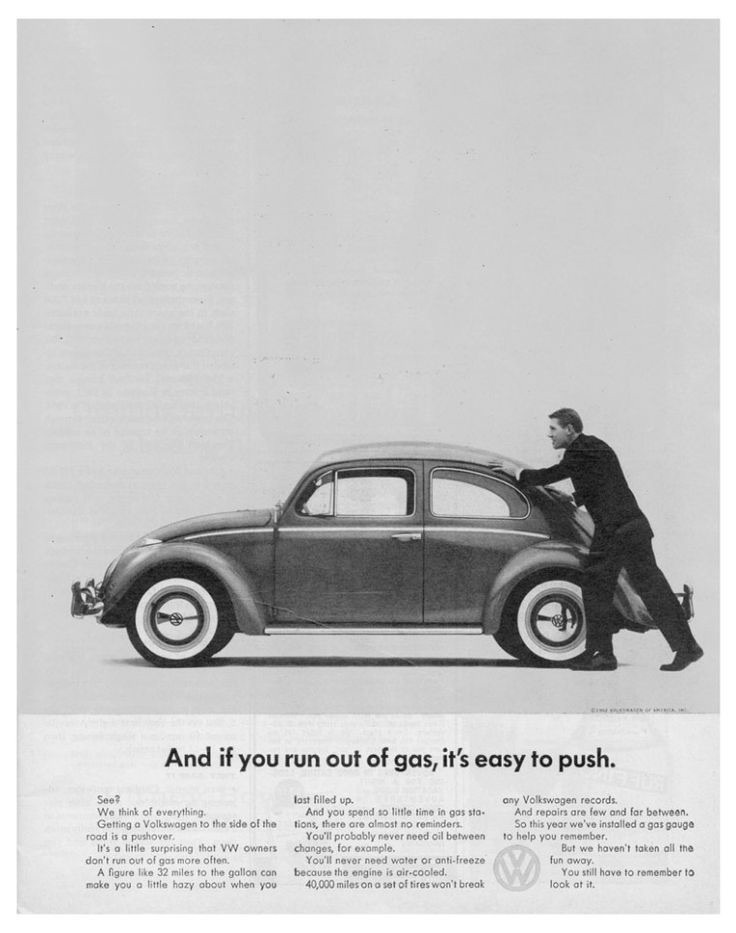
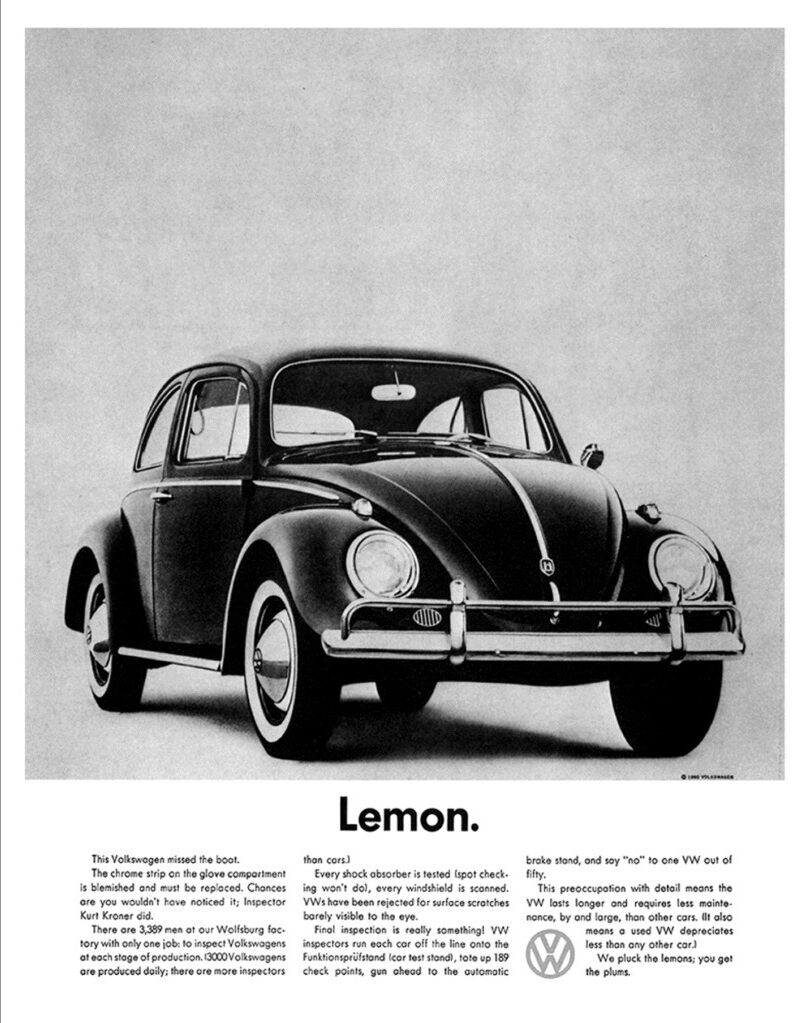
The campaign was a system rather than a single advertisement. The Lemon execution, which followed Think Small inside the first year of the work, showed a Beetle in identical layout under the single word Lemon and explained in body copy that the inspector who had rejected this particular car for a chrome strip blemish was the reason every Volkswagen left the plant ready to drive. The execution proved the campaign's structural rule. Each advertisement opened with an apparent confession, then resolved that confession with a quietly precise piece of engineering or production-quality argument. The format scaled across dozens of headlines and continued throughout the 1960s, with Volkswagen Type 2 vans, Volkswagen Karmann Ghias, and later the Volkswagen Type 3 receiving the same treatment.
The visual system mattered as much as the writing. Helmut Krone reduced the page to a small photograph, a short headline, and three columns of body copy. The white field around the car carried as much editorial weight as the photograph. The grid was held across hundreds of executions over more than a decade, with the consequence that the Beetle's owners came to recognise a Volkswagen advertisement by layout before reading the copy. The campaign therefore taught the discipline that print advertising could rely on consistent visual architecture rather than on novelty.
The commercial result
Volkswagen of America had sold approximately 55,000 Beetles in 1958. By the mid-1960s the figure had risen above 150,000 units annually, and by the early 1970s the Beetle had become the highest-selling import in American automotive history. The campaign supplied the rational case for the purchase decision and turned the Beetle from a curiosity into a category of its own. Ownership extended beyond the expected counterculture audience to suburban families, college graduates, and the second-car market in households with American sedans on the driveway.
The agency benefited too. Doyle Dane Bernbach grew from a small New York shop into one of the principal forces of American advertising in the 1960s on the back of the Volkswagen work. The agency's later commissions for Avis, Polaroid, El Al, Levi Strauss, and Alka-Seltzer extended the same editorial register. The Volkswagen account remained at the centre of the agency's identity for decades.
The legacy assessment
Ad Age conducted a survey in 1999 to identify the most important advertising campaigns of the twentieth century and placed the Volkswagen work at number one. The decision was widely accepted in the industry and has been reaffirmed in repeated retrospectives since. The campaign continues to be cited in art-direction and copywriting curricula as the founding example of what later became known as the Creative Revolution, the late 1950s and 1960s shift in American advertising from declarative product claims and conventional layout grids to writer-led, reader-respectful, photographically honest work.
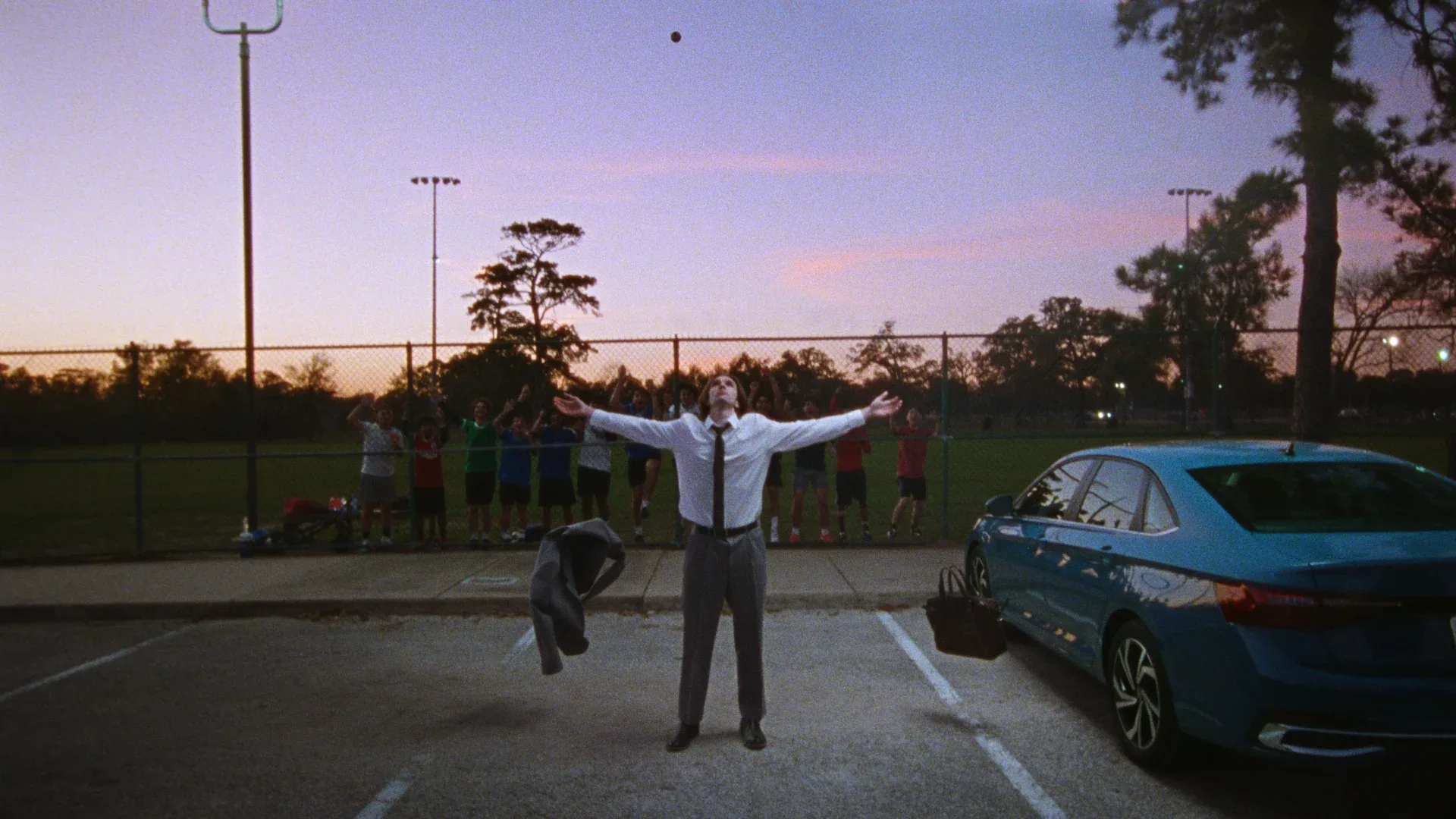
The campaign's argument has also stayed relevant inside the Volkswagen brand. Six decades later, Volkswagen continues to use understatement as its principal communications register, with later work such as The Force at Super Bowl XLV in 2011 and The Parents by BBDO Paris in 2026 inheriting the rule that the brand prefers to credit the audience rather than to boast about the engineering. Think Small set the rule, and Volkswagen has been writing within it ever since.
Written with AI assistance, edited by a human. Find out more about our Use of AI.