
A Super Bowl spot that argued by family rather than by horsepower
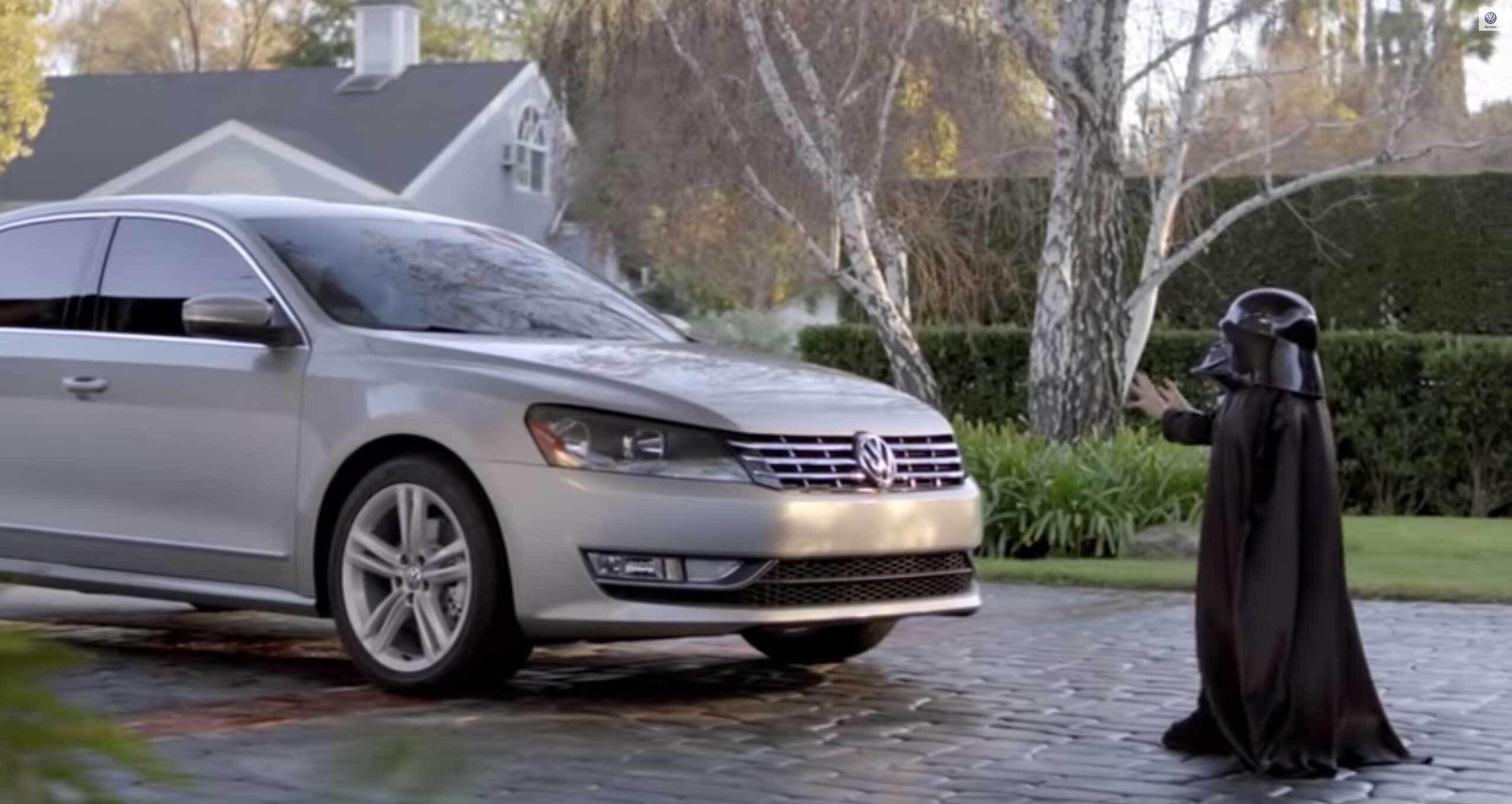
Volkswagen and Deutsch LA released The Force during Super Bowl XLV on 6 February 2011. The 60-second film was created by Deutsch LA for the 2012 Volkswagen Passat, directed by Lance Acord and produced by Park Pictures. A six-year-old Max Page played a child in full Darth Vader costume attempting to use the Force on the everyday objects of a suburban home, a washing machine, a clothes dryer, a doll, a sandwich on the kitchen counter, and a sleeping dog. None of the household experiments succeed. The film resolves at the moment the boy stands in front of a white 2012 Passat in the driveway, raises his arms in a final Force gesture, and is startled to find the engine starts in front of him. The reveal is the father, watching from the kitchen window, who has used a remote key from his coffee cup. The score is John Williams's Imperial March.
The campaign carried an unusual distribution decision. Deutsch LA and Volkswagen posted The Force to YouTube on 2 February 2011, five days before kickoff, where it accumulated thirteen million views before the Super Bowl broadcast on 6 February. Viewers therefore arrived at the game already aware of the film, and the in-game airing functioned as a payoff for an audience that had already shared the work. The decision rewrote the Super Bowl playbook for the decade that followed. Pre-release had been used cautiously before 2011. After The Force, almost every major Super Bowl spot was teased or released ahead of the game.
The strategic problem the campaign answered
Volkswagen of America entered 2011 needing to introduce a redesigned Passat to a North American sedan market that had moved against European brands. The Passat had been positioned in the United States as a near-premium European sedan for two decades, but the redesign was a deliberate move into the mid-market. The vehicle had been built at the new Chattanooga, Tennessee plant, the price had been reset closer to the segment leaders Toyota Camry and Honda Accord, and the trim levels had been simplified. The brand needed to introduce the car to a mainstream American family audience without abandoning the European-design proof that had previously distinguished the Passat from its Japanese competitors.
Deutsch LA solved that problem by refusing the sedan-category vocabulary. American mid-market sedan advertising at the time relied on highway shots, suburban driveways, family-safety messages, and earnest voiceovers. The Force used a single suburban driveway and a single quiet domestic setting, and replaced the voiceover with John Williams's score and the laughter of recognition that the cultural reference invited. The car appeared in the film for less than fifteen seconds in total. The argument was made by the family relationship in the foreground and by the audience's familiarity with the Star Wars universe in the background, with the Passat positioned as the small everyday object that completes the joke.
The production and the licensing
Lance Acord directed through Park Pictures, with Mary Ann Marino producing. The director of photography on the spot was Lance Acord himself, working in the same naturalistic register he had established on his earlier work for Volkswagen and on his feature collaborations with Sofia Coppola and Spike Jonze. Max Page, who played the boy, had been cast through a national search, with an emphasis on physical scale to fit the child-sized Darth Vader costume that Lucasfilm had supplied for the production. John Williams's Imperial March had to be licensed through Lucasfilm and through the relevant music rights holders, and the soundtrack arrived in the cut without re-recording, which preserved the cultural authority the music had already accumulated through five Star Wars feature films.
The Lucasfilm relationship mattered. The Force was one of the first major brand films of the digital era to use a Star Wars character outside of a Star Wars film, and it set the licensing template for the wider Star Wars brand collaborations that followed in the 2010s under Disney ownership. Lucasfilm approved the costume and the use of the Imperial March on condition that the film maintained the dignity of the Darth Vader character. The spot honoured that requirement by treating the child's costumed seriousness with affection rather than parody.
The reception and the measured result
The Force scored at number three on the USA Today Ad Meter for Super Bowl XLV and was named Best Commercial of 2011 by Adweek. The film has since been described as the most-shared Super Bowl advertisement ever produced and as the second most-shared television commercial across all years and formats. The YouTube count has continued to climb across the decade and exceeded 61 million views by the mid-2020s. The Passat redesign reached its annual sales target inside the first nine months of its model year, and the Chattanooga plant moved into a second shift in late 2011.
The campaign also reset the value of pre-release. Brands had previously held Super Bowl creative under embargo until the game broadcast in the belief that surprise was the principal driver of recall. The Force demonstrated that pre-release built shared audience anticipation, and that the in-game airing performed better when viewers had already adopted the work. The decision shifted Super Bowl planning towards multi-week build cycles that the rest of the 2010s sustained.
What the spot continues to model
The Force is a useful reference for any brand introducing a mass-market product into a category dominated by larger spend. It demonstrates that a brand can argue a product by family relationship rather than by feature claim, that a licensed cultural reference can carry a campaign provided the brand respects the source, and that a pre-release strategy can compound the value of a single peak-spend media slot. The film also continues the Volkswagen tradition of communications through quiet observation rather than declarative performance, and connects directly to the Doyle Dane Bernbach work that started with Think Small more than fifty years earlier.
Source: Estadão Youtube
Written with AI assistance, edited by a human. Find out more about our Use of AI.