
A one-word headline that argued for quality by admitting failure
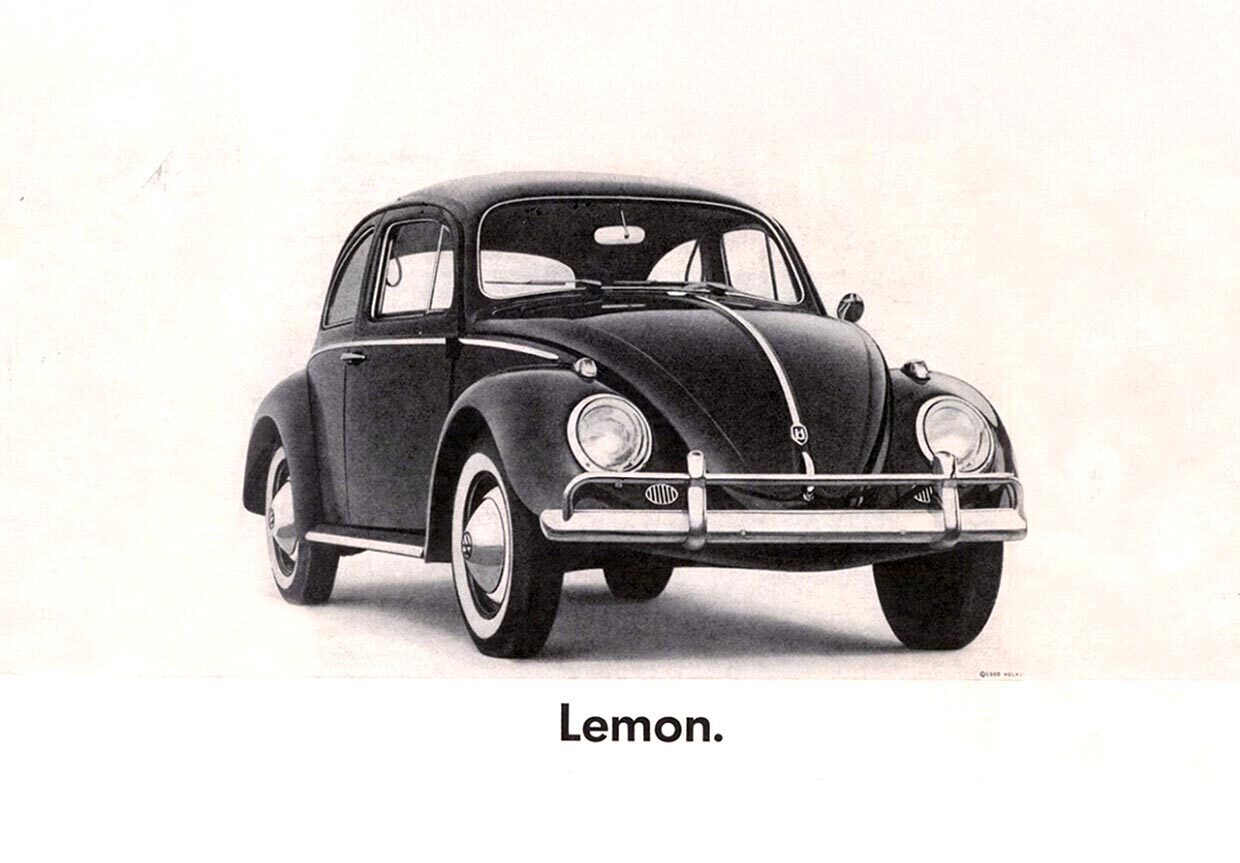
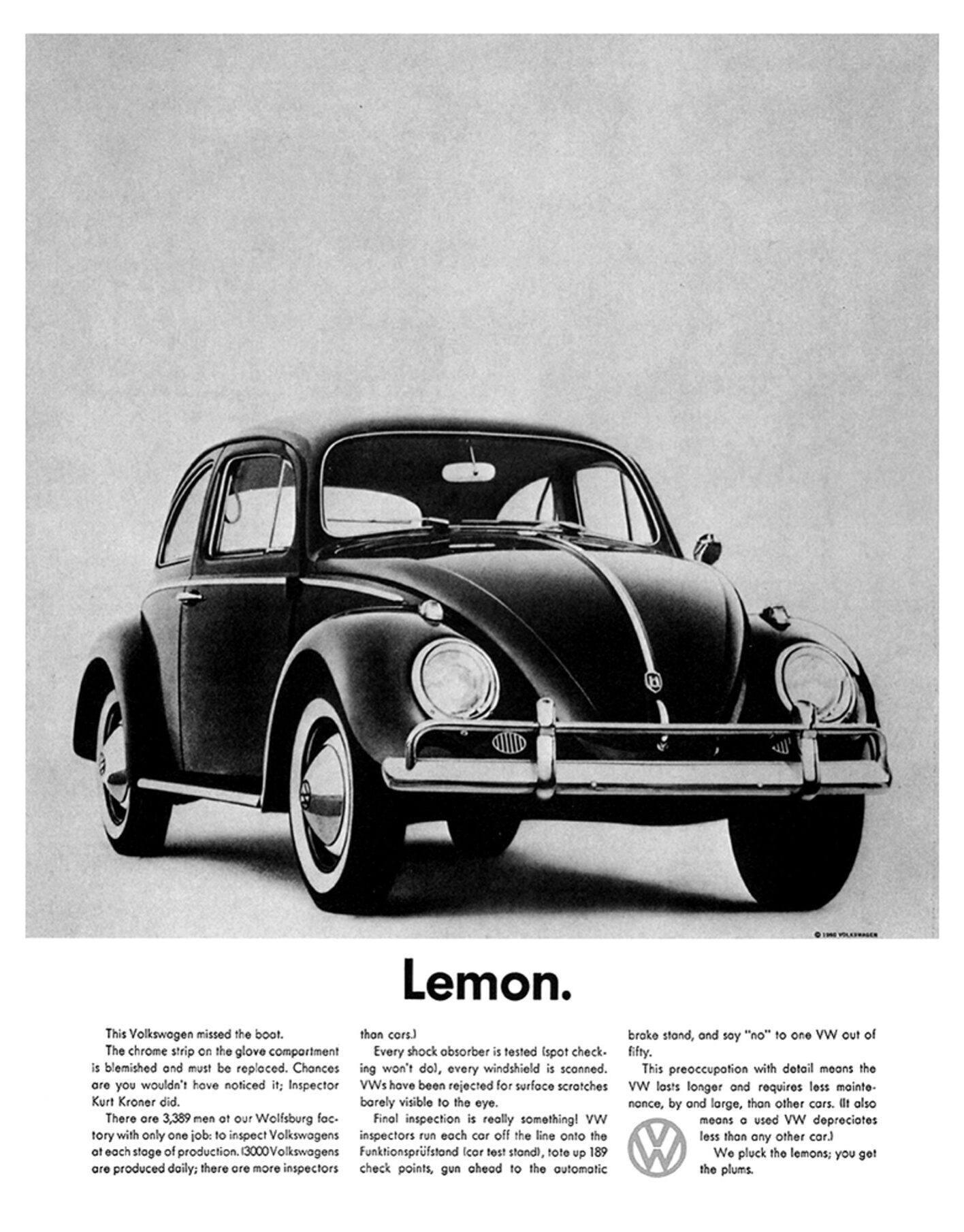
The 11 April 1960 issue of Life magazine carried a Volkswagen print advertisement that turned a slang word for a defective car into one of the most studied headlines of post-war advertising. Lemon, written by Julian Koenig and art-directed by Helmut Krone under William Bernbach at Doyle Dane Bernbach, accompanied Think Small as the second pillar of the campaign that introduced the Beetle to mainstream America and rewrote the conventions of automotive communication. The execution photographed a single 1961 Beetle against a white page, captioned the image with the single word Lemon, and used the body copy to explain that this particular car never reached a dealer because a Wolfsburg factory inspector named Kurt Kroner had rejected a small blemish on the chrome strip of the glove compartment. The closing line read, We pluck the lemons; you get the plums.
The headline performed an unprecedented act of brand-led candour. Automotive advertising in 1960 was governed by aspiration, by sweeping landscape photography, by chrome and tailfins and adult couples in evening wear. Volkswagen and DDB inverted every one of those conventions. The car appeared small and stationary in the upper third of the page. The typography sat in the lower section without ornament. The headline borrowed a pejorative the reader was already inclined to apply to a foreign-built, rear-engined, oddly shaped economy car, and used it as the entry point for a quality argument the rest of the industry was unwilling to make.
The Creative Revolution context
Lemon belonged to the campaign that opened the period later named the Creative Revolution. Doyle Dane Bernbach had won the Volkswagen of America account in 1959 from the New York agency J. Walter Thompson's German parent operation. Bernbach personally directed the editorial standards of the work, and assigned Koenig as copywriter and Krone as art director. The two had built Think Small the year before. Lemon refined the same logic. Both executions relied on a single image, generous white space, a low word count in the headline, and a body copy that read as plain prose rather than as advertising language. The discipline became the template for the agency-led creative model that displaced the older account-led model across the next decade and that produced the founding work of the contemporary advertising industry.
The cultural context mattered. Imports occupied less than ten per cent of the United States passenger car market in 1959, and the Beetle carried a double burden. It was small in a country that purchased size, and it was German in a country that had concluded a war against Germany fifteen years earlier. DDB and Volkswagen of America decided that the strategic answer to both pressures was honesty about the product. The Beetle was small, the brand admitted, and the small format had measurable consequences in price, fuel economy, parking and reliability. The car was German, and the brand admitted that, too, naming the inspector in Wolfsburg and reporting the production statistic that 3,389 inspectors examined the daily output of approximately 3,000 cars across 189 separate quality checks. The numbers were factual, traceable to the plant, and gave the magazine reader an unfamiliar level of detail about the manufacture of a consumer good.
The print mechanics
The black-and-white photograph of the Beetle that anchored the page was shot by photographer Wingate Paine working from a fixed studio position. The car was positioned at a slight three-quarter angle, with the chrome strip on the glove compartment door not visible from the reader's vantage point, which produced the deliberate paradox at the centre of the execution. The reader could see no defect at all. The reader had to read the body copy to learn that a defect existed and that the factory had stopped the car because of it. The art direction therefore reversed the standard relationship between image and headline. The image carried no information about the headline word. The headline produced the question. The body copy answered it. The reader's act of reading completed the argument and earned the closing line about lemons and plums.
The body copy ran to roughly 270 words across three columns, justified left, set in a serif text face at moderate scale. Koenig wrote the copy in a deliberately conversational register, with short declarative sentences and one factory anecdote per paragraph. The voice positioned Volkswagen of America as a colleague speaking to the reader rather than as a manufacturer speaking to a market, and it embedded the technical detail (the dimpling on the chrome strip, the inspection station, the rejected stock) inside that voice without ornament.
The legacy
Lemon became one of the founding documents of the modern print advertisement and has since appeared in almost every retrospective of twentieth century advertising. The American Advertising Federation Hall of Fame, the One Show, and the Ad Age Top 100 lists have placed the campaign and its sister execution Think Small at or near the top of every available ranking. The headline is widely taught in copywriting programmes as a worked example of single-word punch, of reversal as a rhetorical device, and of the brand-led decision to allow a product to be described with the same vocabulary the consumer was already using. The closing line, We pluck the lemons; you get the plums, also entered consumer English as a phrase outside its original context.
The campaign continued for the remainder of the 1960s under Bernbach, Krone and Koenig, and produced more than sixty further executions across print and television. Snow Plow, the 1964 television commercial that ported the same voice into moving image, descended directly from the Lemon discipline. The Volkswagen Beetle reached one million annual United States sales in 1968. By the time the air-cooled Beetle was retired from the North American market in 1979, the DDB platform had run unbroken for two decades and had produced the body of work that the entire post-war advertising industry continued to study.
Written with AI assistance, edited by a human. Find out more about our Use of AI.