
A line that argued with a queue
Samsung Mobile USA introduced a new campaign platform on 23 November 2011 under the line "The Next Big Thing Is Already Here". The work came from 72andSunny in Los Angeles and premiered on Samsung Mobile USA's Facebook page, with the television debut the following day, Thanksgiving, inside the Fox and CBS National Football League broadcasts. It then ran through college football Saturdays until Christmas Day in fifteen and thirty second cuts.
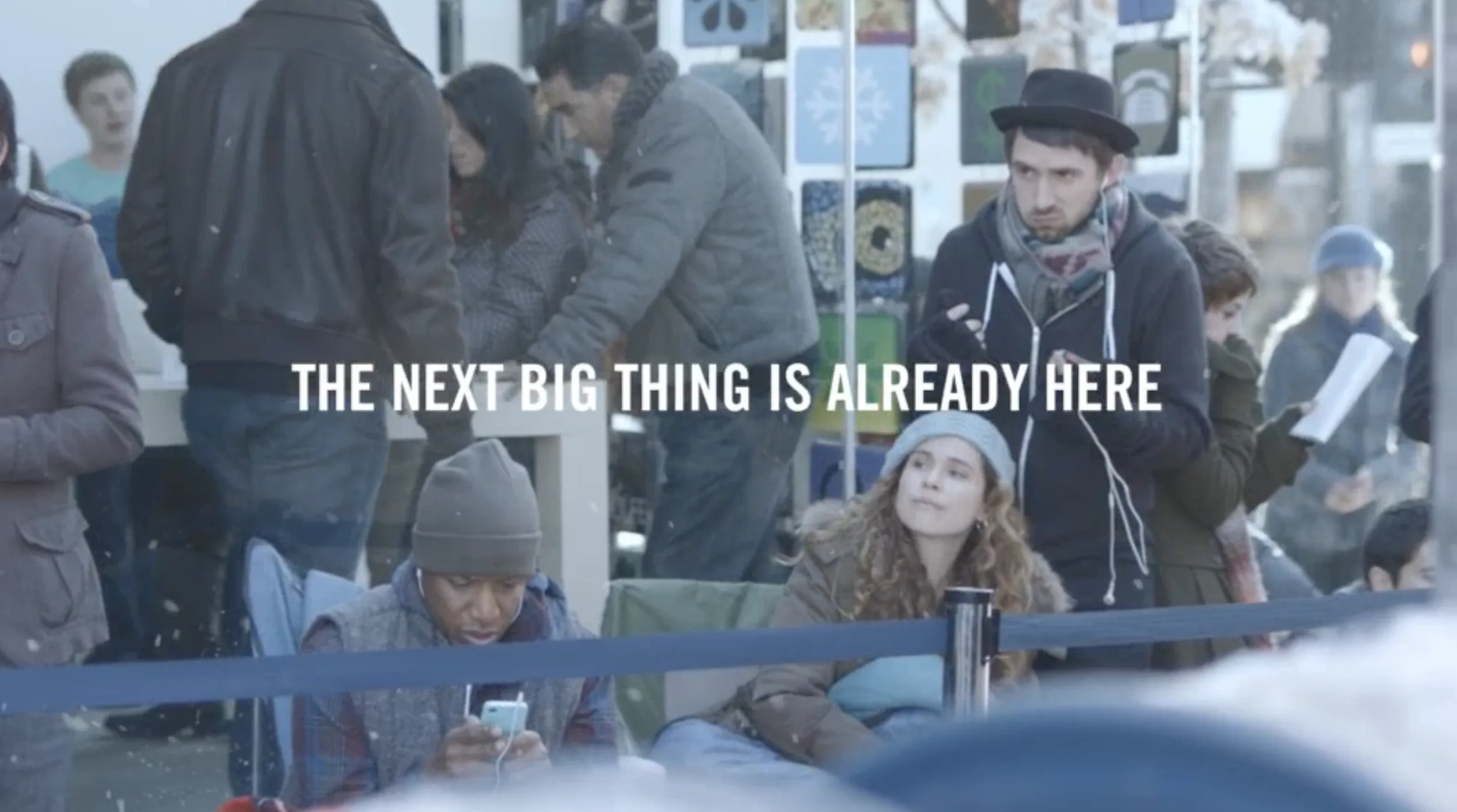
The launch film opened on a pavement queue. People had been waiting outside a store for hours for a phone that was never named and never shown. Owners of the Galaxy S II walked past them, using the device the queue had not yet been sold. No specification was quoted. The argument was carried entirely by who was standing where.
Selling the owner rather than the object
The strategic move was to stop describing the product and start describing the person holding it. Samsung had a large installed base of Galaxy owners and comparatively little cultural presence in the United States. The campaign converted the first asset into a remedy for the second. Todd Pendleton, then chief marketing officer of Samsung Mobile USA, framed it plainly at launch: "The next big thing is already here. You can have the latest, most innovative device without waiting in line."
Brian Wallace, vice president of strategic marketing, described the mechanism the campaign was built to exploit. "We want to use the enthusiasm and word of mouth buzz to our advantage to educate consumers in a fun and new way." Dale Sohn, president of Samsung Mobile, supplied the commercial footing: "The Galaxy S II has already shown its leadership and success through tremendous reviews and sales."
The refusal to name the competitor had a structural effect. Comparative advertising in the smartphone category had until then mostly meant specification tables, and specification tables invite a reply in kind. By showing a queue instead, the campaign made its case in a form the rival could not answer without confirming the premise. The people waiting were not criticised. They were simply shown to be waiting, and the film left the reader of the image to decide what that meant.
Who made it
The 2011 film was credited to 72andSunny with John Boiler as executive creative director, Tim Wolfe as creative director and copywriter, Bryan Rowles as creative director and designer, Jake Kahana as designer and Sam Baerwald as director of film production. It was directed by Bobby Farrelly through Rabbit Content, cut at Cut+Run and graded by Stefan Sonnenfeld at Company 3. The work took a bronze for copywriting at the A-List Awards Hollywood in 2013.
The 2012 sequel carried a partly different team, with Jason Norcross as executive creative director and Barton Corley as creative director and writer, alongside James Townsend and Go Wakimoto on the Samsung side.
Source: Machinimadotcom Youtube
Escalation across three years
In September 2012 the queue returned, this time outside a store selling a phone released the same month. In February 2013 Samsung took the platform to Super Bowl XLVII with a film about the difficulty of making an advertisement that avoids naming a competitor, featuring Seth Rogen, Paul Rudd, Bob Odenkirk and LeBron James. The joke was the constraint itself. Later that year the platform absorbed a distribution deal with Jay-Z around the album Magna Carta Holy Grail, extending the line from broadcast into music release mechanics.
What the campaign moved
The commercial context was substantial. Samsung spent 401 million United States dollars on smartphone advertising in the United States in 2012, ahead of its principal competitor. The Galaxy S II passed 20 million units in ten months, a figure Samsung announced in February 2012.
The brand measurement moved with it. Interbrand valued Samsung at 32.9 billion dollars in 2012, a rise of 40 per cent against a top hundred average of 10 per cent, and placed it ninth, its first entry into the global top ten. The following year it ranked eighth at 39.6 billion dollars, and in 2014 seventh at 45.5 billion. Samsung published each of those results through its own newsroom.
Evidence of the campaign's competitive effect surfaced from an unusual direction. In the second Apple v. Samsung trial, opening on 1 April 2014, Samsung's counsel told the court that the advertising "drove Apple crazy", and internal Apple documents discussing marketing pressure from Android and Samsung were entered into evidence. The campaign is also a logged Effie North America case for 2013.
The line was retired later in the decade. In 2017 Samsung replaced it with the platform Do What You Can't, a broader statement about the company rather than a comparison with a single rival. What "The Next Big Thing Is Already Here" left behind was a demonstration that a challenger does not always need a new claim. Sometimes it needs a way of pointing at the people who have already agreed with it.
Written with AI assistance, edited by a human. Find out more about our Use of AI.