A heritage brand sold at the bottom of its value
On 26 June 1999 the American optical company Bausch & Lomb completed the sale of its sunglass business to the Italian eyewear group Luxottica for approximately 640 million dollars. The deal, agreed in April that year, transferred a portfolio that included Revo, Arnette and Killer Loop, but its centre of gravity was Ray-Ban, the brand Bausch & Lomb had introduced in 1937 and built into one of the most recognised names in eyewear.
By the late 1990s that name carried far less weight than its history suggested. Ray-Ban frames were widely available for around 19 dollars in petrol stations and convenience stores in the United States. The product had drifted downmarket, the tooling was dated and the frames felt flimsy. A brand that had defined the category for decades was being sold at the moment its value had fallen close to its lowest point.
Repositioning before redesign
Luxottica did not begin with a new logo or a new product. It began by changing where and how Ray-Ban could be bought. The company pulled the brand out of mass discount channels and reduced its presence in low-end retail, accepting a short-term loss of volume in order to repair the brand's standing. The aim was to make Ray-Ban scarce again in the places where it had become cheap, and to rebuild the perception of quality before rebuilding sales.
Alongside the distribution reset, Luxottica raised manufacturing standards. It moved production into its own Italian facilities, improved the materials and the build of the frames, and lifted prices to a level consistent with a premium product. This was a deliberate exercise in repositioning, the strategic work of changing what a brand stands for in the mind of the buyer, carried out through the unglamorous levers of where a product sells and how well it is made.
The role of brand architecture
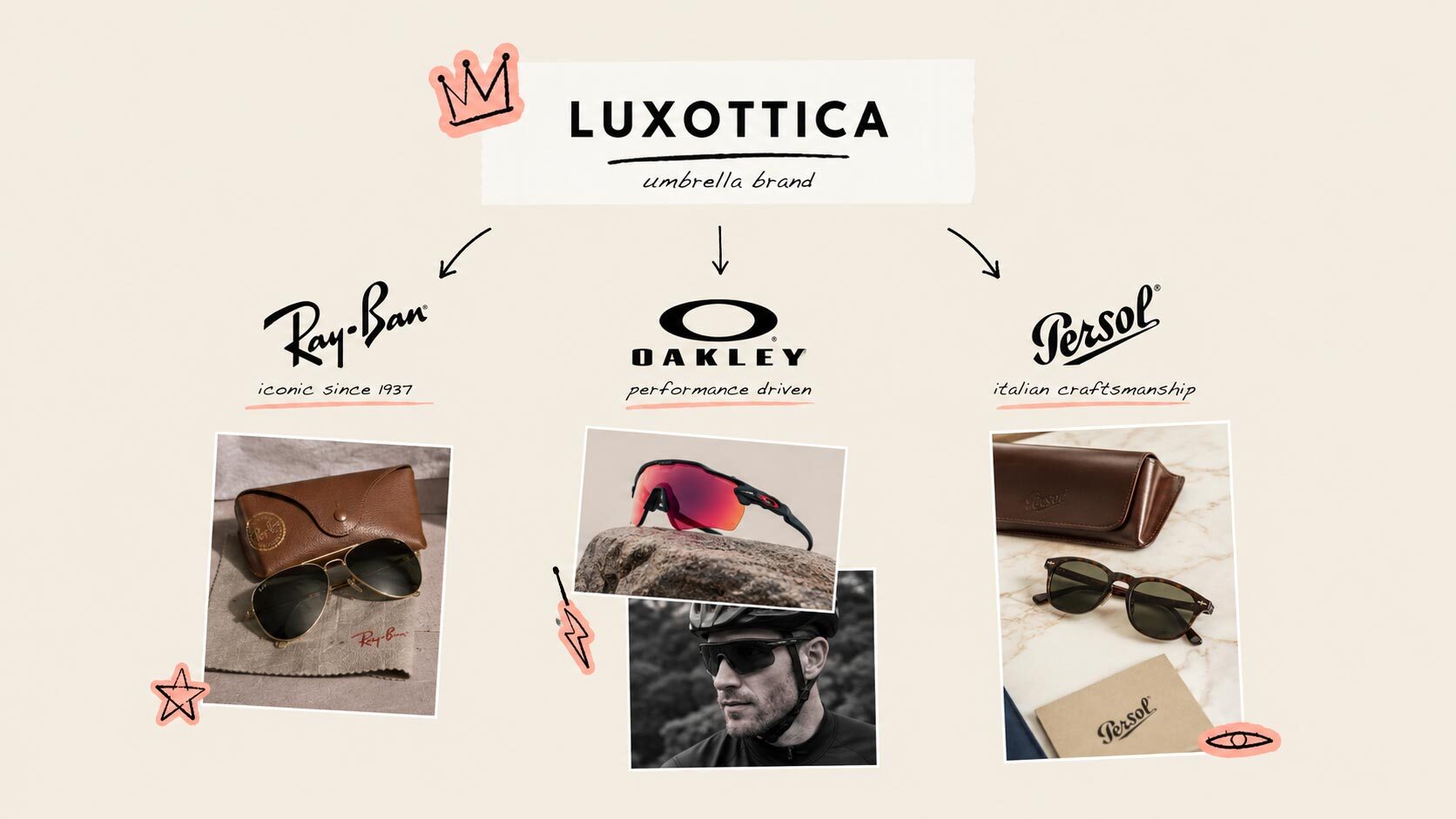
The acquisition also reshaped Luxottica's brand architecture, the way a company organises its portfolio of brands. Luxottica already owned and licensed a range of eyewear names, and Ray-Ban gave it a heritage house brand with genuine cultural depth to sit alongside its designer licences. Rather than absorb Ray-Ban into a generic line, Luxottica treated it as a flagship, investing in the two models that carried the most history, the Aviator of 1937 and the Wayfarer of 1952.
That decision set the pattern for the following decade. Luxottica protected the equity in those founding designs, kept them at the heart of the range and used them as the platform for later marketing. The brand's recovery rested on assets it already owned, reframed and supported rather than replaced.
Luxottica's structure gave it unusual control over this process. As a vertically integrated company that owned both manufacturing and a large retail network, including the Sunglass Hut chain, it could decide exactly how Ray-Ban appeared at the point of sale. That control let the group present the brand consistently, place it in the right stores and defend its pricing in a way that an independent brand owner reliant on third-party retailers could not easily match.
From discount rack to portfolio anchor
The financial turnaround was substantial. In 2000, the first full year under Luxottica, Ray-Ban generated 252 million euros, about 10 percent of company sales. By 2014 that figure had risen more than eightfold to roughly 2.065 billion euros, around 27 percent of Luxottica's sales. A brand that had been selling for 19 dollars a pair at the point of acquisition had become one of the most valuable assets in the world's largest eyewear group.
The 1999 deal is now read as one of the more instructive brand turnarounds in the consumer-goods sector. It showed that a damaged heritage brand could be restored without discarding its identity, and that the most decisive moves were often about distribution, pricing and manufacturing rather than visual design. Luxottica did not reinvent Ray-Ban. It removed the brand from the channels that had devalued it, rebuilt the product to match its reputation and let the existing icons carry the recovery.
The acquisition also positioned Ray-Ban for the structural changes that followed. When Luxottica merged with the lens maker Essilor in 2018 to form EssilorLuxottica, Ray-Ban entered the combined group as an established premium brand rather than a discounted one. The work done after 1999 gave the brand the standing it would later carry into new categories, including its partnership with the technology company Meta. The foundation for those later moves was laid in the patient, decidedly unglamorous repositioning that began with the 1999 purchase.
Written with AI assistance, edited by a human. Find out more about our Use of AI.