
A marriage of art and business
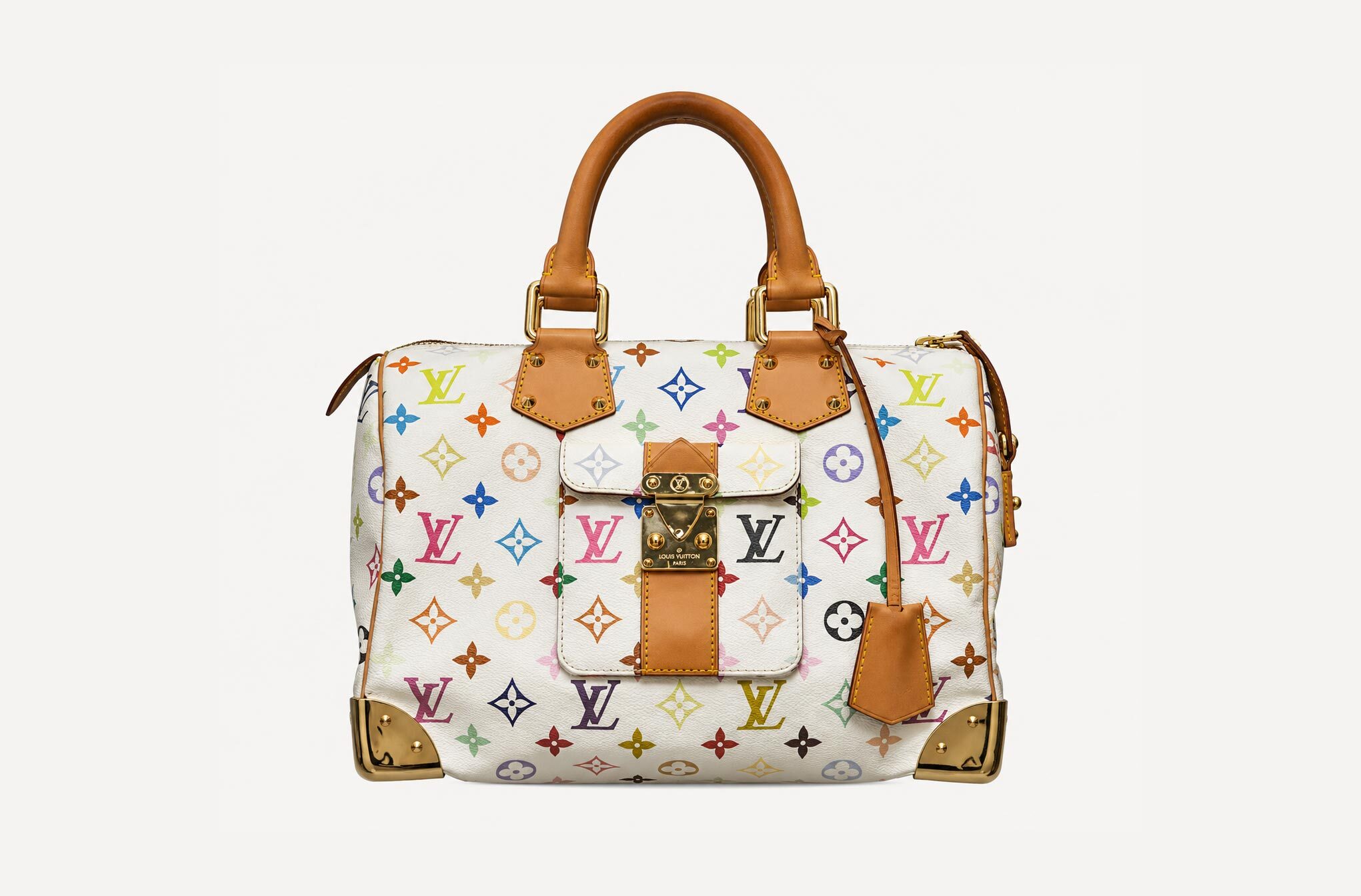
Marc Jacobs introduced the Monogram Multicolore in March 2003, as part of Louis Vuitton's Spring/Summer 2003 collection. Drawn by the Japanese artist Takashi Murakami, the collection recast Georges Vuitton's 1896 Monogram canvas in thirty-three colours on either a black or a white coated canvas ground. The handbags, small leather goods and luggage that carried the print travelled with the season's ready-to-wear and within months entered the fashion press as the most commercially successful artist collaboration in the brand's hundred-and-fifty-year history.
The commission originated with Marc Jacobs, who joined Louis Vuitton as Creative Director in 1997 and had used the previous five seasons to introduce ready-to-wear and to test the brand's appetite for outside authors on its core canvases. The Spring 2001 collection had already invited the artist Stephen Sprouse to inscribe his graffiti tag over the Monogram, the first time the canvas had been altered since 1896. Jacobs's brief to Murakami, recorded in interviews with The New York Times and Document Journal between 2003 and 2008, asked for a treatment that would feel "Pop Disney rather than Pop Warhol" and would preserve the legibility of the Monogram while changing its temperature.
The artist and the Superflat manifesto
Murakami arrived at the Vuitton brief with a developed body of work and a manifesto. The artist had launched the Superflat movement in 2000 with an exhibition at the Museum of Contemporary Art in Los Angeles, theorising a flatness common to traditional Japanese painting, Edo-period prints, post-war manga and contemporary anime. His studio Kaikai Kiki, founded in 2001, operated as a factory and brand-management entity simultaneously, and was already producing the artist's signature characters Mr DOB, the Kaikai Kiki figures and the smiling flower drawings. Murakami's interest in the boundary between art and consumer product made the Vuitton brief structurally compatible with his own practice.
The Multicolore canvas applied thirty-three colours to the same quatrefoil, four-petal flower and LV ligature drawn by Georges Vuitton. The black-ground iteration kept the original outline relations and altered only the colour palette; the white-ground iteration inverted the historical figure-ground relationship of the canvas. Both grounds carried the Eye Love Monogram bag motif on selected pieces and were applied across the Speedy, Pochette Accessoires, Alma, Keepall, Papillon and Sac Plat silhouettes. Production was concentrated in the Vuitton ateliers in Asnières-sur-Seine and Ducey.
The commercial response and the celebrity surface
The commercial response was unusually strong. Within twelve months the Multicolore line was credited with a measurable lift in Louis Vuitton's leather-goods revenue and with broadening the customer base beyond the brand's traditional luxury consumer. Press coverage from The New York Times, Vogue and Women's Wear Daily across 2003 and 2004 tracked the handbags' appearance on celebrities including Jessica Simpson, Naomi Campbell, Paris Hilton and Beyoncé. Counterfeit production accelerated in parallel, with the Multicolore canvas becoming one of the most copied luxury graphics of the decade. Trade-press reporting on Louis Vuitton's anti-counterfeit operations across the mid-2000s repeatedly cited the canvas as the most affected single product.
The retail roll-out was staged for visibility. The first ad campaign was photographed by Mert Alas and Marcus Piggott on the model Eva Herzigová and ran across print insertions in the global fashion press in February and March 2003. The bags were stocked at the Champs-Élysées flagship and at the global flagship network with priority allocation. Several silhouettes sold out within their first ninety days; resale prices stabilised above retail within the first year, an unusual outcome for a contemporary luxury handbag at the time.
The template the collaboration set
The Multicolore collaboration set a template that defined Louis Vuitton's accessory-line strategy through the Jacobs era. Murakami and Vuitton continued the partnership across Cherry Blossom (2003), Cerises (2005), the Multicolore Eye Love expansion (2003 to 2005), the MOCA Hands edition (2007 for the artist's Murakami retrospective at the Museum of Contemporary Art Los Angeles), Monogramouflage (2008) and Cosmic Blossom (2010). The format, an external artist commissioned to draw a temporary skin over the founding canvas, was extended to Robert Wilson, Richard Prince (Bag of the Day, 2008), Yayoi Kusama (Infinity Dots, 2012, and the second 2023 collaboration covered separately in this archive), Jeff Koons (Masters, 2017) and others.
Marc Jacobs called the Multicolore canvas a "monumental marriage between art and business" in the 2003 collection notes. The phrasing held. The commercial outcome reframed the question of whether luxury houses should commission contemporary artists at all and provided the case study referenced through the following two decades. By 2015, when Louis Vuitton retired the Multicolore canvas from regular production, the collection had become the most archive-cited artist edition in the brand's history; resale prices stabilised above original retail and the canvas remained the most counterfeited Vuitton pattern.
The 2025 reissue
In January 2025 Louis Vuitton announced the reissue of the Multicolore canvas as part of the LV x Murakami capsule, drawn around the twenty-first anniversary of the original release and launched globally with a March 2025 retail roll-out. The reissue retained the thirty-three colour scheme and added five new silhouettes, accompanied by an installation programme that opened in Tokyo, New York, Paris, Shanghai, London and Los Angeles. The presentation underlined the Multicolore canvas's status within Louis Vuitton's strategic archive: a temporary intervention that the house has returned to twice within twenty-five years and that continues to organise its collaborative method with contemporary artists.
Written with AI assistance, edited by a human. Find out more about our Use of AI.