
A pattern against counterfeit
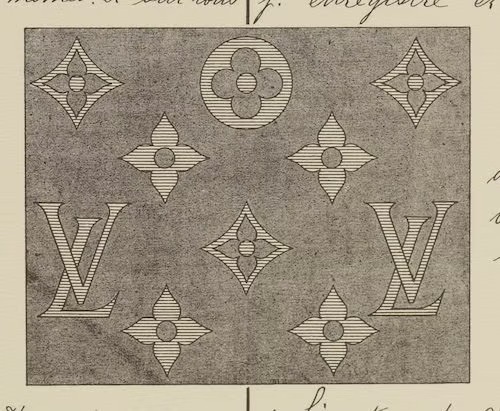
In the summer of 1896, four years after his father's death, Georges Vuitton introduced a new canvas for the trunks the family atelier produced at Asnières-sur-Seine. The canvas carried four motifs in repeat: the interleaved LV cipher of the founder's initials, a four-petal flower, a four-pointed star, and a convex-cornered quatrefoil enclosing the star. Printed in beige ink on chestnut-brown ground, the canvas became the Monogram. It registered as a trademark in France in 1905, was registered internationally over the following decades, and remained the single most distinctive brand asset of Louis Vuitton Malletier across the 130 years that followed.
The problem the canvas solved
Counterfeit was the immediate problem. Louis Vuitton had introduced the Damier canvas in 1888 with the registered legend "marque Louis Vuitton déposée" running along its checkerboard border. The Damier itself responded to imitation of the earlier rayé striped canvas of 1872. By the mid-1890s, the Damier had also been widely copied across the leather-goods workshops of Paris, Lyon and London. The atelier needed a pattern that combined a higher counterfeit threshold with a clearer connection to the Maison name.
Georges Vuitton's response was to embed the founder's initials directly into the canvas pattern. The LV cipher could no longer be removed without removing the canvas itself. A counterfeit producer could imitate the colour palette and the geometry, but could not produce the Louis Vuitton mark without simultaneously printing the name into the goods being passed off. The construction installed the brand at the level of the substrate rather than at the level of the finish.
The Japonisme reference
Georges Vuitton drew the surrounding ornament from sources he had encountered at the Universal Expositions of Paris in 1867 and 1889. The four-petal flowers, the convex-cornered quatrefoils and the four-pointed stars draw on the kamon (Japanese family crests) and mon (heraldic emblems) that French audiences had been exposed to through the Japonisme movement of the 1860s and 1870s. The decision is consistent with the Vuitton family's broader posture in the period: the Asnières workshop produced bespoke trunks for travellers to Asia, including a tea-ceremony trunk for the Vanderbilt family and a Japanese-lacquer-finished trunk for the Khedive of Egypt.
The Japonisme reference embedded the Monogram in a recognisable visual conversation of late-19th-century French decorative arts. It also gave the canvas a graphic clarity that read at distance: the four motifs alternated across the canvas in a way that the eye registered as a single pattern before resolving into the individual elements. The construction is, in modern brand-asset terms, an unusually disciplined application of distinctive-asset logic to a substrate.
The legal architecture
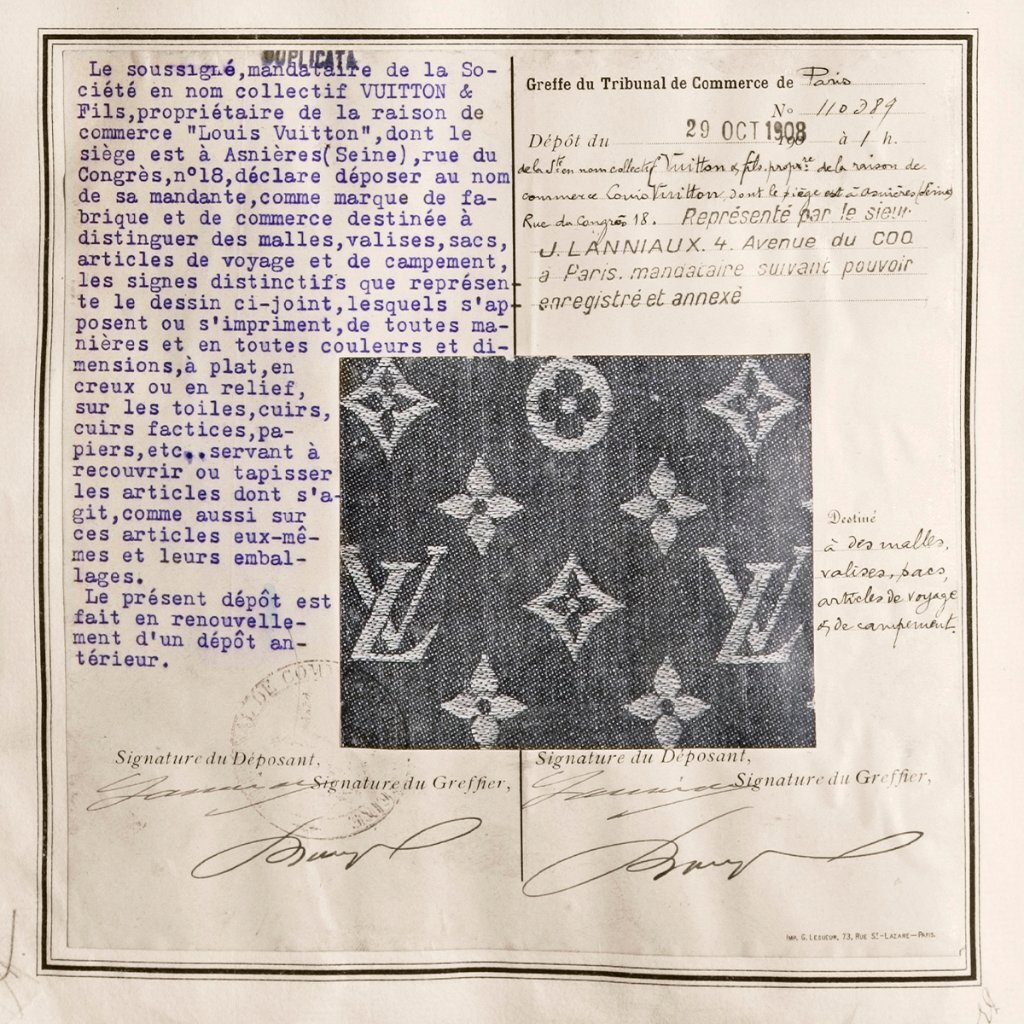
Georges Vuitton patented the Monogram canvas in France on 1 November 1896. The patent specified the geometry, the print method and the registration of the motifs. International trademark registration followed over the next three decades, including registration in the United Kingdom (1905), Germany (1908) and the United States (1932). The 1905 French registration is the foundation document of the Monogram as a legal brand asset.
The Maison defended the canvas in court from the early 1900s. A series of judgments in French commercial courts between 1898 and 1914 established the principle that the Monogram canvas, taken as a whole, constituted a registered trademark of Louis Vuitton Malletier and that imitations producing the four motifs in the same configuration constituted infringement. The 1905 French registration was cited in every successful prosecution. The legal architecture Georges Vuitton built around the Monogram is the same legal architecture that LVMH defends in the 2020s, with approximately 20,000 anti-counterfeit cases filed per year across roughly 50 jurisdictions.
The brand reading
The Monogram is the single distinctive brand asset on which the modern Louis Vuitton stands. Approximately 80 percent of the Maison's leather-goods sales in the 2020s carry the canvas in some form, whether as the historical chestnut-on-beige original, the Multicolore variant Takashi Murakami introduced in 2003, the Stephen Sprouse Graffiti overlay of 2001, the Yayoi Kusama Infinity Dots overlay of 2012, the Damoflage variant Pharrell introduced in 2023, or any number of seasonal recolourings, lacquered finishes, and reverse-Monogram constructions. The canvas survives every creative director, every colour treatment, every collaboration, and every product extension without losing recognition.
The Monogram also reframes how brand-identity history reads the 1896 introduction. Most luxury houses built their distinctive assets in the 20th century, after the development of modern advertising. Louis Vuitton built its distinctive asset in the 19th century, before modern advertising, and built it for a legal-defence reason rather than for a marketing reason. The Maison's subsequent advertising posture, including the Annie Leibovitz "Core Values" platform of 2007-2014, the Marc Jacobs era collaborations, and the Pharrell-era cultural shows, all operate on a substrate that Georges Vuitton printed in 1896. The construction is, in the history of brand assets, an unusually durable one.
Source: Louis Vuitton Youtube
Written with AI assistance, edited by a human. Find out more about our Use of AI.