
A platform brand with a very short life
On 18 January 2023, Google switches off Stadia, the cloud gaming service it had introduced with considerable ceremony less than four years earlier.1, 2 Google refunds hardware and software purchases made through its own stores, an unusually complete unwinding, and the brand disappears from the market it was built to enter.3
Stadia was announced in March 2019 during Google's keynote at the Game Developers Conference in San Francisco, and launched on 19 November 2019 in fourteen countries.4, 5 The proposition was straightforward and technically impressive: games would run on Google's servers and stream to a screen, removing the console from the equation entirely. The name came from the Latin plural of stadium, chosen to suggest a place where people both watch and take part.6
What the brand promised
The positioning was ambitious. Google was not presenting Stadia as a service that sat alongside consoles but as the thing that would replace them. Phil Harrison, who led the platform and had previously held senior roles at Sony and Microsoft, framed it as a generational shift in how games reach players.4 The launch materials leaned on scale, instant access and the absence of downloads, and the company opened Stadia Games and Entertainment, a first-party studio headed by the industry producer Jade Raymond, to make games that only Stadia would have.7, 8
That last point matters for the brand. Platforms in gaming are defined by what is exclusive to them, and Google understood this well enough to build a studio. A platform brand is a promise of a place to keep things, and players judge it by whether the company intends to stay.
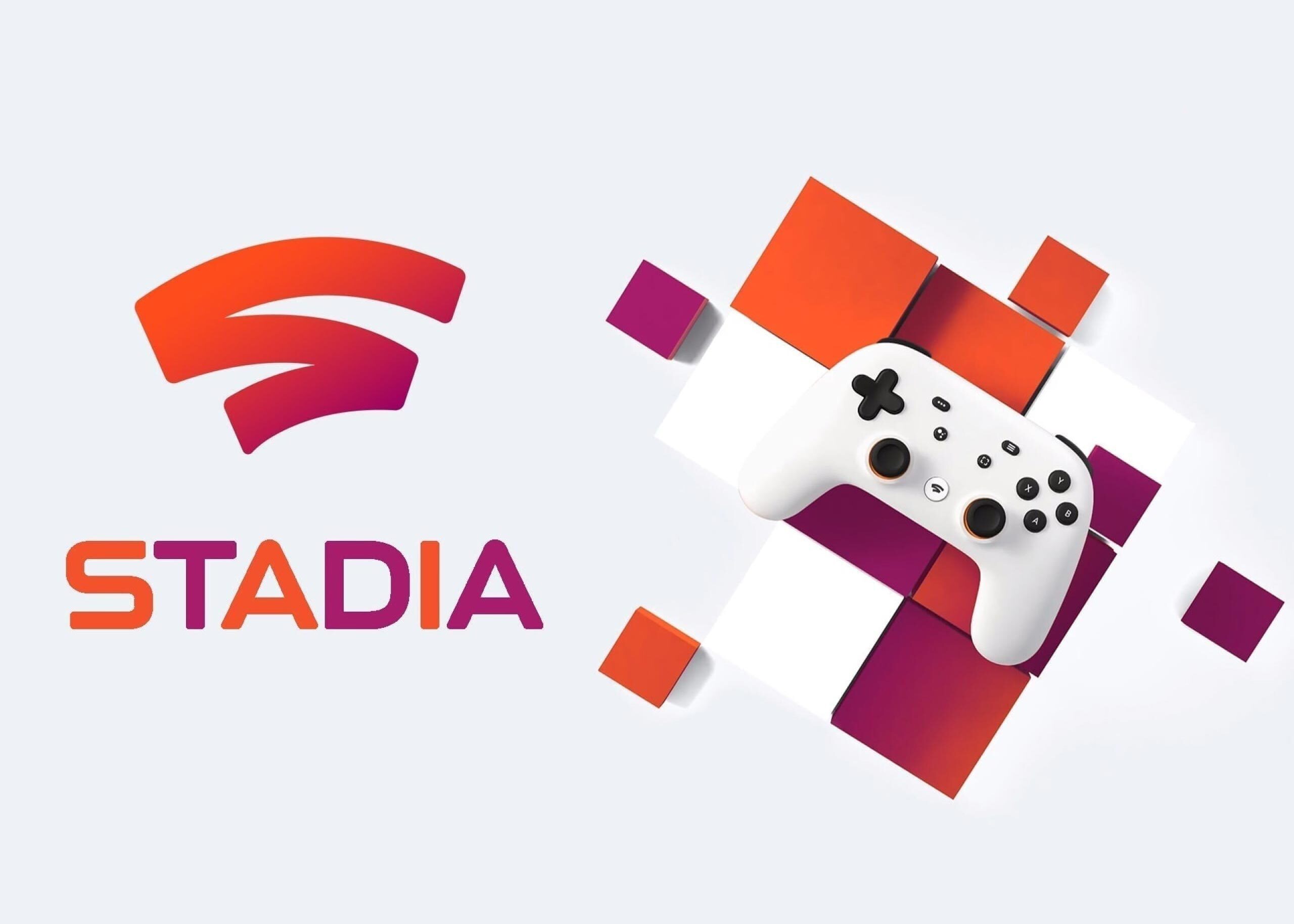
The identity supported that ambition. Stadia was given a distinct wordmark, a signature orange, and a controller of its own, hardware that a purely software service did not strictly require.5 Building a physical object for a platform that claimed to eliminate hardware was a brand decision rather than a technical one: it gave the service something to put in a shop window and something for a player to own.
Source: IGN
Where the promise came apart
At launch, several announced features were missing, the catalogue was thin, and the commercial model asked players to buy games individually at full price while also paying a subscription for higher resolution.5, 9 The free tier arrived months later than planned. Reviewers noted inconsistent image quality and latency, which was damaging for a service whose entire argument rested on technical performance.9
The most consequential decision came on 1 February 2021, when Google closed Stadia Games and Entertainment, roughly fifteen months after launch and before the studio had shipped an original title.7, 8 Around 150 staff were affected. Read commercially it was a cost decision. Read as a brand signal it was decisive: the company that had asked players to move their libraries onto its servers had just demonstrated how quickly it was willing to reverse a commitment.
From that point the brand carried a reputation it could not shed. Google's record of retiring products, catalogued endlessly by its own users, became the frame through which every Stadia announcement was read.2 Developers hesitated to commit; players hesitated to buy; the catalogue stayed thin; and the cycle reinforced itself. The shutdown announcement on 29 September 2022 confirmed what much of the audience had already assumed.1, 10
The lesson inside the failure
Stadia is often described as a technology failure, but the underlying streaming work was sound enough that parts of it continued inside Google in other forms.1, 2 The failure was one of brand credibility. Google entered a category where the buying decision is an act of trust in the seller's longevity, and it entered as a company with a widely known habit of closing things.
The refund policy at the end was notable. Returning customers' money in full is not the standard behaviour of a company withdrawing from a market, and it protected Google's wider reputation at the cost of the specific one. It also underlined the point: the money could be given back, but the four years players might have invested in a library could not.
The audience matters too. Players are among the most brand-literate consumer groups there is, accustomed to reading platform announcements for signals of long-term intent and quick to organise their scepticism in public. A category like that offers very little tolerance for a company still establishing whether it belongs there.
For a brand portfolio as broad as Google's, Stadia is a useful marker of where extension reaches its limit. The parent name opens doors in categories where the company is trusted to persist, and closes them in categories where it is not.
Source: Google Youtube
Written with AI assistance, edited by a human. Find out more about our Use of AI.
1. Google, Phil Harrison, Vice President and General Manager, Stadia, "A message about Stadia and our long term streaming strategy", 29 September 2022, for the announcement of 29 September 2022 that Google would begin winding the service down, for players keeping access to their libraries "through January 18, 2023", for the refund of "all Stadia hardware purchases made through the Google Store, and all game and add-on content purchases made through the Stadia store", for Google's own account that Stadia "was built on a strong technology foundation" but "hasn't gained the traction with users that we expected", and for the underlying platform having "been proven at scale and transcends gaming", with Google naming "other parts of Google like YouTube, Google Play, and our Augmented Reality (AR) efforts" as where it would be applied. https://blog.google/products/stadia/message-on-stadia-streaming-strategy/
2. GSMArena, Prasad, "Google will shut down Stadia on January 18, 2023", 29 September 2022, off whitelist and used for corroboration only, for 18 January 2023 as the date the service closes, for the refund covering "all hardware and software purchases", for Stadia having been "met with immediate skepticism from the industry due to Google's tendency to close businesses that don't immediately take off", and for the streaming technology being carried into YouTube, Google Play and Google's augmented reality work. This piece dates Stadia to "March of 2019", which is when the service was announced rather than when it launched. https://www.gsmarena.com/google_will_shut_down_stadia_on_january_18_2023-news-55996.php
3. TechRadar, Hamish Hector, "Google is shutting down Google Stadia and refunding everyone's money", 29 September 2022, off whitelist and used for corroboration only, for the scope of the refund, every Stadia hardware purchase made through the Google Store and every game and add-on content purchase made through the Stadia store, and for Google expecting the majority of refunds to be completed by mid-January 2023. https://www.techradar.com/news/breaking-google-is-shutting-down-google-stadia
4. Google, Phil Harrison, Vice President and General Manager, Stadia, "Stadia launches today", 19 November 2019, for 19 November 2019 as the launch date, and for Harrison having led the platform as its Vice President and General Manager. The post does not state the number of launch countries, and it says nothing about Harrison's earlier career. https://blog.google/products-and-platforms/products/stadia/stadia-launches-today/
5. Android Authority, Joe Hindy, "RIP Google Stadia, the gaming service aimed at no one", 18 January 2023, off whitelist and used for corroboration only, for Stadia having been "officially announced at GDC 2019 and launched in November 2019", for the launch hardware bought outright being "a controller and Chromecast for your TV", for the commercial model in which players bought games on the platform to stream at up to 1080p while a Stadia Pro subscription at $9.99 a month unlocked 4K, HDR, surround sound, free games and discounts, and for Stadia Games and Entertainment having been closed in February 2021, a decision that also closed Typhoon Studios. https://www.androidauthority.com/rip-google-stadia-3267642/
6. Game Informer, Matt Bertz, "Phil Harrison Answers (Some Of) The Hot Questions About Stadia", 21 March 2019, off whitelist and used for corroboration only, for Harrison's own account of the name at the Game Developers Conference, Stadia being the plural of stadium, and for the intent he describes behind it, "this idea of watching and playing, being merged into one platform". https://www.gameinformer.com/gdc-2019/2019/03/21/phil-harrison-answers-some-of-the-hot-questions-about-stadia
7. Google, Phil Harrison, Vice President and General Manager, Stadia, "Focusing on Stadia's future as a platform, and winding down SG&E", 1 February 2021, for 1 February 2021 as the date Google announced it would not be "investing further in bringing exclusive content from our internal development team SG&E, beyond any near-term planned games", for Jade Raymond having led that internal studio and having "decided to leave Google to pursue other opportunities", and for the reason Google gave, that "creating best-in-class games from the ground up takes many years and significant investment, and the cost is going up exponentially". The post gives no figure for the number of staff affected. https://blog.google/products/stadia/focusing-on-stadias-future-as-a-platform-and-winding-down-sge/
8. TechCrunch, Romain Dillet, "Google shuts down its internal Stadia game studios", 1 February 2021, for Jade Raymond having led Google's first-party studios after more than fifteen years in the video game industry and for her leaving Google with the announcement, and for the studio having been wound down before releasing anything, in the piece's words "the company has yet to release a single game under the Stadia brand but it's already over". https://techcrunch.com/2021/02/01/google-shuts-down-its-internal-stadia-game-studios/
9. Android Police, "One year later: Where Google went wrong with Stadia", off whitelist and used for corroboration only, for the promised features that were absent at launch, named there as "true 4K gameplay, streaming to YouTube, and the absence of game additions", for the catalogue having been "incredibly limited" beyond a handful of major titles with "the rest of the catalog made up of lesser-known indie games", against Google's promise at the beginning of 2020 to release more than 100 games that year, and for the "inconsistent experiences" players reported. The page was reachable on 19 September 2026 but carries no byline or publication date that could be read from it; it refers to the closure of 18 January 2023 in the past tense. https://www.androidpolice.com/looking-back-stadia/
10. Axios, Stephen Totilo, "Google is shutting down its Stadia gaming service", 29 September 2022, off whitelist and used for corroboration only, for the shutdown having been announced on 29 September 2022, for the servers going dark on 18 January 2023, and for Google having closed its internal Stadia Games and Entertainment studios in February 2021. https://www.axios.com/2022/09/29/google-stadia-shutdown