
A thirty-second answer to a single rhetorical question
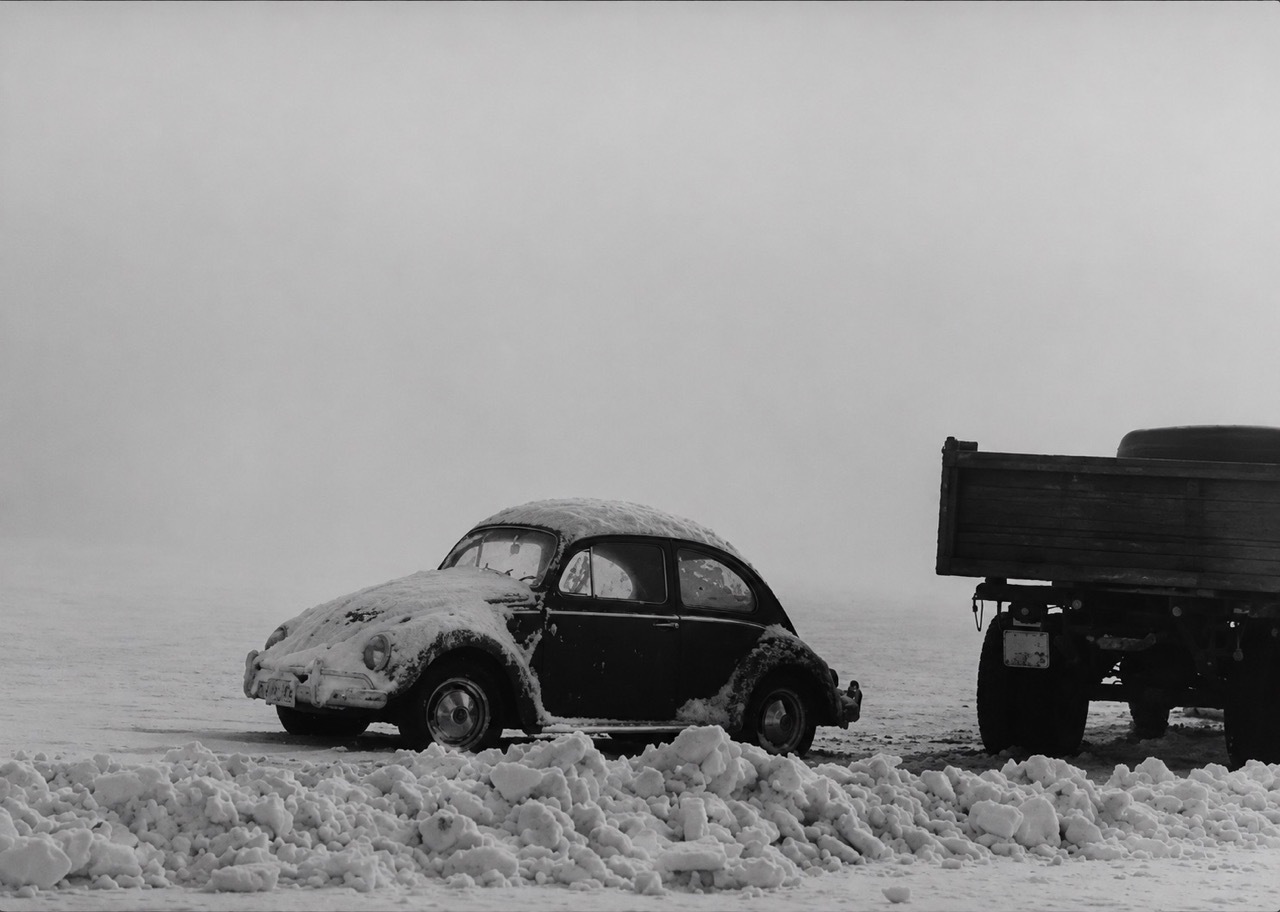
The 1964 Volkswagen Beetle commercial known as Snow Plow opened on a darkened, snow-covered road. The camera followed a single Beetle from a fixed side angle as the car moved through an unbroken white landscape under a single source of pre-dawn light. The narrator, with the conversational and slightly dry voice that the Doyle Dane Bernbach Volkswagen platform had already established in print, asked the audience to consider how the man who drove the snowplough ever reached the snowplough in the first place. He drove a Volkswagen, the narrator concluded, and the viewer could stop wondering. The car arrived at a depot, the driver stepped out, climbed into the cabin of the waiting plough, and the commercial cut to the Volkswagen logotype.
The thirty seconds of black-and-white footage were produced by Doyle Dane Bernbach for Volkswagen of America under William Bernbach's account leadership, and the spot became the first television execution that successfully ported the DDB print voice into a moving-image format. The same editorial discipline that had governed Think Small in 1959 and Lemon in 1960 was extended to a new medium. The image carried no information about the headline question. The voice produced the question. The simple visual of a small car making its way through snow answered it. The audience completed the argument.
The transition from print to broadcast
Volkswagen had built the American Beetle market through print between 1959 and 1963. Life, Time, The New Yorker, the Sunday supplements of major metropolitan newspapers, and the trade press carried the DDB executions month after month. The voice was singular, the format was disciplined, and the readership was wide. Television, by contrast, was the territory of the larger Detroit advertisers, of General Motors, Ford and Chrysler, all of whom worked through the older account-led agencies and all of whom produced commercials that relied on sweeping landscape photography, orchestral scoring and patriotic voiceovers. The conventions of automotive television advertising in the early 1960s were almost the opposite of the conventions DDB had established for Volkswagen in print.
Doyle Dane Bernbach made a deliberate decision to refuse those conventions. The agency carried the same standards from one medium to the other. The advertisement would feature a single Beetle, a single product fact, a conversational voice, and an audience that completed the joke or the argument through its own act of attention. The discipline produced Snow Plow and a small group of companion executions, including the 1969 Volkswagen Funeral spot and the 1972 Volkswagen Drive Carefully campaign. Each treated television as a quiet form rather than as a noisy one, and each demonstrated that the DDB editorial discipline travelled across formats without dilution.
The product argument inside the image
Snow Plow rested on a single product fact. The original air-cooled Beetle had its engine mounted at the rear, directly over the drive wheels. The weight distribution gave the car unusually good traction in snow, on ice, on dirt roads and on gravel. The thin standard tyres cut through surface snow to grip the road below rather than riding on top of the snow. The combination meant the Beetle, in 1964, was one of the most capable winter vehicles a private owner could buy in North America, and the snowplough driver of the commercial offered a small piece of evidence the broader market did not yet know. The product fact was true, the proof was visual, and the narrator named the implication only by indirection.
The decision to use a snowplough driver rather than a postman, a doctor or a farmer was strategic. The snowplough driver represented a class of working professional whose own arrival depended on the conditions everyone else expected him to clear. The implication of professional trust transferred to the Beetle without claim. The spot did not state that the Beetle was the best winter car on the American market. The spot allowed the viewer to draw that conclusion from the evidence that the man whose job started before the rest of the country woke up was already arriving in a Beetle.
The awards and the broadcast trail
Snow Plow took the Gold Lion at the 1964 Cannes International Advertising Festival, then the most prestigious television advertising award in the world, and the Gold at the New York Art Directors Club annual that year. The recognition mattered for two reasons. The Cannes Lion confirmed that the DDB Volkswagen platform translated to international audiences as well as it did to the domestic American market, and the New York Art Directors Club Gold confirmed that the work was accepted on craft grounds by the professional community whose standards governed the editorial direction of the industry.
The spot ran across United States network television in late 1964 and into 1965, and the script was rotated through a small group of related winter and rural-driving executions for the rest of the decade. Each followed the same template. A single Beetle, a single product fact, a conversational voice, and a quiet visual. The platform held its discipline for the full DDB tenure on the account, and Volkswagen of America reached annual Beetle sales of over half a million units by 1967 and over one million by 1968.
What Snow Plow continues to model
Snow Plow is studied today as the founding example of the brand television commercial that argues by quiet observation rather than by declarative claim. The spot also demonstrated that a print-led editorial voice could carry into broadcast without modification, provided the brand and the agency were willing to refuse the conventions of the receiving medium. The decision to keep the script at fewer than thirty spoken words, the decision to use black-and-white in an era of expanding colour broadcast, and the decision to let the visual proof do the work, all became reference points for the brand television form that the Creative Revolution went on to establish across the remainder of the 1960s and 1970s.
Source: Cory Heisterkamp Youtube
Written with AI assistance, edited by a human. Find out more about our Use of AI.