
A two-word payoff line that carried the brand for ten years
In July 1995 the agency Arnold Fortuna Lawner & Cabot, soon renamed Arnold Communications and later Arnold Worldwide, introduced a new advertising platform for Volkswagen of America. The agency had won the brand's North American account, valued at approximately 110 million United States dollars, earlier in the year against larger New York incumbents. The platform carried a two-word payoff line, Drivers wanted, and it remained the editorial frame for Volkswagen advertising in the United States for the next ten years. The first executions appeared as television, print, outdoor and an early-internet presence in the same month, and the agency targeted an audience between eighteen and thirty-four years old, a demographic that had moved away from the brand during the late 1980s when the air-cooled Beetle had been retired from the market and the Golf and Jetta had not yet rebuilt the marque's cultural standing in North America.
The first wave of Drivers wanted commercials placed the Golf and the Jetta inside a small set of city and night scenes that the rest of the category was not using at the time. The most quoted of the first executions, Security, ran in July 1995 and used a stationary parking-lot scene, a single line of conversational voiceover, and the Drivers wanted payoff as the closing card. The two-word phrase carried two meanings at once, and Arnold preserved both. The phrase read as a recruitment notice for an open driver position. It also read as a category claim. The car was made for drivers, not for passengers, and the brand was looking for a specific kind of buyer rather than for any available customer.
The strategic problem the campaign answered
Volkswagen of America entered 1995 with a small share of the United States passenger car market and a brand reputation that had fractured. The Beetle had carried the Volkswagen identity in North America for two decades, but the model had been removed from the United States market in 1979, and the Rabbit, the Golf and the Jetta had taken its place without replicating its cultural pull. Sales figures had fallen from a 1970 peak of more than half a million units to fewer than fifty thousand units by 1993. The brand had cycled through DDB Needham and other agencies during the 1980s, and none of the work had produced a coherent voice. The Volkswagen of America management team led by Clive Warrilow concluded that the brand needed a platform that would last more than one product cycle, that would distinguish Volkswagen from the Japanese mid-market sedans then dominating the segment, and that would address an emerging Generation X audience.
Arnold's response was to refuse the conventional category vocabulary. The category communicated through highway photography, family-safety messages, lease offers and rear-three-quarter beauty shots of the vehicle. Drivers wanted communicated through quiet observation, off-centre humour, urban and suburban night settings, and the conviction that the Volkswagen owner was a different kind of consumer from the Toyota Camry owner or the Honda Accord owner. The platform did not name the competition and did not list features. The platform built a community of recognition around a temperament. The audience either responded to that temperament or did not, and the brand accepted the segmentation.
The work that the platform produced
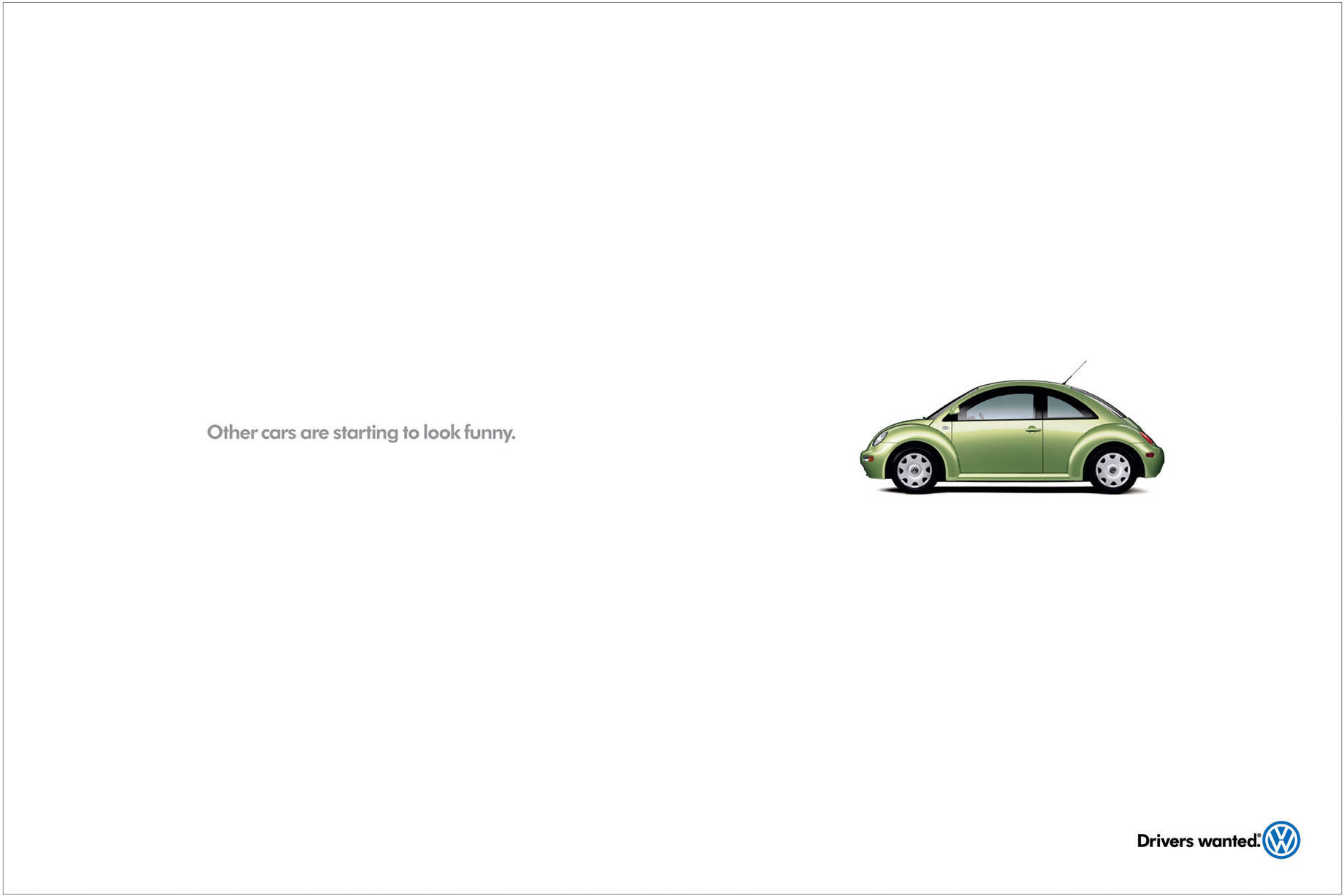
Drivers wanted carried Arnold's Volkswagen of America output from 1995 through 2005. The platform produced a body of work that included the 1997 Da Da Da Golf spot, the 1999 Milky Way Cabrio commercial with Nick Drake's Pink Moon, a long sequence of Jetta and Passat executions, and the 1998 New Beetle launch that re-introduced the Beetle silhouette to the North American market. Each commercial was tagged with the Drivers wanted lockup. The line travelled across product launches, dealer activations, magazine print, outdoor and the early Volkswagen of America website. The consistency of the lockup gave the brand a single recognition cue across a decade of work and across the entire Volkswagen of America product line.
The platform also helped Arnold expand. The agency had been a Boston regional shop with a small national profile before winning the Volkswagen of America account. By 2002 it had grown into Arnold Worldwide with offices in New York, Los Angeles, Toronto, London and Prague, and the Volkswagen of America business remained its anchor client through that growth. The platform produced more than two dozen Cannes Lions, multiple Effies and several Grand Prix recognitions during its run, and the work was studied internally at Volkswagen Group Wolfsburg as the international benchmark for the marque's local-market editorial standards.
The product and sales arc
Volkswagen of America sales rose from approximately 50,000 vehicles in 1993 to more than 350,000 vehicles by 2001. The New Beetle launch in March 1998 produced 55,842 units in its first full calendar year and became one of the highest-profile car launches of the decade. The Passat redesign of 1998 reset the model into the upper-mid market and added meaningful volume to the brand. The Jetta moved from a marginal mid-market position to a top-three import sedan ranking by the end of the decade. The Drivers wanted platform was not the only reason for the recovery, but every observer of the period named it as a primary factor.
The end of the run and what followed
Drivers wanted was retired in 2005 and replaced by a sequence of shorter platforms across the following decade, the most prominent of which was Das Auto, the Wolfsburg-led international claim that ran from 2007 to 2015. The retirement of Drivers wanted was not the result of a failure of the platform. The phrase had become so recognisable that the brand and Arnold concluded together that the next stage of the work needed a different conceptual framing. Drivers wanted returned to Volkswagen of America communications briefly in 2017, in the immediate aftermath of the diesel emissions matter, as an explicit invocation of the trust that the earlier Arnold era had built. The two-word line continues to be cited inside the industry as one of the longest-running and most coherent positioning platforms of the late twentieth century.
Source: ambanmba Youtube
Written with AI assistance, edited by a human. Find out more about our Use of AI.