A network fact in search of a picture
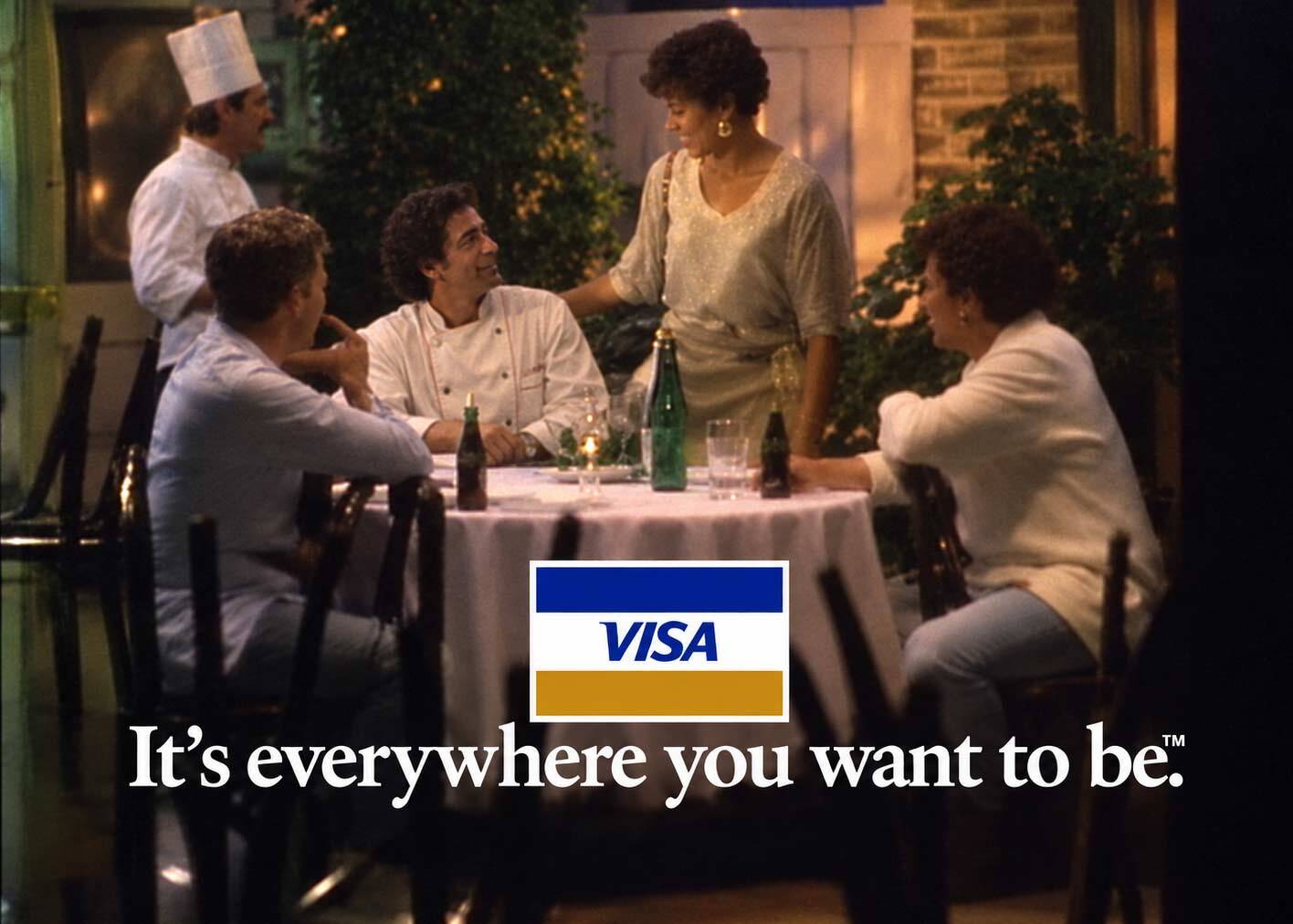
On 1 October 1985, Visa U.S.A. launched a television and print campaign conceived by its advertising agency, BBDO New York.1 Its sign-off was "Visa. It's everywhere you want to be."1 The line would close Visa's advertising in the United States for about two decades.2
The brand behind it was young as a name. National BankAmericard had become Visa only in 1976.3 What it had to sell was not an object anyone could admire but a fact about a network: the number of places that took the card. The task, as the Encyclopedia of Major Marketing Campaigns records it, was to set Visa apart from its competitors and present it as the most widely accepted credit card in the world.1 Acceptance is an abstract claim. The campaign's work was to make it concrete.
Acceptance, told as a destination
The first commercial did not open on a statistic. It opened on a small town on the coast of Massachusetts: "Just a little north of Boston, in the old town of Marblehead is a place where only the local people used to eat".1 The place was a restaurant called Rosalie's. Later spots visited the Telluride ski resort, the restaurants of Wolfgang Puck and the Ringling Brothers and Barnum & Bailey Circus.1 Each was somewhere a viewer might plan a trip, a weekend or an evening around.
This was the central move. A count of merchants became a set of desirable places, and the tagline put the viewer in charge of the wanting. "Everywhere" stated the network fact. "You want to be" turned it into travel, leisure and taste. The card itself barely mattered as an object; it appeared as access. Visa stopped describing where it worked and started describing where its customers would like to go, which allowed a payment network to speak the language of a travel brand.
The rival in the closing line
The early spots also named a competitor. The merchants they featured accepted Visa but not American Express, Visa's chief rival in travel and entertainment, and the commercials said so.1 That comparison became a positioning device of its own, with its own article, but within the tagline it only supplied the edge: the places carried the meaning.
Source: mrgiosb123 Youtube
One line over every product
Over the years the tagline became the frame for nearly everything Visa said. It united later commercials and was carried over to the Gold Card, the Platinum Card and the Visa Check Card.1 Jan Soderstrom, Visa's executive vice president, described the campaign as "an umbrella for everything we do from a marketing standpoint."1 Visa widened the audience from adults aged 25 to 54 to Generation X consumers and small business owners without changing the words.1 The products changed and the listeners changed. The promise did not, and every new card inherited a meaning it had not had to earn on its own.
That stability was the asset. A single sentence repeated across products, sponsorships and audiences gave Visa a recognisable voice that no single issuing bank could have built on its own. The company attributed its rise in market share, from 43.8 percent in 1985 to 51.4 percent in 1997, to the campaign.1 Adweek called it "the perfect, pure example of very insightful strategy brilliantly executed".1
What two decades left behind
The partnership with BBDO lasted about 20 years. In February 2006 the brand retired the line in favour of "Life takes Visa", arguing that consumers now cared about more than where their card was accepted.4 The successor line is a story of its own; what matters here is that the old sentence did not disappear with it.
In January 2014 Visa built a new corporate platform on the old tagline and presented it as a return to the company's heritage. Its own release spoke of "our famous tagline".5 A line retired eight years earlier was still the strongest piece of language the brand owned.
In September 2025 the brand turns the promise on itself. A spot made with Ryan Reynolds' company Maximum Effort extends the line to "And Some Places You Don't" and puts the card in situations nobody would choose.2 The joke works only because the original sentence is still familiar four decades after BBDO wrote it.
What the two decades had built was a meaning for the name itself. For a generation of American cardholders, Visa stood for reach, and reach stood for the places they wanted to be. A network statistic had become an aspiration, and the aspiration became heritage the brand could return to when it needed one.
Written with AI assistance, edited by a human. Find out more about our Use of AI.
1. Rebecca Stanfel, "Visa U.S.A.: Visa. It's Everywhere You Want To Be campaign", Encyclopedia of Major Marketing Campaigns via WARC, 1 January 2000, read 18 October 2026, for the launch on 1 October 1985, BBDO New York, the aim of positioning Visa as the most widely accepted card, the Marblehead opening line and further merchants, American Express as chief rival in travel and entertainment, the extension to Gold, Platinum and Check Card, the quotation from Jan Soderstrom, executive vice president, the audience expansion, the market share figures attributed by Visa to the campaign and the Adweek quotation. https://www.warc.com/content/article/gale-emmc/visa-usa-visa-its-everywhere-you-want-to-be-campaign/en-gb/84565
2. Danielle Oster, "Visa Puts Spin On Iconic Tagline With 'And Some Places You Don't'", MediaPost Marketing Daily, 18 September 2025, read 18 October 2026, for the tagline introduced in 1985 by BBDO New York and running for about two decades, and the September 2025 spot "And Some Places You Don't" made with Ryan Reynolds' Maximum Effort, placing Visa in unpleasant situations. https://www.mediapost.com/publications/article/409221/visa-puts-spin-on-iconic-tagline-with-and-some-pl.html
3. Wikipedia, "Visa Inc.", read 18 October 2026, for the renaming of National BankAmericard to Visa in 1976. https://en.wikipedia.org/wiki/Visa_Inc.
4. Zachary Rodgers, "'Life Takes Visa' Takes to Web", ClickZ, 7 February 2006, read 18 October 2026, for the retirement of the 20-year-old "Everywhere you want to be" promise and the reasoning that consumers were no longer only concerned with acceptance. https://clickz.com/?p=83809
5. Visa, "Visa Launches 'Everywhere You Want to Be,' a Corporate Platform That Reconnects the Company to Its Heritage", press release, 13 January 2014, read 18 October 2026, for the 2014 platform evolving the tagline, described in the release as "our famous tagline". https://usa.visa.com/about-visa/newsroom/press-releases.releaseId.9726.html