A newspaper takeover that argued by single object
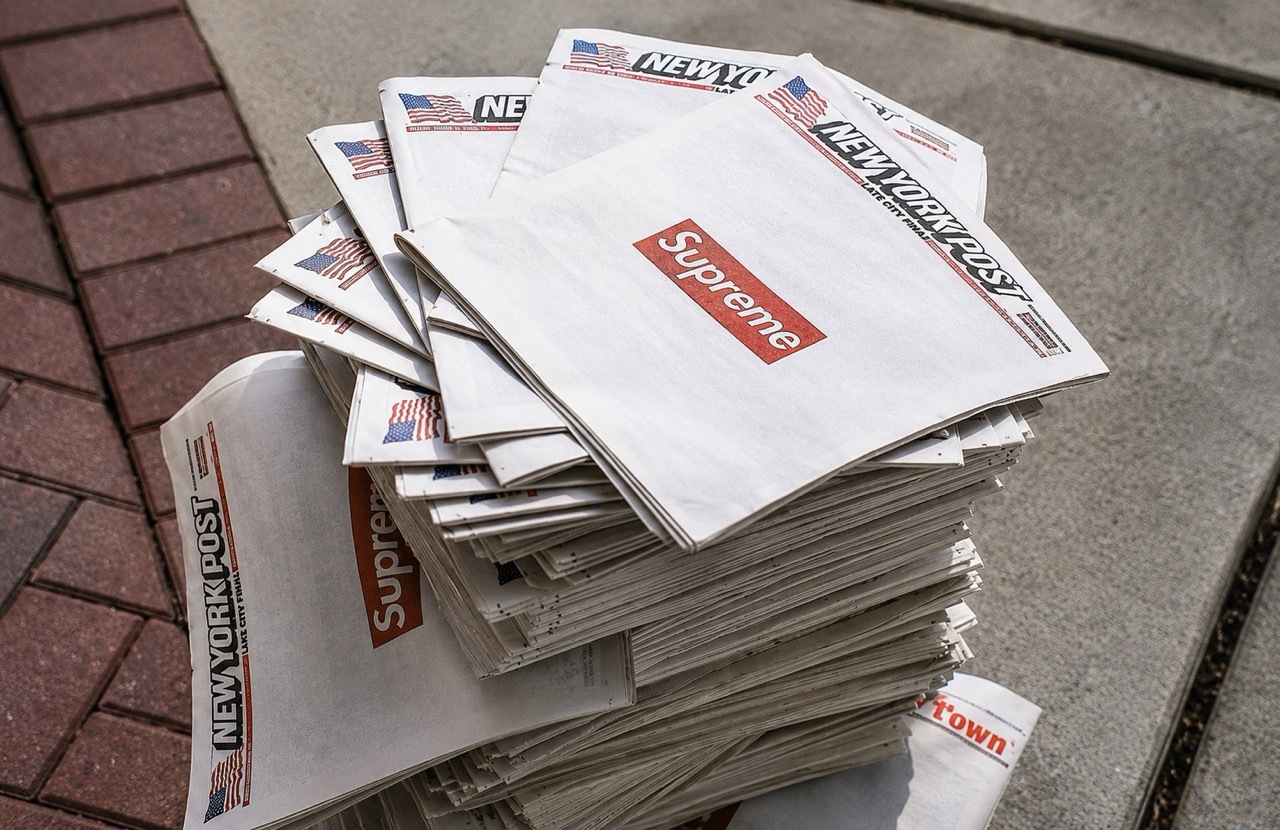
Supreme wrapped the 13 August 2018 edition of the New York Post in a single red Box Logo on a white field. The takeover replaced the regular front and back pages of the New York Post tabloid with full-bleed Supreme branding. The wrap was sold across the entire metropolitan newsstand run at the regular cover price of one United States dollar. It was the first time the New York Post had handed front and back of its entire newsstand distribution to a single brand. The takeover served as the FW18 collection announcement. The Supreme Fall/Winter 2018 collection went on sale at the brand's stores and website on 16 August 2018, three days after the wrap appeared.
The print sold out by mid-morning on the day of publication. Hudson Booksellers at the Port Authority Bus Terminal in Times Square reported the entire tabloid run gone before the commuter rush ended, and the same pattern repeated across kiosks throughout Manhattan, Brooklyn, and Queens. Resale listings began on eBay within hours of publication, with copies asking between 10 and 25 United States dollars in the first 24 hours and rising further over the following week. The brand had effectively turned a one-dollar tabloid into a tradable collectable on the day of its release.
The strategic problem the takeover solved
Supreme entered the second half of 2018 with a wider audience than its core skate constituency. The brand had completed its Louis Vuitton collaboration in 2017, had been the subject of mainstream-fashion press coverage throughout the same year, and had moved into a phase of brand-architecture preparation that would culminate in the VF Corporation acquisition of November 2020. The brief for the FW18 launch was to announce the new collection in a form that matched the brand's expanded audience while preserving the brand's particular relationship with New York. A standard fashion campaign in Vogue or in Hypebeast would have reached the audience but would have looked too conventional. A purely digital announcement would have reached the audience but would have failed to mark the moment with a physical artefact.
The New York Post wrap solved both problems. The Post is the tabloid of the city Supreme was founded in. Its readership runs across the boroughs the brand's stores are located in. Its physical print form provided the tangible object that a digital campaign could not deliver. The wrap therefore announced the collection, marked the city, and created a collectable in a single move. The cost to the audience was one dollar, and the cost to the brand was the price of a single full-distribution print run wrap.
The form of the wrap
The cover wrap was structurally simple. The front and back pages of the New York Post were replaced with a white field carrying only the Supreme Box Logo. No headlines, no campaign image, no model, no garment, no date. The interior pages remained the regular New York Post for 13 August 2018. Customers therefore opened the wrap on the way to work, read the news that the Post had published that day, and held an object that doubled as both newspaper and brand artefact. The Post itself ran an interior page that explained the takeover, with the writers describing the partnership as Supreme's announcement of its FW18 collection.
The brand also worked with the Post on supporting digital content. For the first time, the Post allowed a brand to film inside its Bronx printing facility. Supreme and the Post co-produced a short film of the late-night print run that distributed on the brand's Instagram channel. The film documented the rolls of newsprint being threaded through the presses, the wrapped covers being stacked, and the bundles being loaded onto delivery trucks for the morning distribution. The behind-the-scenes content extended the takeover from a single morning event into a multi-day social distribution.
Source: steppiiy Youtube
The economics of the takeover
Trade reporting at the time placed the cost of a New York Post full-distribution wrap somewhere between 150,000 and 500,000 United States dollars. The number was a fraction of what a comparable national magazine campaign would have cost, and a tiny fraction of the Super Bowl-scale broadcast spend that the most visible Fall fashion campaigns deployed. The unit economics therefore worked unusually well. Supreme reached a citywide audience for a relatively small print-media budget, generated organic photographic content from every commuter who held a wrapped Post, and earned international press coverage that would have cost millions of dollars to buy through paid channels.
The wrap also generated a second-order revenue stream for the New York Post. The newspaper sold every printed copy within hours, the price of the next-day editorial coverage of the Supreme takeover boosted general traffic to the Post's digital edition, and the wrap repositioned the newspaper as a venue for brand-as-art statements rather than as a standard tabloid carrier. Other brands approached the Post afterwards for similar takeovers, although none had quite the same cultural effect.
What the takeover continues to model
The Supreme x New York Post takeover is a useful reference for any brand considering print as a launch venue inside the digital era. It demonstrates that a physical, low-cost, broadly distributed print object can outperform a digital launch when the brand's audience values the artefact as much as the message. It also shows the value of single-image discipline. The wrap carried only a Box Logo on white. Every commuter who saw the wrap, every social-media share, every interior coverage piece carried the same single image. The brand earned the kind of consistent global broadcast that a hundred-million-dollar television flight would deliver, at a unit cost closer to a small print buy. The wrap stands as the cleanest example of Supreme's principle that brand identity can carry a campaign alone.
Written with AI assistance, edited by a human. Find out more about our Use of AI.