
A branded object that argued by mass-produced absurdity
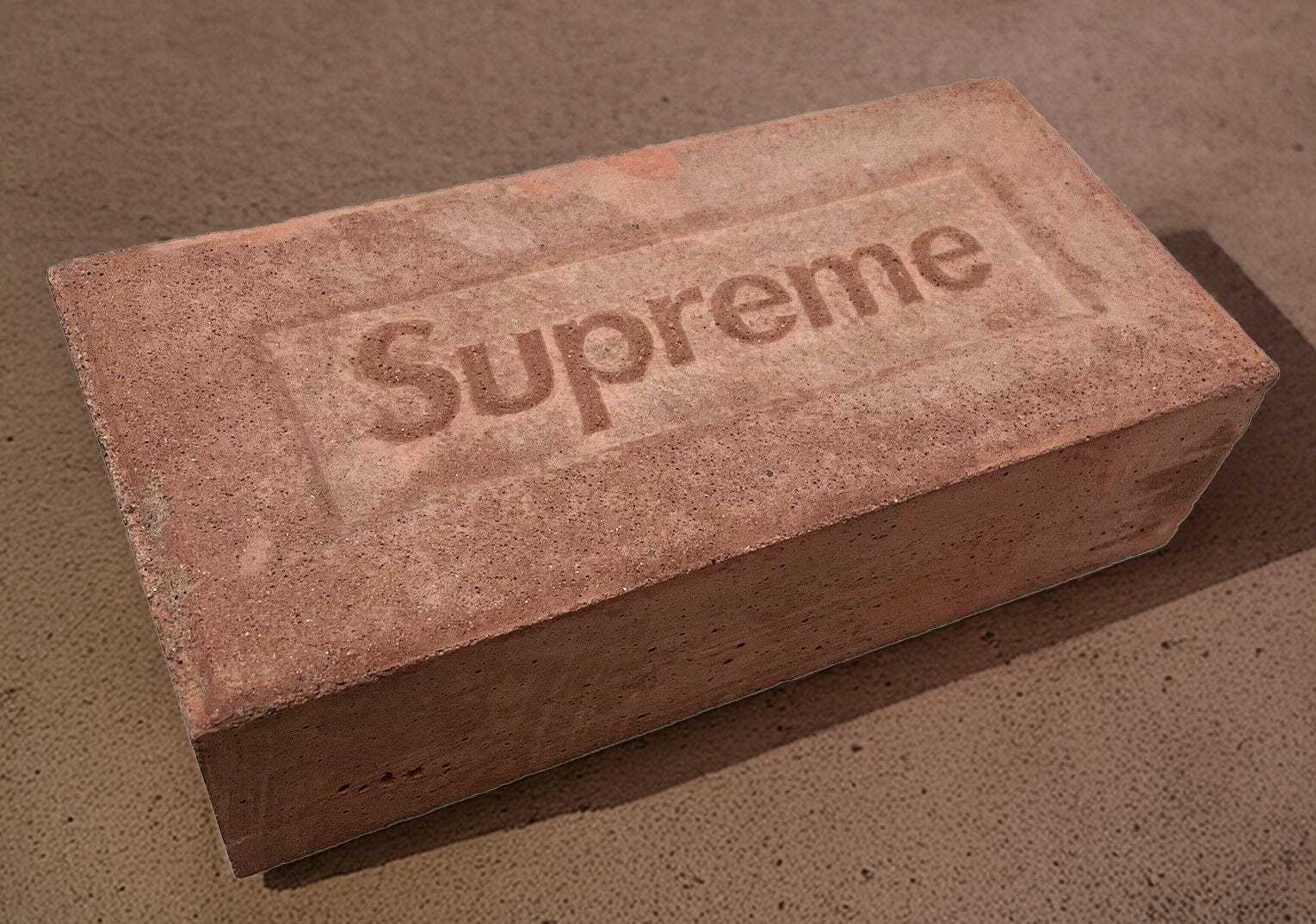
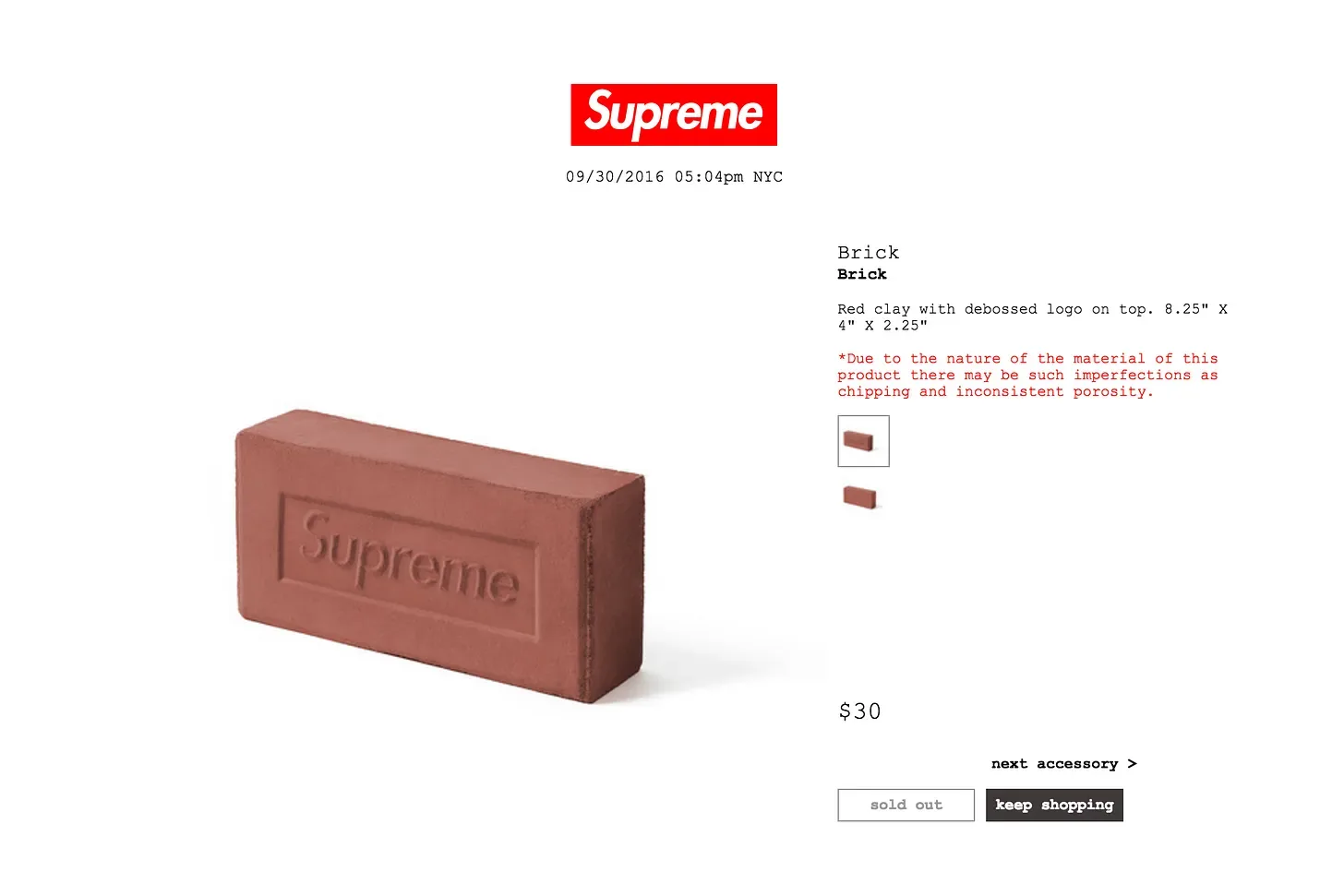
Supreme released a red clay brick as part of its Fall/Winter 2016 accessories drop on 18 August 2016. The brick measured 8.25 by 4 by 2.25 inches, was supplied in a single red colourway, and carried the Box Logo debossed at the centre of the broad face. The retail price was 30 United States dollars. The drop landed simultaneously in the four Western flagship stores in New York, Los Angeles, London, and Paris on the standard Thursday schedule, and arrived in Japan on Saturday 20 August. Supreme noted in product copy that the brick could arrive chipped or imperfect because of the material and the shipping conditions, a small disclaimer that itself became part of the editorial framing.
The brick sold out on release day. Secondary-market values began multiplying within hours of the drop, and resale listings in the following weeks asked between 80 and 200 United States dollars for an unboxed example. The accessory sat inside a wider Fall/Winter 2016 accessories collection that also included a Simpson Street Bandit racing helmet, a Bang and Olufsen BeoPlay A2 portable speaker, a silver Cuban link bracelet, a gold microseahorse pendant, and a portable street light for skate locations. The brick was the most photographed item of the season.
The strategic argument the brick made
Supreme's accessories programme had built up across the previous decade as a deliberate test of the brand's pricing and cultural elasticity. The brand had released a Box Logo-marked Bic lighter, a roll of duct tape, a chopsticks set, a Box Logo-marked baseball bat, a Mancini metal-pail garbage bin, and an MTA MetroCard inside the same general accessories category. Each of those releases tested how far the brand could push a non-apparel item before the Box Logo failed to confer value. The brick was the cleanest test in the sequence. It carried no functional dressing, no sport-cultural reference, no useful interior space. It was a brick.
The strategic argument was therefore made by the very lack of utility. Supreme demonstrated that the Box Logo, applied to a culturally meaningless object, converted that object into a tradable asset on the secondary market. The brick became one of the cleanest live demonstrations of the distinctive-brand-asset principle that Ehrenberg-Bass and other marketing researchers had been describing for a decade. A brand that owns a distinctive mark and a distribution mechanism can produce value at the level of object rather than at the level of category.
The cultural reading of the drop
The brick produced an unusually high volume of media coverage for a 30 dollar object. Hypebeast, Highsnobiety, Complex, GQ, the New York Times, and Vice each published commentary on the drop, with most reading the brick as either an art-world gesture inside a streetwear container or as a knowingly absurd statement on hype. Both readings were available inside the same object. Customers who bought the brick treated it as a brand mark, a paperweight, a desk object, or an investment asset depending on their relationship with the brand. The brand's official copy gave no editorial steer beyond the dimensional and material specification.
Photographs of the brick spread across social platforms in the days that followed. Customers photographed the brick on shelves alongside contemporary art monographs, used the brick as a smartphone stand on a desk, propped doors open with the brick, set the brick next to a Hermès Birkin or a vintage Louis Vuitton trunk. The flexibility of placement, in part because the object was a brick and could go anywhere, multiplied the photographic reach of the release. The brand earned the secondary distribution without sponsoring any of it.
The drop discipline and the drop economics
Supreme released the brick in a relatively small quantity and did not restock the item. The brand's Thursday drop discipline therefore performed exactly as designed. Each customer in the queue or on the website faced a binary outcome: buy the brick or miss it. The narrow window, combined with the brand's no-restock convention, set the conditions for the immediate secondary market. The 30 dollar retail price functioned as a kind of opening bid, with the secondary market discovering a price closer to 100 to 200 dollars over the following weeks. The format made the brick a small live experiment in mark-up economics, with the brand capturing the retail margin and the resale community capturing the rest.
The drop also worked because the brick was easy to ship. The brick is robust, easy to pack, low-value relative to the volumetric weight it occupied, and required no fitting, no sizing, and no return logistics. Supreme could fulfil thousands of units across four physical flagships and the website without any of the complications that an apparel drop required. The accessory programme had been designed around exactly that operational economics.
What the brick continues to model
The Supreme brick is a useful reference for any brand thinking about branded merchandise outside its core category. It demonstrates that a distinctive brand mark, applied with discipline through a controlled distribution mechanism, can produce value at the level of object rather than only at the level of category. It also continues to mark the limit case of the Supreme accessories programme. A brick is the smallest cultural unit Supreme could plausibly produce, and the brand still sold it out on release day. The release sits in the brand's archive as a permanent point of reference for how far identity and scarcity can carry an object that has no functional argument of its own.
Written with AI assistance, edited by a human. Find out more about our Use of AI.