Supreme x Comme des Garçons SHIRT: the first luxury bridge
In March 2012 Supreme released its first joint collection with Comme des Garçons SHIRT, the menswear diffusion line of Rei Kawakubo's Tokyo-based fashion house. The drop introduced a small run of Box Logo tees, hooded sweatshirts and reworked Vans sneakers, each carrying CDG SHIRT's signature graphic codes. The collaboration looked modest on paper. Read against the trajectory that followed, it became the most consequential brand-architecture decision Supreme made in its first three decades. Without the CDG SHIRT bridge in SS 2012, the Louis Vuitton arrangement of FW 2017 would not have been credible.
The Kawakubo factor
Rei Kawakubo founded Comme des Garçons in Tokyo in 1969 and incorporated it in 1973. By the mid-1980s the brand had reset the international fashion lexicon through the early Paris collections, with the deconstructed silhouettes, asymmetric tailoring and ruptured palettes that influenced Martin Margiela, Helmut Lang and an entire generation of conceptual designers. Comme des Garçons SHIRT was launched in 1988 as a Paris-based menswear diffusion line, originally focused on shirting and later extended into knitwear, casualwear and accessories. The line operated as the most commercially active extension of the CDG architecture, designed for repeat purchase rather than runway statement, and it sat closest in spirit to Supreme's own product logic.
The SS 2012 drop
The first collection consisted of three core garment groups. A Box Logo tee in three colourways carried the standard red Supreme rectangle, overlaid with CDG SHIRT's signature polka dot graphics in white. A pullover hooded sweatshirt repeated the same overlay across the chest in a Box Logo configuration. A Vans Era sneaker, in white and black variants, carried embroidered Supreme and CDG SHIRT branding on the heel counter, with corresponding striped laces. Retail pricing ran between 60 and 250 US dollars across the range, with stock split across the Supreme stores in New York, Los Angeles, London and Tokyo plus selected Dover Street Market doors. The drop sold through within hours of release. Secondary market pricing reached three- to five-times retail by the end of the week.
What the partnership made possible
Three architectural moves followed directly from SS 2012. First, the collaboration set the pattern of annual SS releases that would run continuously through to the present, with twelve distinct drops by 2024 spanning Box Logo treatments, polka dot graphics, leopard prints, archive remixes and footwear pairings (the partnership later widened to include Air Force 1 and Air Max silhouettes co-produced with Nike). Second, the relationship opened the door to Junya Watanabe, the Kawakubo protégé who runs his own line under the CDG umbrella, with subsequent Junya Watanabe Man x Supreme drops in the second half of the 2010s. Third, and most importantly, the relationship signalled to other luxury houses that Supreme could be a credible partner without the streetwear identity threatening the parent brand. Comme des Garçons is among the most respected names in fashion. Once Kawakubo had accepted Supreme as a recurring collaborator, the brand graded up.
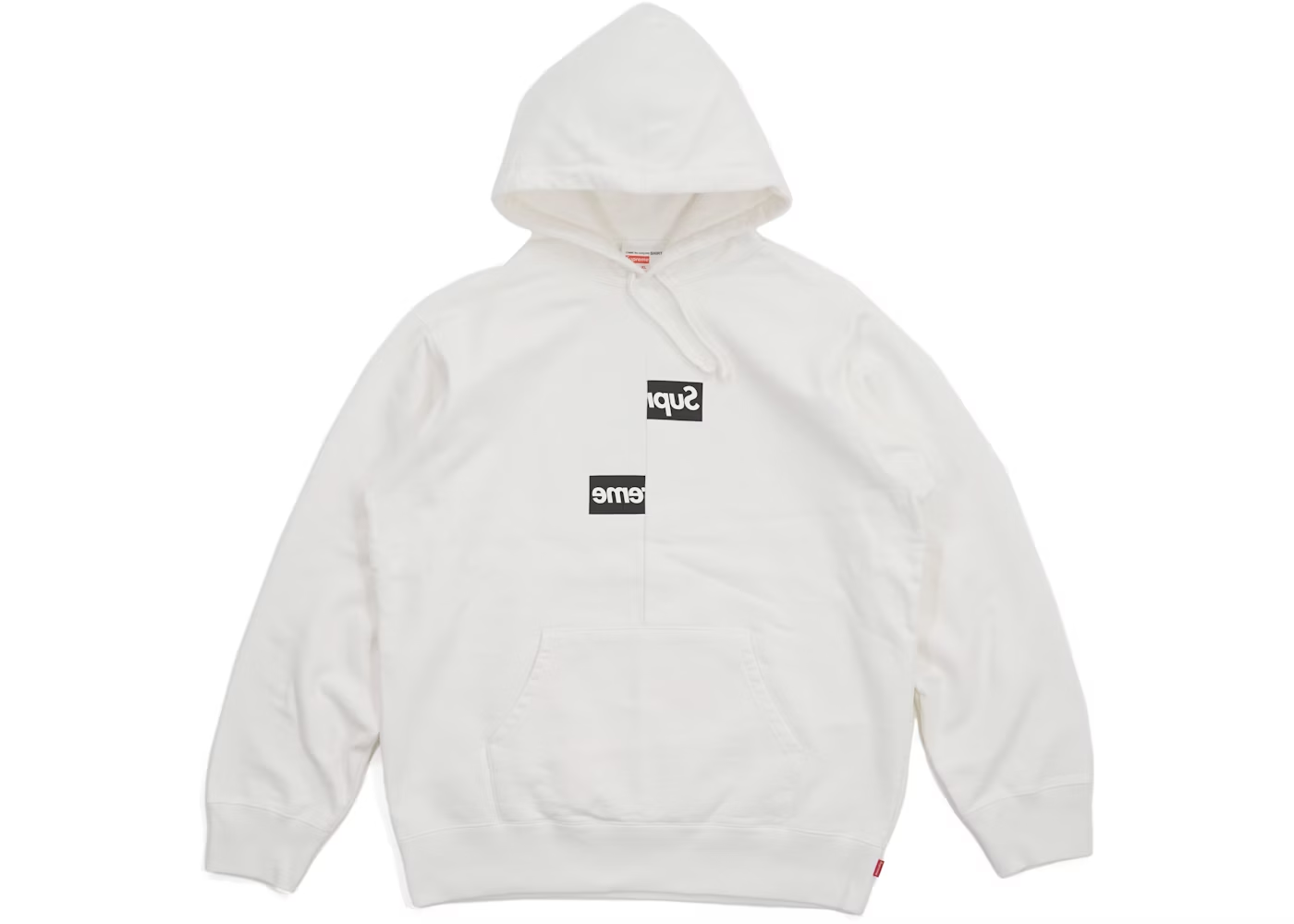
The Split Box Logo lineage
The single most consequential visual artefact from the partnership is the Split Box Logo, introduced in SS 2018, in which the Supreme rectangle is bisected by a horizontal blank strip carrying CDG SHIRT's wordmark. The mark traced its origin to a Comme des Garçons Homme piece from SS 2001, in which Kawakubo had used a similar split treatment on the brand's own logo. The 2018 application became one of the most photographed Box Logo variants in the brand's history. Resale pricing peaked above 500 US dollars for the tee and above 1,500 US dollars for the matching hooded sweatshirt. The mark itself has continued to function as a permanent reference point in the Supreme visual lexicon, deployed sparingly enough to retain its scarcity value.
Editorial reading
The strategic significance of SS 2012 sits in two registers. Inside fashion, the drop was the first time a streetwear brand and a designer house of Kawakubo's standing had operated as peers in a recurring co-branded format. Earlier streetwear and designer drops, including Supreme's own SS 2007 with Lacoste and various Stüssy and BAPE pairings with smaller designer labels, had been one-off events at lower price tiers. The CDG SHIRT arrangement was a structural partnership with annual cadence and full retail integration. Inside Supreme's own brand architecture, the drop confirmed a graduation. From SS 2012 onwards the brand operated with a credible luxury-adjacent partner profile, and the LV menswear show in January 2017 became thinkable. Kim Jones, who designed the FW 2017 LV menswear collection, had been a Supreme customer in the 1990s. The Kawakubo collaboration was the bridge that made the cultural arithmetic add up for Michael Burke, then CEO of Louis Vuitton, when he initiated the conversation in 2016. The SS 2012 drop was that bridge.
Written with AI assistance, edited by a human. Find out more about our Use of AI.