
A three-day meeting that reset a conglomerate
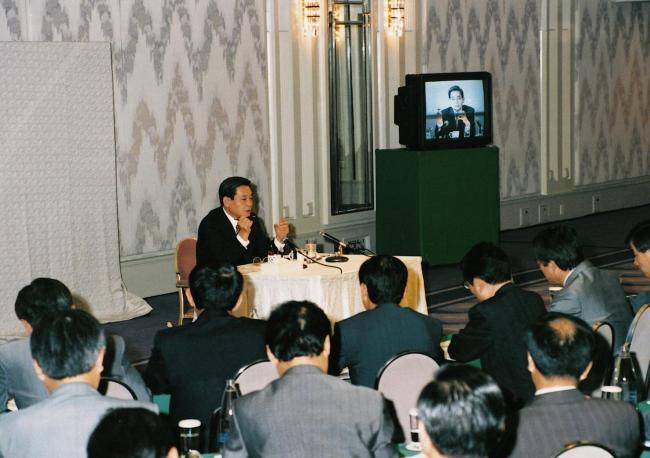
In June 1993, Samsung chairman Lee Kun-hee gathered around 200 executives in Frankfurt for a three-day meeting that has since become one of the most cited moments in Korean corporate history. The sentence that survived it is short. "If you are to change, change completely," Lee told the room. "I'm not kidding. Change everything except your wife and children."
What Samsung calls the New Management programme began there. The company was profitable, large and, by Lee's assessment, mediocre. Samsung built volume. It did not build reputation. The Frankfurt meeting reframed the entire group around a single instruction: quality before quantity, in products, in processes and in the way the company presented itself abroad.
The identity followed the strategy
The brand change came after the decision rather than announcing it. In 1993 Samsung retired the three-star marks that had carried the company since its founding and adopted a new corporate identity built on the English brand name set inside a blue ellipse. The choice was consequential. Until then, Samsung's marks had been drawn for a Korean audience and read as one of many chaebol emblems. The new wordmark was drawn for export.
The name itself carries the earlier symbolism. Samsung means three stars in Korean, chosen by founder Lee Byung-chul in 1938 because he wanted a company that would be, in his words, powerful and everlasting like stars in the sky. Those stars appeared in Samsung's logos in various forms for 55 years. Removing them in 1993 took away a literal illustration of the name and replaced it with something a global audience could read without translation.
The timing was not accidental. Korean exporters in the early 1990s competed largely on price, and a Korean-language emblem reinforced the perception of a supplier rather than a brand. Setting the name in Latin letters, in a single blue container, gave Samsung a mark that behaved the same way on a shelf in Seoul, a trade show stand in Las Vegas and a shipping container. The identity did not claim quality on its own. It made the quality claim portable.
Samsung has described the ellipse as standing for stability, reliability and corporate social responsibility. The tilted oval also solved a practical problem. It gave the wordmark a container that worked at the scale of a semiconductor package, a television bezel and a stadium sign, and it gave Samsung a single asset to apply across a group spanning electronics, construction, shipbuilding and financial services.
What quality looked like in practice
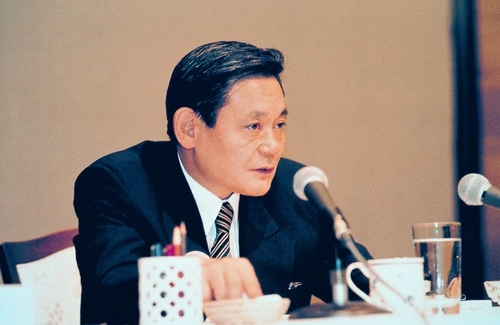
The programme was not confined to design. Samsung reorganised production around defect reduction, and the episodes that followed became part of the corporate folklore. The most repeated took place at the Gumi plant in March 1995. Samsung's handset division had rushed a product to market in 1994 with a defect rate of 11.8 percent, and 150,000 faulty phones had accumulated at the factory. In front of roughly 2,000 employees, ten workers broke the devices with hammers and the pieces were burned. Lee's instruction, as reported at the time, was blunt: "Get rid of defect rates even if it means we shut down." Samsung's share of the domestic handset market reached 19 percent by the end of that year.
The engineering results arrived quickly. Within a year of the Frankfurt meeting Samsung produced the world's first 256-megabit DRAM chip, and in 1996 followed it with a 1-gigabit part. Memory became the business in which Samsung could credibly claim leadership rather than participation, and that claim gave the new wordmark something to stand for.
Thirty years on
The scale of the change is easiest to read in the group's numbers. Samsung Group's combined market capitalisation rose from 3.1 trillion won in 1993 to 626.6 trillion won, about $481 billion, by 2023. Revenue grew from 41 trillion won to 466.8 trillion won over the same period, and operating profit from 490 billion won to 55.6 trillion won.
The identity set out in Frankfurt has proved similarly durable, though not unchanged. Samsung refined the lettermark in 2005 to improve legibility, adjusting the spacing and height of the letters so that they distribute evenly across the word. The company's current brand identity guidance describes the logo simply as the English brand name, sets it in Samsung Blue as PMS 286C, black or white, and makes no mention of the ellipse. The oval that defined the 1993 identity has quietly left the core system, while the wordmark it framed remains.
Samsung did not mark the 30th anniversary of the declaration with a public commemoration. The company's stated focus in 2023 was chairman Lee Jae-yong's New Samsung agenda, announced in 2021, and its Super Gap strategy in semiconductors and biotechnology. The vocabulary has changed. The pattern behind it, a strategic reset decided internally and then made visible through the brand, is the one Frankfurt established.
Written with AI assistance, edited by a human. Find out more about our Use of AI.