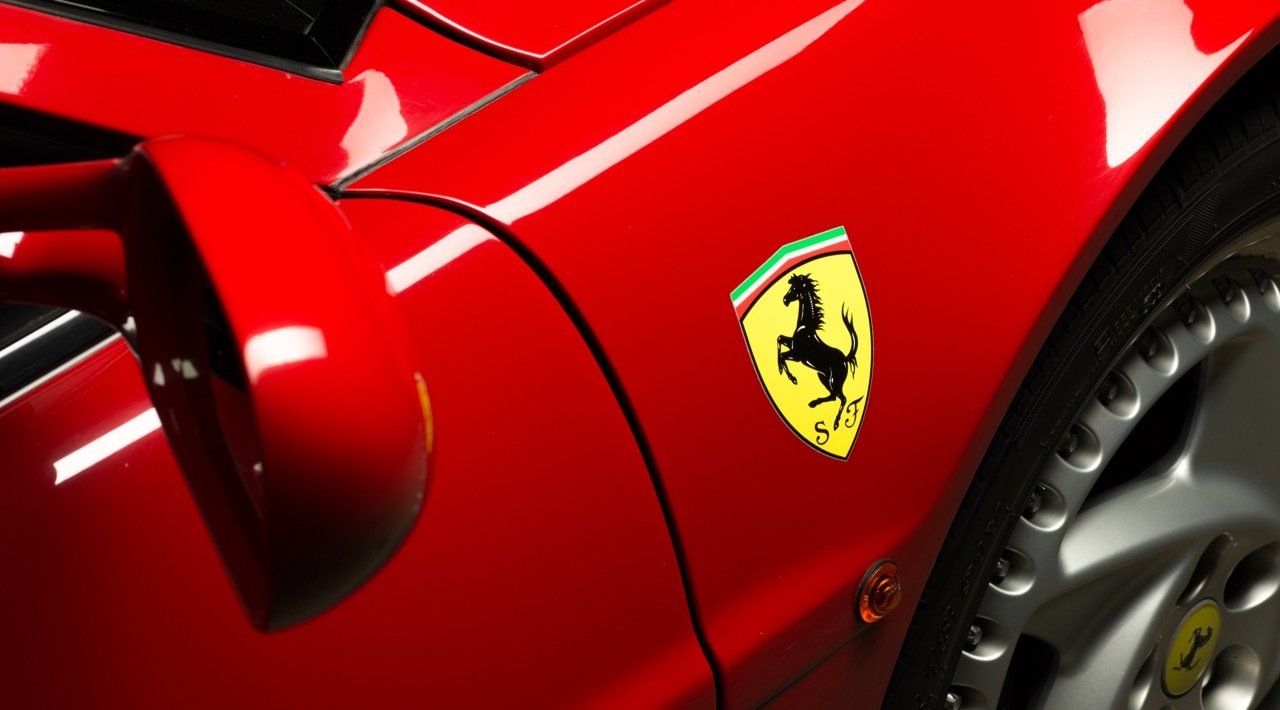

Two colours that define a marque
Few brands are as closely tied to colour as Ferrari. The deep red of its cars and the canary yellow of its shield are recognised far beyond motorsport. Neither colour was invented by the company, and the history of each explains how Ferrari assembled a colour identity from national racing convention and civic pride.
The red is Rosso Corsa, literally racing red. In the early decades of international motor racing, organisers assigned national colours to competitors rather than relying on commercial liveries. Italian cars raced in red, British cars in green, French cars in blue and German cars in white, later silver. Rosso Corsa was therefore the colour of Italian competition, used by Alfa Romeo, Maserati and others long before Ferrari built cars of its own.
Inheriting the national racing colour
When Ferrari began racing and then manufacturing under its own name, it inherited Rosso Corsa as the colour of Italian motorsport. Enzo Ferrari had managed Alfa Romeo's racing efforts in the 1930s, and his cars carried the same national red when Scuderia Ferrari and later Ferrari competed. As the company's racing success grew through the 1950s and 1960s, the association between the brand and the colour deepened, to the point where red came to be read as a Ferrari signature rather than a national one.
Formula 1 reinforced the link year after year. Scuderia Ferrari is the longest continuously competing team in the championship, and its red cars appeared in every season from the start of the modern world championship in 1950. The repeated, highly visible presence of red Ferraris on the grid bound the colour to the brand in the minds of a global audience, far beyond the people who followed the rules of national racing colours.
The shade itself was never fixed. Ferrari used several variations of red over the decades, and the company today offers a range of reds alongside an extensive palette of other colours. Yet the cultural shorthand remained, a red sports car reads as a Ferrari even to people with no interest in cars. That recognition is one of the brand's most valuable inherited assets, built on a convention that originally belonged to a nation rather than a company.
The yellow of Modena
The second colour is the canary yellow that forms the background of the prancing horse shield. Enzo Ferrari chose it because it was the traditional colour of Modena, his birthplace. The yellow framed the black horse adopted from the aviator Francesco Baracca and gave the emblem its distinctive ground. Where the red connected Ferrari to Italian racing, the yellow connected it to a specific city, grounding the brand in a place.
Giallo Modena became more than a backdrop. The yellow appears on the shield worn by the cars and the Formula 1 team, in the company's retail and brand communications, and as a body colour offered on production cars. Its consistent use turned a civic colour into a recognisable element of the Ferrari identity, complementing rather than competing with the red. The two colours work as a pair, the red carrying the body of the car and the yellow concentrating attention on the emblem.
A colour identity built from convention
Ferrari's colour identity is a study in how brands can build distinctiveness from materials they did not create. The red came from a national racing system, the yellow from a city. Through decades of consistent application, both became so strongly linked to Ferrari that their origins are now widely forgotten. The combination, red bodywork and a yellow shield, gave the company a colour language that operates across cars, clothing, retail spaces and motorsport.
The discipline is easy to underestimate. Many manufacturers offer their cars in a wide spectrum of colours and develop no strong association with any of them. Ferrari allowed customers to choose freely while ensuring that its most public expressions, the racing cars, the emblem and the brand communications, returned consistently to red and yellow. That selective consistency is what built the association, holding the line on the colours that mattered most while leaving room for variety elsewhere.
The lesson for branding is one of ownership through use rather than invention. Ferrari did not register a unique colour at its founding. It adopted established colours, applied them with discipline over a long period, and connected them to consistent success on the track. The result is a colour identity that functions as a distinctive brand asset, instantly legible and difficult for any competitor to claim.
Written with AI assistance, edited by a human. Find out more about our Use of AI.