
The art of focus
The brand foundation says who a brand is on the inside. Focus is where that becomes a strategy, because a market rewards a brand for one ownable thing, not for everything it could be. This chapter is about that discipline: what positioning is, why it demands sacrifice, how real differentiation works, and how a brand can reframe a whole category in its favour.
What positioning is
The classic job of positioning is to secure consistency and continuity in how customers perceive a brand across every touchpoint.2 Al Ries and Jack Trout framed the same idea from the other side, as owning a clear place in the customer's mind, defined against competitors.2 Both point at the same target: a single, stable position that a brand can hold over time.
The warning that comes with it is that classic positioning models often look too far inward, treating the brand's own view as the whole picture, which fits poorly with markets that behave like networks rather than closed industries.1 A position has to be built for the mind of the customer, not for the comfort of the boardroom.
Focus means giving something up
The hard part of positioning is subtraction. It feels wrong to narrow the offer, because limiting what you sell seems to limit what you can earn. Yet it is often better to be number one in a small category than number three in a large one, since the leader can charge a premium while the follower is pushed to compete on price.3 History rewards being first in a category, so the move is usually to find or create a category you can lead, not to fight for a rung someone else already owns.
Focus is therefore a decision about what to leave out. A brand that keeps every option open never occupies a clear position, and a position no one can state is not a position.
Differentiation
Differentiation is the fifth job that separates branding from ordinary design, which only identifies, informs, entertains and persuades.3 The point is to be genuinely different in a way people can name, not merely better at the same thing.
The most common way brands fail here is by reaching for interchangeable, abstract words. Innovation, quality, service, partnership, solution orientation: many brands try to differentiate on these and fail, because the terms are both swappable and empty. Real differentiation is concrete and ownable, tied to something a competitor cannot easily claim.
De-positioning and repositioning
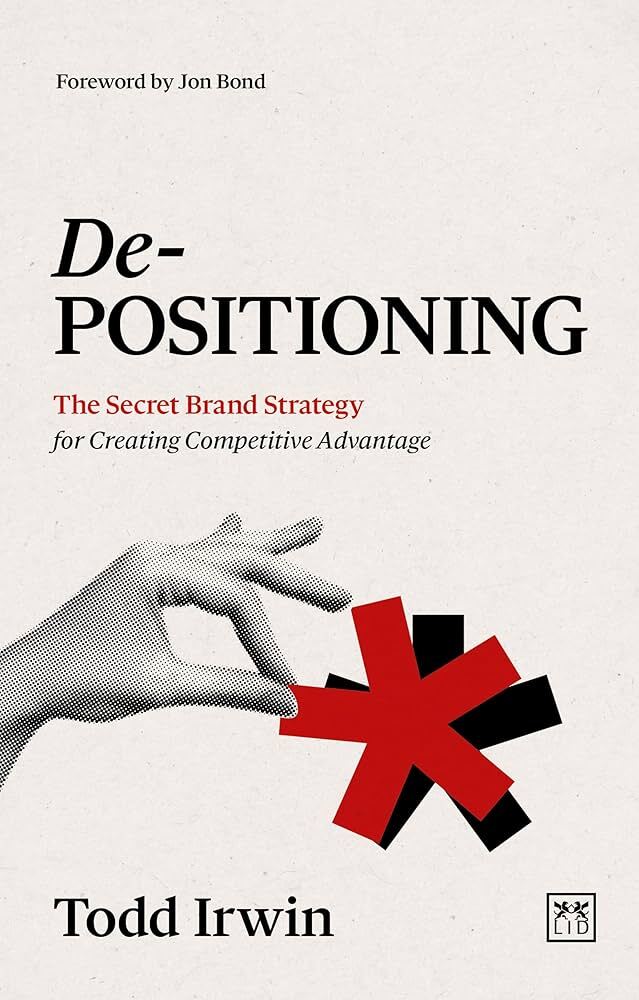
Sometimes the strongest move is not to find a gap inside the category but to reframe the category itself. De-positioning reframes the established norms of a market to open new space, rather than accepting the terms the leaders have set.4 It is an offensive version of focus: instead of choosing a position within the existing map, a brand redraws the map.
Repositioning is the related work of moving an established position as markets shift. Both depend on discipline elsewhere in the arc, since a reframed or moved position only holds if the brand stays singular and coherent behind it, which is the subject of brand leadership.
In practice
How to focus a real brand.
Start by writing the position as a single claim the brand can own in the customer's mind, then stress test it against competitors: could a rival say the same thing, and if so, it is not yet a position. Decide explicitly what to give up. Name the category you can credibly lead, even if it is smaller than the one you are in now, and accept the sacrifice that comes with it.
For differentiation, ban the interchangeable words from the brief. For every abstract claim like quality or innovation, force a concrete, ownable proof or drop it. Then ask whether the bigger opportunity is a gap inside the category or a chance to de-position the category itself, reframing the norms the leaders rely on.
Common mistakes: trying to be everything to everyone, fighting for a position a rival already owns, differentiating on empty abstractions, and reframing a category without the coherence to sustain the new position.
Questions to ask: what one thing can we own in the mind, what are we willing to give up for it, is our point of difference concrete and hard to copy, and would we be stronger finding a gap or redrawing the map.
Continue the journey
Back to TheoryRecommended reading


¹ McGrath, R. (2013). The End of Competitive Advantage. Harvard Business Review Press. (Think in arenas rather than industries; markets behave like networks, so inward-looking models fall short.)
² Ries, A. & Trout, J. Positioning: The Battle for Your Mind. McGraw-Hill.
³ Neumeier, M. The Brand Gap. (Differentiation as the fifth job; focus means giving something up; number one in a small category beats number three in a large one.)
⁴ Irwin, T. De-Positioning. (The gaps are already taken; win by out-solving the competition on the customer's most important problem, not by finding gaps.)