Quick Facts
Introduction
The first book to deal with the problems of communicating to a skeptical, media-blitzed public, Positioning describes a revolutionary approach to creating a "position" in a prospective customer's mind-one that reflects a company's own strengths and weaknesses as well as those of its competitors. Writing in their trademark witty, fast-paced style, advertising gurus Ries and Trout explain how to:
• Make and position an industry leader so that its name and message wheedles its way into the collective subconscious of your market-and stays there
• Position a follower so that it can occupy a niche not claimed by the leader
• Avoid letting a second product ride on the coattails of an established one.
Positioning also shows you how to:
• Use leading ad agency techniques to capture the biggest market share and become a household name
• Build your strategy around your competition's weaknesses
• Reposition a strong competitor and create a weak spot
• Use your present position to its best advantage
• Choose the best name for your product
• Determine when-and why-less is more
• Analyze recent trends that affect your positioning.
Ries and Trout provide many valuable case histories and penetrating analyses of some of the most phenomenal successes and failures in advertising history. Revised to reflect significant developments in the five years since its original publication, Positioning is required reading for anyone in business today.
Review
Positioning by Al Ries and Jack Trout is widely regarded as the foundational text of modern brand strategy, and for good reason. First published in the 1970s, the book introduced a simple but powerful idea that continues to shape marketing thinking today: success is not determined by what you do, but by what you represent in the customer’s mind.
At its core, the book reframes marketing as a battle for perception. Rather than focusing on product features or creative messaging alone, Ries and Trout argue that brands must claim a clear, distinct position in the mind of the consumer.
The core principle: own a mental slot
The central thesis is brutally straightforward: the human mind can only hold a limited number of associations per category. The brands that win are those that occupy a single, clear position while everyone else struggles for relevance.
Impact on modern branding
The influence of Positioning is difficult to overstate. It laid the groundwork for decades of branding practice, from naming strategies to brand architecture to go-to-market positioning. Even more importantly, it introduced discipline. Instead of trying to say everything, brands were forced to choose one idea and commit to it. This constraint is what gives strong brands their clarity and memorability.
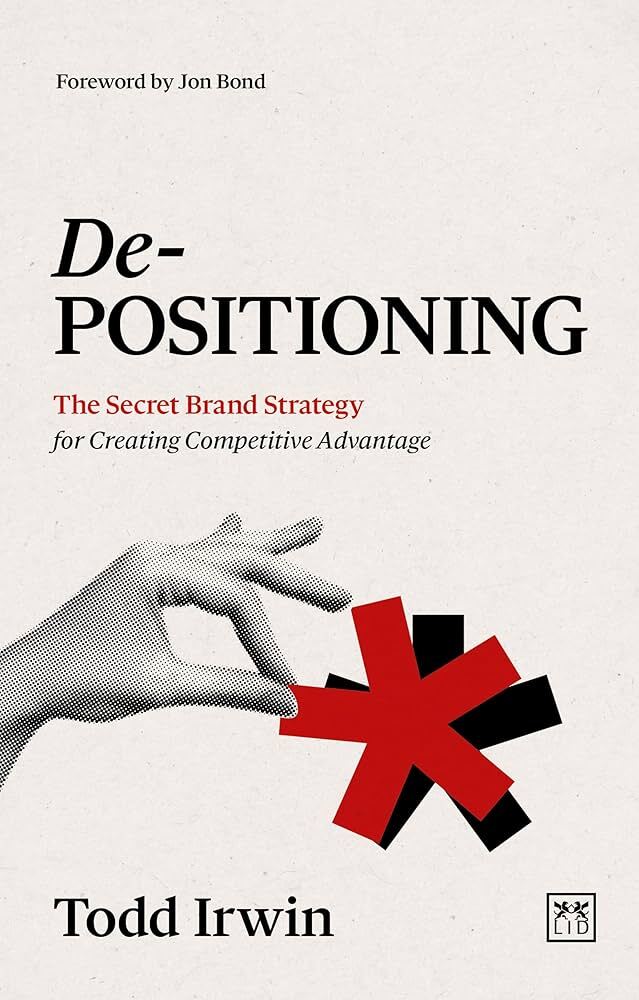
Virtually every modern framework, whether purpose-driven branding, category creation, or even newer ideas like De-Positioning, can be traced back to or defined against the principles Ries and Trout established.
Strengths
The book’s greatest strength is its clarity. The arguments are direct, often blunt, and highly actionable. It avoids abstraction and focuses on how people actually process information and make decisions.
It’s also remarkably durable. Despite being written decades ago, its core insights remain relevant in today’s oversaturated, attention-scarce markets—arguably even more so.
Limitations
That said, the book reflects its era. Some examples feel dated, and the media landscape it describes is far simpler than today’s fragmented digital environment.
It also leans heavily toward rational, category-based positioning and gives less attention to emotional branding, storytelling, or long-term brand building. In modern practice, these elements often complement positioning rather than replace it.
Overall assessment
Positioning is not just a great marketing book, it is the foundation of the entire discipline. It defines the rules of the game: how markets are structured, how brands compete, and how customers decide.
Anyone working seriously in branding, marketing, or strategy should read it at least once. Not because it has all the answers, but because it establishes the baseline. Every meaningful advancement in positioning, whether it’s purpose-driven branding or newer frameworks like De-Positioning either builds on it or pushes against it.
About the author