Quick Facts
Summary
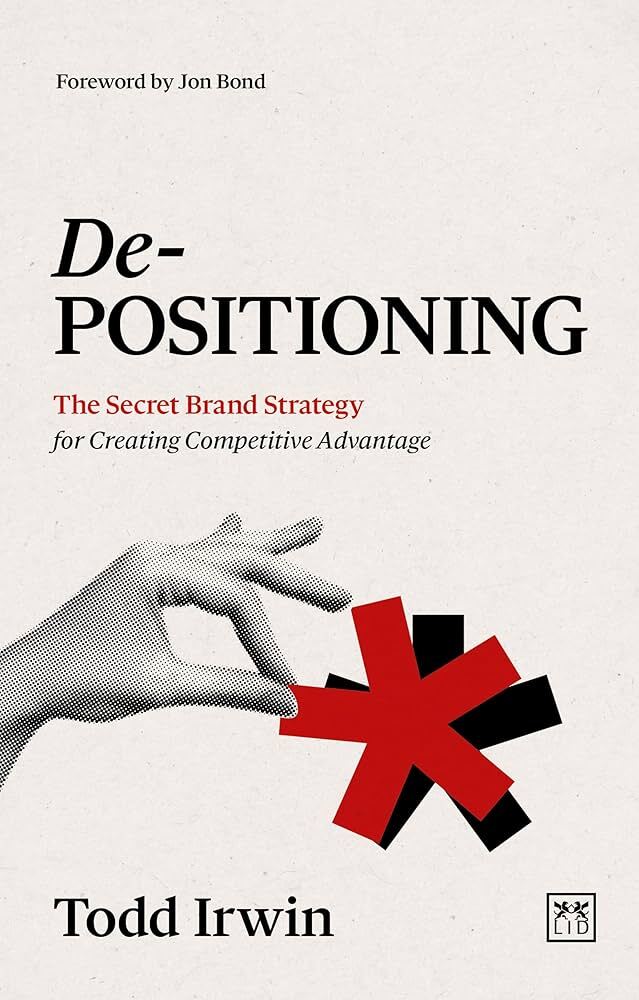
What is the brand strategy Apple, Starbucks, and other market leaders have mastered for decades, yet never name? It’s not differentiation. It’s not purpose. It’s something far more powerful, and in today’s hyper-competitive business world, it’s the only strategy that consistently wins.
It’s called De-Positioning, a method that turns your competitor’s strengths into liabilities while positioning your brand as the only solution your customer truly trusts. De-Positioning works by identifying the most critical problem your customer needs solved, exposing how your competitors fail to solve it, and making your brand the clear, inevitable choice. When applied with discipline, it renders competitors irrelevant.
In this book, brand strategy veteran Todd Irwin shares the exact process he’s used to help Fortune 500 giants and disruptive VC-backed startups dominate their markets. He explains why “being different” no longer works, how to uncover your market’s Hero Pain Point, and how to build an unshakable competitive advantage rooted in hard strategy, not hype.
Drawing on three decades in the trenches and case studies from brands like Apple, Volvo, and Zoom, Irwin shows how De-Positioning becomes the unifying force behind every decision, message, and customer interaction. This is not a marketing gimmick. It’s a battle-tested, repeatable system for building a brand so ultra-relevant and trusted that your competitors fade into the background. If you’re ready to stop fighting for attention and start dominating your market, this is your brand strategy playbook
Review
De-Positioning by Todd Irwin arrives as a deliberate counterweight to much of the purpose-driven branding thinking that dominated the 2010s. Where frameworks like Simon Sinek’s Golden Circle elevated “why” as the starting point of brand meaning, Irwin shifts the focus outward: away from internal belief systems and toward competitive perception, customer pain, and market reality.
At its core, the book argues that positioning is not about self-expression, but about occupying a specific, defensible space in the customer’s mind, often by actively redefining how competitors are perceived. Rather than asking what a brand stands for in isolation, De-Positioning asks what category assumptions must be challenged, disrupted, or rendered obsolete for a brand to become the obvious choice.
A reaction against “why-driven” branding
One of the book’s most compelling contributions is how directly it addresses the limitations of narrative-first branding models. While Start with Why helped brands articulate purpose, Irwin points out a structural weakness in that approach: it can become inward-looking, overly abstract, and detached from competitive context.
De-Positioning re-centers strategy on the external battlefield, how customers actually choose, compare, and eliminate options. In doing so, it reframes branding as an act of strategic displacement rather than inspirational storytelling.
The core idea: win by making others irrelevant
The defining idea is simple but sharp: strong brands don’t just differentiate—they invalidate alternatives. Instead of competing on incremental distinctions, the goal is to shift perception so that competitors feel outdated, misaligned, or unnecessary in comparison.
This creates a more aggressive, but arguably more realistic model of positioning. It reflects how modern markets actually behave: saturated categories, short attention cycles, and decision-making driven by cognitive shortcuts rather than brand narratives alone.
Where it stands out
The strength of De-Positioning lies in its pragmatism. It feels grounded in real consulting work, especially in hypercompetitive markets where “brand purpose” alone is insufficient to break through. The framework is particularly useful for companies entering crowded categories where differentiation has already collapsed.
It also forces clarity: instead of asking brands to define increasingly abstract missions, it demands a precise answer to a harder question, what must customers stop believing in order for you to win?
Limitations and tensions
The trade-off is tone and philosophy. Compared to Sinek’s inspirational framing, Irwin’s model is more combative and market-centric. It can feel less emotionally expansive and more strategically reductive, especially for brands that rely heavily on values-based identity.
Overall assessment
De-Positioning feels like a response to a maturing branding landscape. If Start with Why defined a language of purpose for the 2010s, Irwin’s work points toward a more competitive, perception-driven era of positioning.
It is less about inspiration and more about strategic dominance — less about articulation of identity, and more about control of mental real estate.
As such, it can reasonably be seen as a framework for a new positioning era: one where brands are not just storytellers, but active shapers of category perception and competitive relevance.
About the author