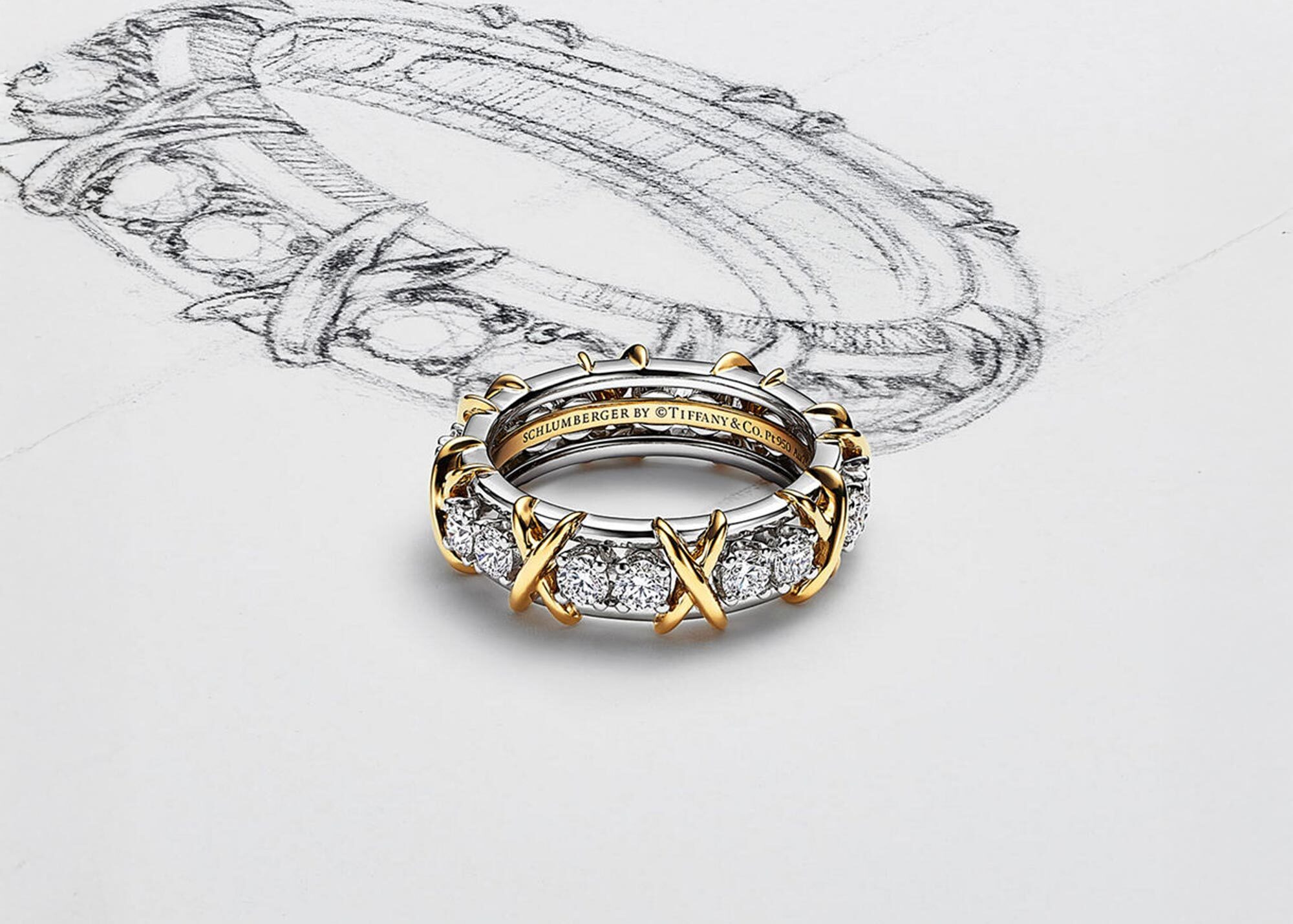

A textile motif becomes a Tiffany signature
Jean Schlumberger, a French-born designer working in a tradition shaped by his family's background in textile manufacturing, joined Tiffany & Co. in 1956 at the invitation of the house, becoming one of the first designers permitted to sign jewelry under his own name alongside the Tiffany mark. He had previously designed costume jewelry in Paris and run his own atelier, but Tiffany gave him a permanent home and a level of creative independence unusual for a jewelry house of the period.
In 1959, Schlumberger created Sixteen Stone, a ring built around a motif drawn from his family's textile background: a cross-stitch pattern, rendered in gold, with round brilliant diamonds set at each intersection so that the stones appear strung together by threads of precious metal rather than mounted individually. Conceived originally as a wedding band, the design reinterpreted a domestic, handcraft image, embroidery, as a piece of fine jewelry, consistent with Schlumberger's wider practice of drawing on natural and everyday forms rather than on historical revival styles.
A house style built on named designers
Schlumberger's arrival, and the freedom Tiffany gave him to sign his own pieces, set a template the house extended to other designers in the following decades, including Elsa Peretti from 1974 and Paloma Picasso from 1980. Rather than presenting every collection as an anonymous house product, Tiffany began building part of its identity around a roster of named designers whose personal style customers could learn to recognize, distinct from most European maisons of the same period, which generally kept design authorship internal and uncredited.
The Sixteen Stone ring, and the cross-stitch motif behind it, has stayed in Tiffany's catalogue in various forms since 1959, produced by craftspeople the house says require more than two decades of training to assemble the design's intersecting gold threads by hand. That production difficulty has kept the piece positioned at the upper end of Tiffany's collections rather than as an entry-level design, reinforcing Schlumberger's status inside the house as a couture-level jeweler rather than a commercial designer working to volume.
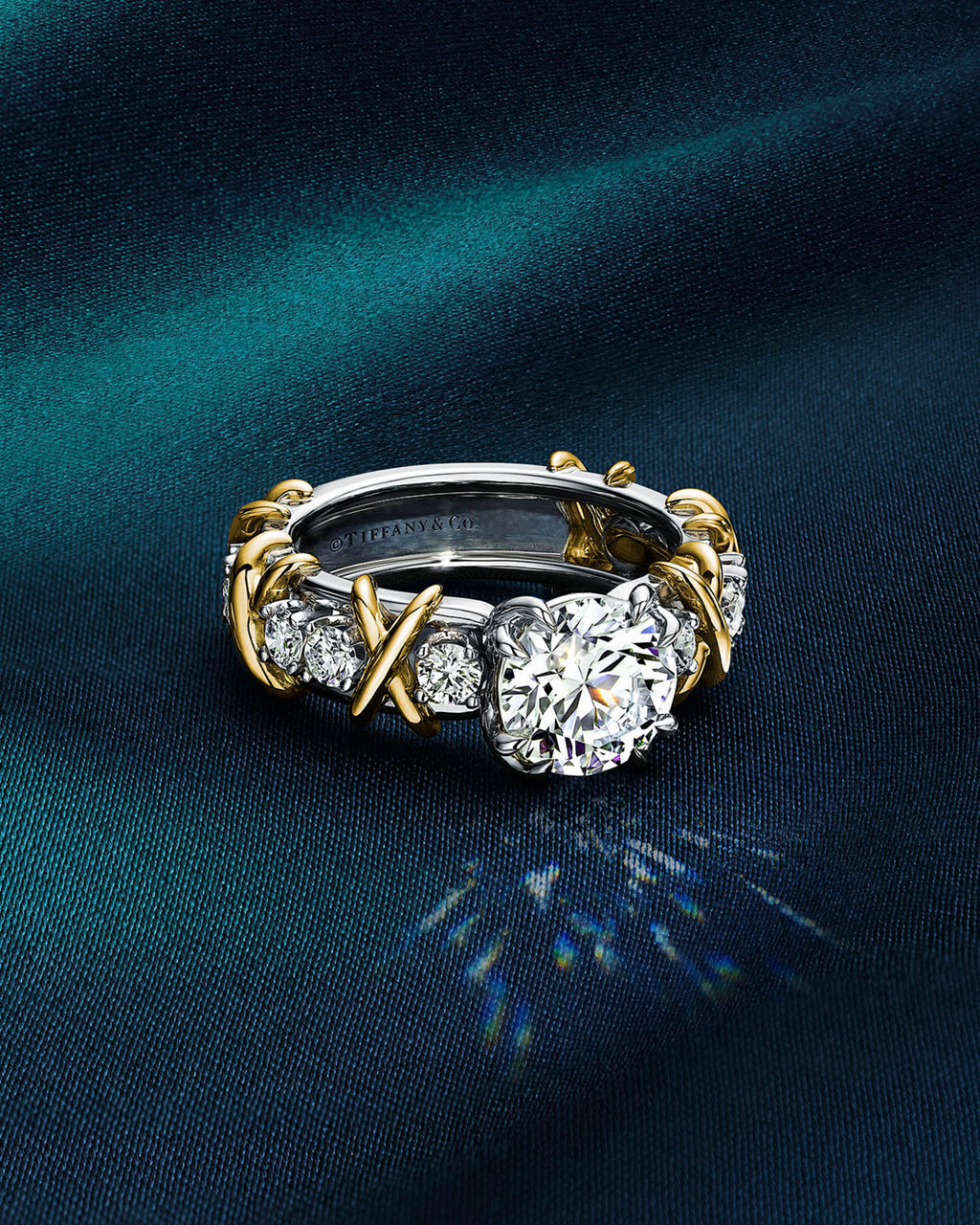
An archive Tiffany keeps returning to
Tiffany has periodically revisited the Sixteen Stone design since Schlumberger's death in 1987, reissuing it in new metal and stone combinations while keeping the original cross-stitch geometry intact. The approach mirrors how the house treats several of its named-designer archives: rather than retiring a design once its creator is no longer active, Tiffany reworks the original idea for new collections and campaigns, crediting Schlumberger by name each time rather than absorbing the design into an anonymous house catalogue.
That practice gives Tiffany a body of designer-attributed archive work comparable to what fashion houses do with a founding couturier's sketches, and it means a decision made in 1956, to let one designer sign work under his own name inside the Tiffany mark, continues to shape how the house markets pieces created under his name nearly seven decades later.
The original 1959 Sixteen Stone pieces are rare enough that they now surface primarily at auction and through vintage specialist dealers rather than through Tiffany's own retail counters, and specialist jewelers price them at a premium over comparable Schlumberger-signed work precisely because they date to the design's first year of production. That collector's market, built entirely around a single named designer's tenure at one house, is itself a measure of how durable the identity Schlumberger built at Tiffany between 1956 and his death in 1987 has proven to be.
Sixteen Stone sits inside a wider body of Schlumberger work at Tiffany that also includes the Bird on a Rock brooch and a series of sea-life and botanical pieces built from enamel, gold and gemstones arranged to look grown rather than manufactured. Compared with those more sculptural, singular-feeling pieces, Sixteen Stone was unusual in Schlumberger's output for being conceived as a wearable, repeatable design rather than as a one-of-a-kind art object, which likely explains why it has proven easier for Tiffany to keep in continuous or semi-continuous production across six decades than several of his more elaborate works.
The ring's status inside Tiffany's internal hierarchy of designer archives has also grown over time. Where the house's marketing in the twentieth century tended to present Schlumberger, Peretti and Picasso as a loose group of resident artists, more recent campaigns increasingly name Schlumberger specifically and frame his work as a distinct strand within Tiffany, complete with its own dedicated pages on the house's press site and its own retrospective museum loans, a level of individual designer branding that few jewelry houses extend to designers who have been dead for nearly four decades.
Written with AI assistance, edited by a human. Find out more about our Use of AI.