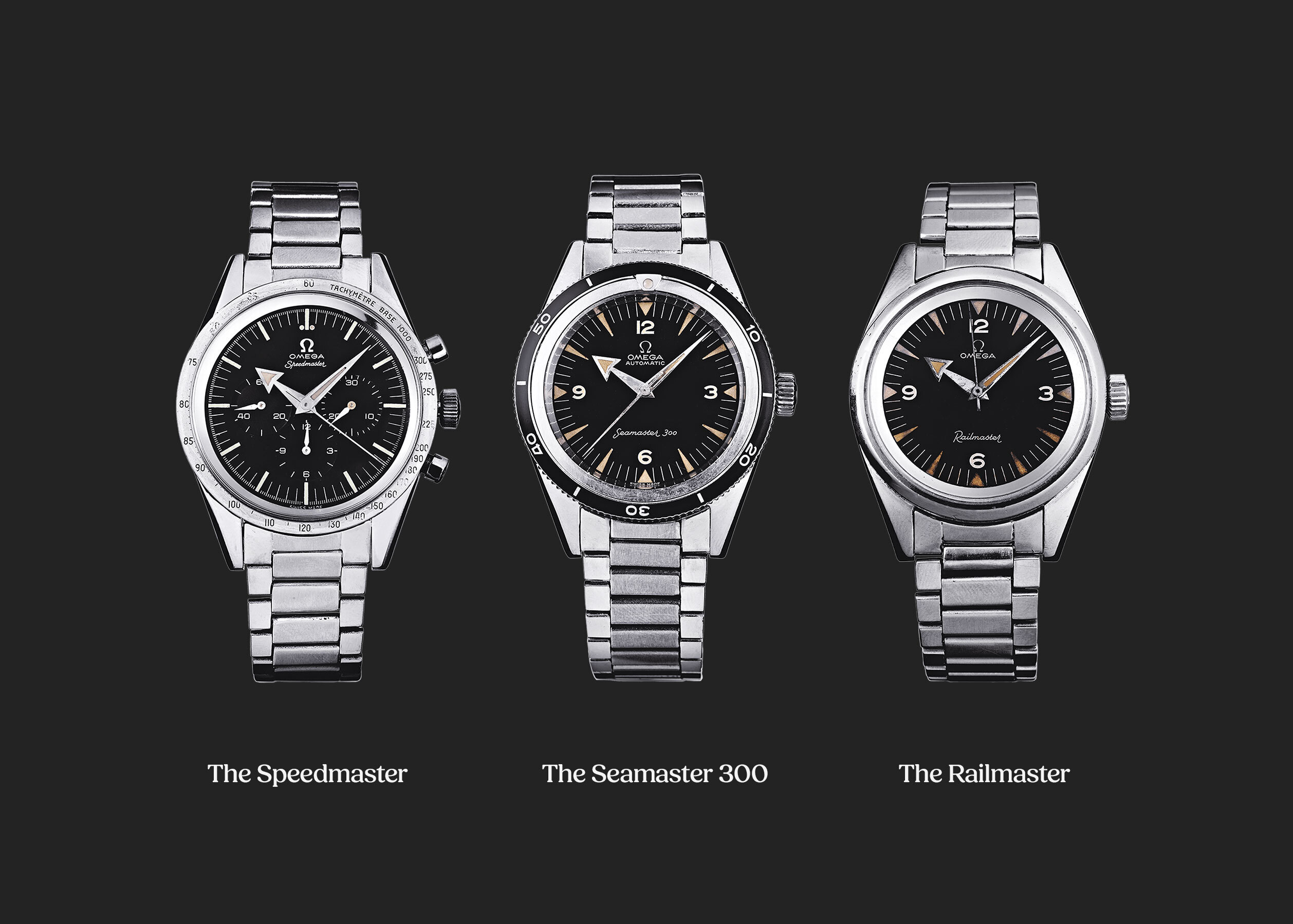

Three watches for three professions
In 1957 Omega introduced its Professional line, three watches launched together: the Speedmaster, the Seamaster 300 and the Railmaster.1 Each was built for a particular kind of user. The Speedmaster was a chronograph for pilots and racing drivers, the Seamaster 300 was made for professional divers, and the Railmaster for scientists and people working in magnetic environments.2 Omega describes the Railmaster as its first commercially available watch able to resist magnetism of more than 1,000 gauss.1
The launch is usually told as the birth of three models that went on to separate careers. It can also be read as a single decision about how Omega would name what it made.
One suffix, three territories
Each of the three names joins a field to one word: speed, sea and rail, each followed by Master. The pattern was not entirely new. The Seamaster had come first, launched in 1948 to mark the company's centenary.3 What 1957 added was repetition. With three names built the same way and presented at the same moment, a single model name became a naming system.
The system does two jobs at once. The prefix tells the buyer where the watch belongs, on the track, under water or beside a generator. The suffix tells the buyer how the watch should be regarded there: as a tool for someone who has mastered the field, not as an accessory. Together they present the range as a set of specialist instruments, which fits a brand whose authority rests on measured performance. The structure is also open. Any new field can be named the same way without explaining the logic again.
Names that outgrew their professions
The names proved more durable than the jobs they were written for. The Speedmaster began as a sport and racing chronograph whose bezel carried a tachymeter scale for measuring speed.4 Within a decade it was in space, and Omega's own account of 1957 notes that it went on to become known as the Moonwatch.1 The word speed was broad enough to travel from motor racing to orbital flight without the name ever sounding wrong.
That flexibility is the practical value of naming by field instead of by function. A name such as Speedmaster describes an ambition, not a feature, so it can absorb whatever the watch later becomes known for. The Seamaster name has shown the same capacity, covering a wide family of water-resistant watches far beyond the professional dive model of 1957.
The Railmaster shows the other side. Its field was the narrowest of the three, and Omega's catalogue today files it among the Seamaster's heritage models, not as a line of its own.5 Within one architecture two of the names grew into collections and the third became a chapter inside one of them. The system held; the hierarchy inside it adjusted to what each name had come to mean.
Source: OMEGA Youtube
The trilogy as a heritage asset
In 2017, 60 years on, Omega treated the three launches as one event again. At Baselworld it presented the 1957 Trilogy, re-editions of all three watches limited to 3,557 pieces each, with a further 557 boxed sets containing the three together. The company used digital scanning of original pieces to reproduce the dimensions.2
Selling the three as a set sold the architecture itself as heritage. The boxed trilogy does not celebrate any single watch. It celebrates the year in which Omega decided that its professional watches belonged to one family, and it asks the collector to buy into that family in full. A single re-edition would have been a tribute to one model. Three released together, in matching numbers, turn a naming decision taken in 1957 into something that can be held, displayed and sold on its own terms, which shows that Omega itself treats the shared structure as part of its heritage.
A suffix that became a standard
The word has kept working. In 2015 Omega introduced the Master Chronometer certification, under which a movement passes, in addition to COSC certification, a series of eight tests set by METAS, the Swiss federal institute of metrology.6 The suffix that described the users of three watches in 1957 now names the standard Omega sets for its movements.
That is an unusual journey for a naming device. It began as a way of telling divers, drivers and scientists that a watch was meant for them. It ended up as a statement of how Omega wants every watch it makes to be judged. The 1957 launch is remembered for its three models, but its more lasting contribution to the brand may be the one word they shared.
Written with AI assistance, edited by a human. Find out more about our Use of AI.
1. OMEGA, "1957: Three legends are born", OMEGA Chronicle, read 29 September 2026, for the introduction of the Professional line in 1957 with the Speedmaster, Seamaster 300 and Railmaster, for the Railmaster as OMEGA's first commercially available watch able to resist magnetism of more than 1,000 gauss, and for the Speedmaster becoming known as "the Moonwatch". https://www.omegawatches.com/en-us/chronicle/1957-three-legends-are-born
2. Brice Goulard, "Omega 1957 Trilogy Reissue (Speedmaster, Seamaster 300, Railmaster 60th anniversary)", Monochrome Watches, 22 March 2017, for the intended users of the three 1957 models, for the Baselworld 2017 re-editions limited to 3,557 pieces each and 557 boxed sets, and for the use of digital scanning of the originals. https://monochrome-watches.com/omega-1957-trilogy-speedmaster-seamaster-300-railmaster-reissue-baselworld-2017-price/
3. OMEGA, "1948: Creation of the Seamaster", OMEGA Chronicle, read 29 September 2026, for the Seamaster launched in 1948 to mark the brand's centenary. https://www.omegawatches.com/chronicle/1948-creation-of-the-seamaster
4. Wikipedia, "Omega Speedmaster", read 29 September 2026, for the reference CK 2915 introduced in 1957 as a sport and racing chronograph with a tachymeter scale on the bezel. https://en.wikipedia.org/wiki/Omega_Speedmaster
5. OMEGA, "Seamaster Railmaster Watches", catalogue page, read 29 September 2026, for the Railmaster listed under Seamaster heritage models. https://www.omegawatches.com/en-us/watches/seamaster/heritage-models/railmaster/product
6. Wikipedia, "Omega SA", read 29 September 2026, for the Master Chronometer certification introduced in 2015, combining COSC certification with a series of eight tests set by METAS. https://en.wikipedia.org/wiki/Omega_SA