
Star Wars changes hands
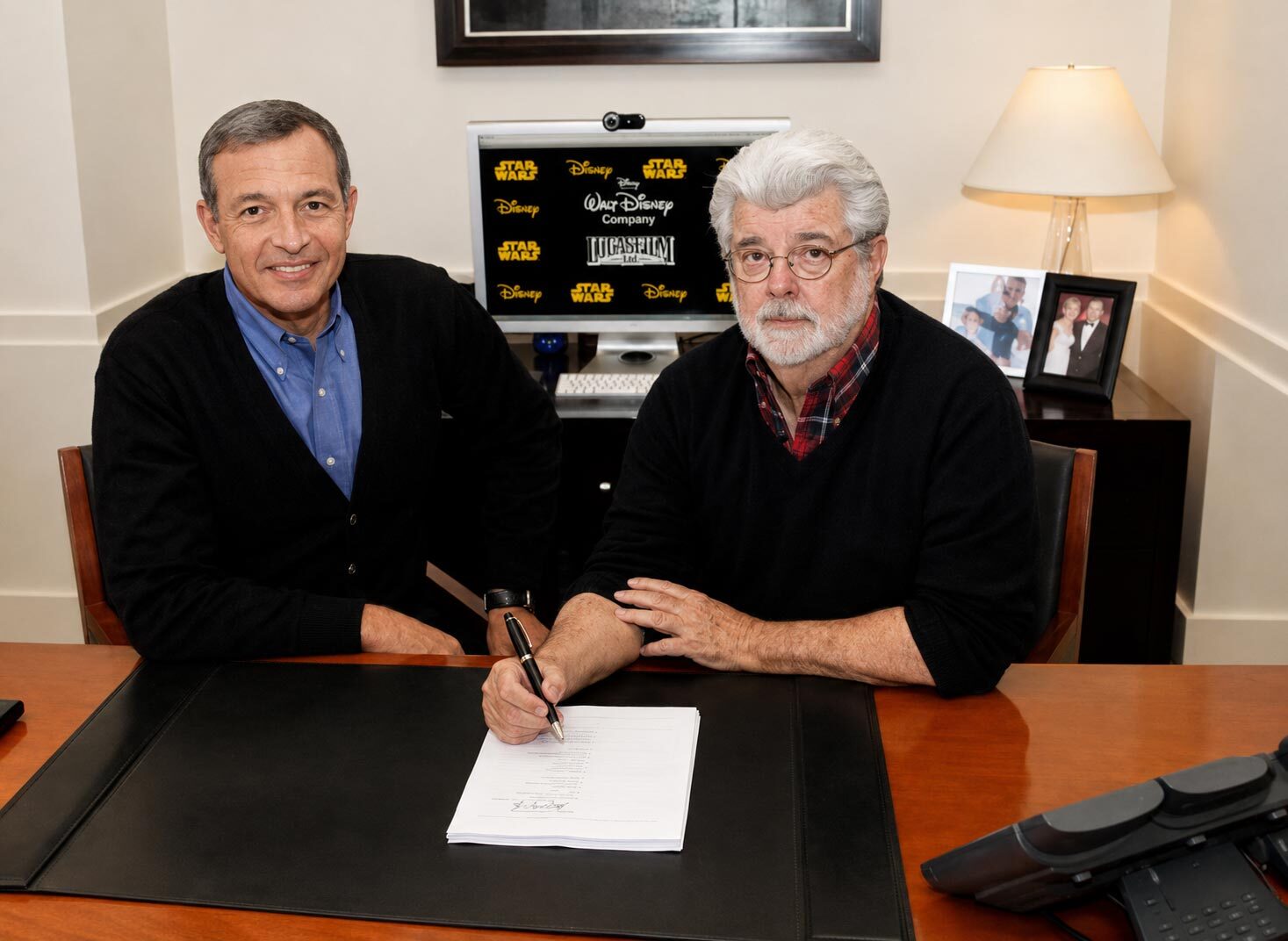
On 30 October 2012, The Walt Disney Company announced that it would acquire Lucasfilm, the studio founded by George Lucas, in a cash-and-stock deal valued at around 4.05 billion US dollars. The acquisition brought Star Wars, one of the most valuable entertainment franchises in the world, under Disney's ownership, along with the Indiana Jones franchise and Lucasfilm's technical operations. It completed a trio of major acquisitions that reshaped Disney's portfolio in less than a decade.
The deal was notable not only for its scale but for what it represented for Lucas personally. He had built Lucasfilm as an independent company and had maintained tight control over the Star Wars saga for more than three decades. Selling to Disney meant handing that control to another custodian, and Lucas framed the decision in part as securing the future of the franchise beyond his own involvement. Disney, in turn, signalled its intent to continue the saga, and new Star Wars films followed within a few years.
Completing a portfolio strategy
The Lucasfilm acquisition is best understood as the third move in a clear strategy. With Pixar in 2006 and Marvel in 2009, Disney had already demonstrated a pattern of acquiring companies with powerful, well-defined brands and loyal audiences. Lucasfilm fit the same template. Star Wars carried enormous cultural weight and a devoted global following, and it reached audiences, including older fans and science-fiction enthusiasts, that complemented Disney's other holdings.
Together, the three acquisitions gave Disney a set of distinct franchise brands, Pixar, Marvel and Star Wars, each with its own identity and audience, sitting alongside the core Disney brand. This was brand architecture at scale: rather than stretching a single name across every kind of content, Disney assembled a portfolio of strong brands and let each speak to its own audience in its own voice.
Keeping Lucasfilm distinct
Consistent with its earlier deals, Disney chose to preserve Lucasfilm and Star Wars as distinct brands rather than absorb them into the Disney identity. Star Wars films continued to be presented under the Lucasfilm banner, with their own tone, aesthetic and conventions, and the Disney connection remained largely in the background. The value of Star Wars lay in what it already meant to audiences, and Disney was careful not to overwrite that meaning with its own name.
This restraint was central to the logic of all three acquisitions. Disney understood that the brands it bought were valuable precisely because they were not Disney, and that their power depended on maintaining their own identities. The integration happened in ownership, financing, distribution and marketing, not in the branding that audiences encountered.
Source: The Walt Disney Company Youtube
Extending the franchise across the company
As with Pixar and Marvel, the acquisition fed Disney's wider integrated model. Star Wars generated new films, television series, merchandise and, prominently, large themed areas within Disney's parks, immersive lands that let visitors step into the franchise's world. The property that Disney acquired in 2012 became content and experience across many parts of the company, extending far beyond cinema.
The technical assets that came with Lucasfilm were significant in their own right. The company had long been associated with pioneering work in visual effects and sound, capabilities that carried real value across Disney's productions. The acquisition therefore added not only a franchise but a set of production strengths that reinforced the company's filmmaking.
Seen alongside the Pixar and Marvel deals, the 2012 acquisition of Lucasfilm completed a decade of transformation in which Disney rebuilt itself as a company of powerful, independently branded franchises. Each acquisition followed the same disciplined approach: identify a brand with deep audience loyalty, acquire it, protect its identity, and integrate the business behind it. The result was a portfolio few competitors could match, and a model of brand architecture that continues to define how Disney grows.
Source: Star Wars Youtube
Written with AI assistance, edited by a human. Find out more about our Use of AI.