Five words for a market entry
On 21 March 1975 BMW of North America took out its first victory advertisement. The brand had recorded a class win at the 12 Hours of Sebring earlier in the week, and the advertisement carried a five word tagline that had been written the previous year by copywriter Martin Puris of the New York agency Ammirati Puris AvRutick. The line read The Ultimate Driving Machine. It would remain the brand's North American signature for the next five decades and would eventually be adopted as the global tagline of the BMW Group.
How the brief reached a six person agency
The brief had landed at Ammirati Puris AvRutick by an unusual route. The agency had been founded three years earlier by Ralph Ammirati, Martin Puris and Lou AvRutick, after the three partners had left the New York office of Young and Rubicam. The agency was small, with a single floor and a single client of consequence, the American operation of Fiat. Bob Lutz, then a board member of BMW responsible for sales, had noticed the Fiat work and had asked the partners to compete for the BMW account as the company prepared to take over its own US distribution from the previous importer.
The pitch was settled in March 1975. The agency was retained at a moment that was strategically delicate for BMW. The company had just incorporated BMW of North America Inc. as its own subsidiary and was building its first dealer network outside the existing Hoffman Motors arrangement. US sales for the financial year ending in 1974 had stood at 15,007 cars, a figure that placed the brand in the third tier of European imports behind Mercedes Benz and Volvo. The brief was therefore not to defend a position but to define one, in a market that did not yet have a clear category slot for BMW.
Why the line worked as a category move
The line that Martin Puris had written in 1974 performed a specific piece of category work. The American premium automotive market in the mid 1970s was organised around two competing arguments. Mercedes Benz argued from engineering authority and from formal luxury, with advertising that emphasised heritage and craftsmanship. Cadillac and Lincoln argued from ride comfort, interior volume and chrome surface. Both arguments treated the car primarily as a passive object that the owner occupied or displayed. The Ultimate Driving Machine moved the category onto a different axis. The word Driving placed the owner in the driver's seat rather than in the back of the car, and the word Machine reasserted engineering primacy without conceding it to Stuttgart. The word Ultimate gave the line a competitive register without naming a competitor.
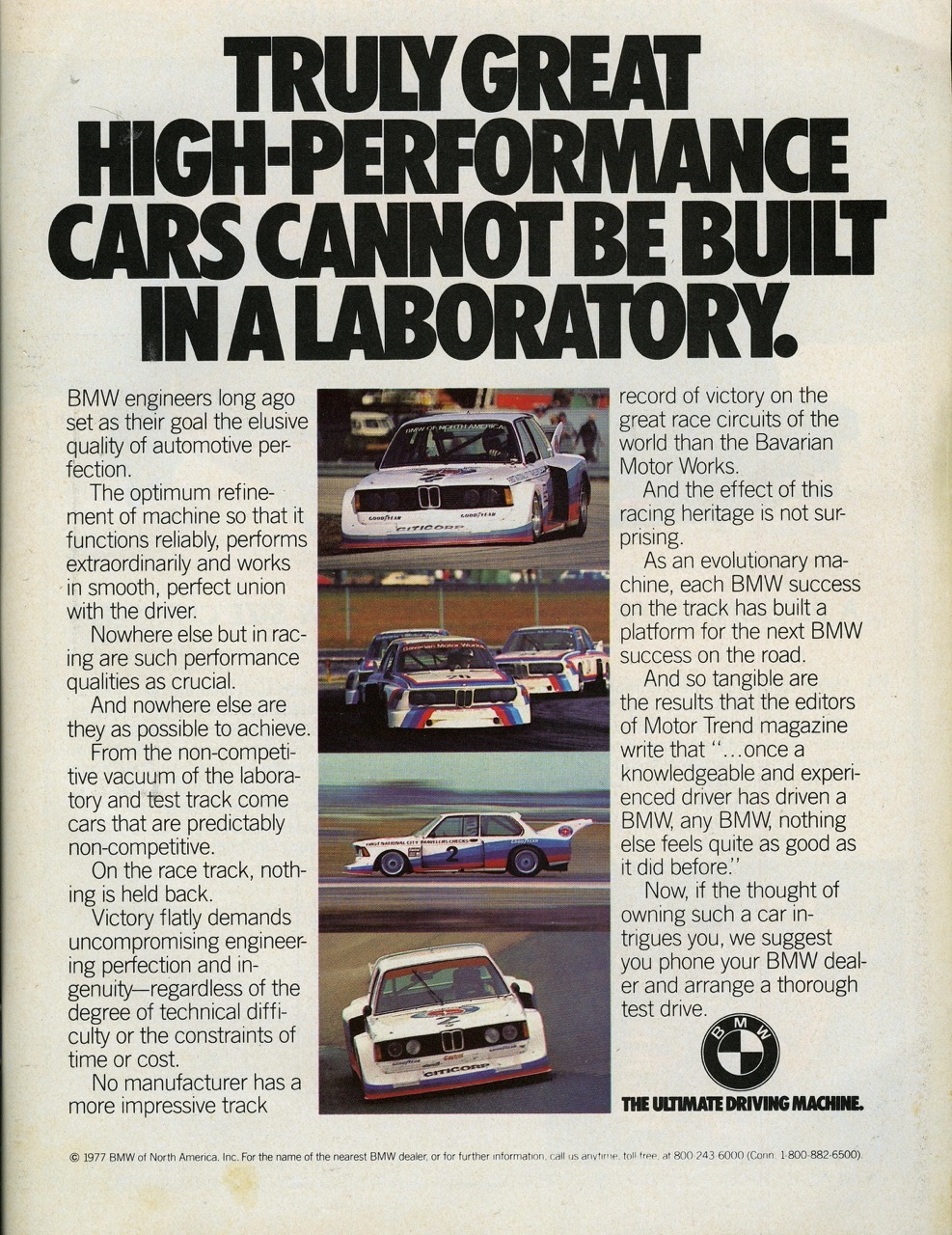
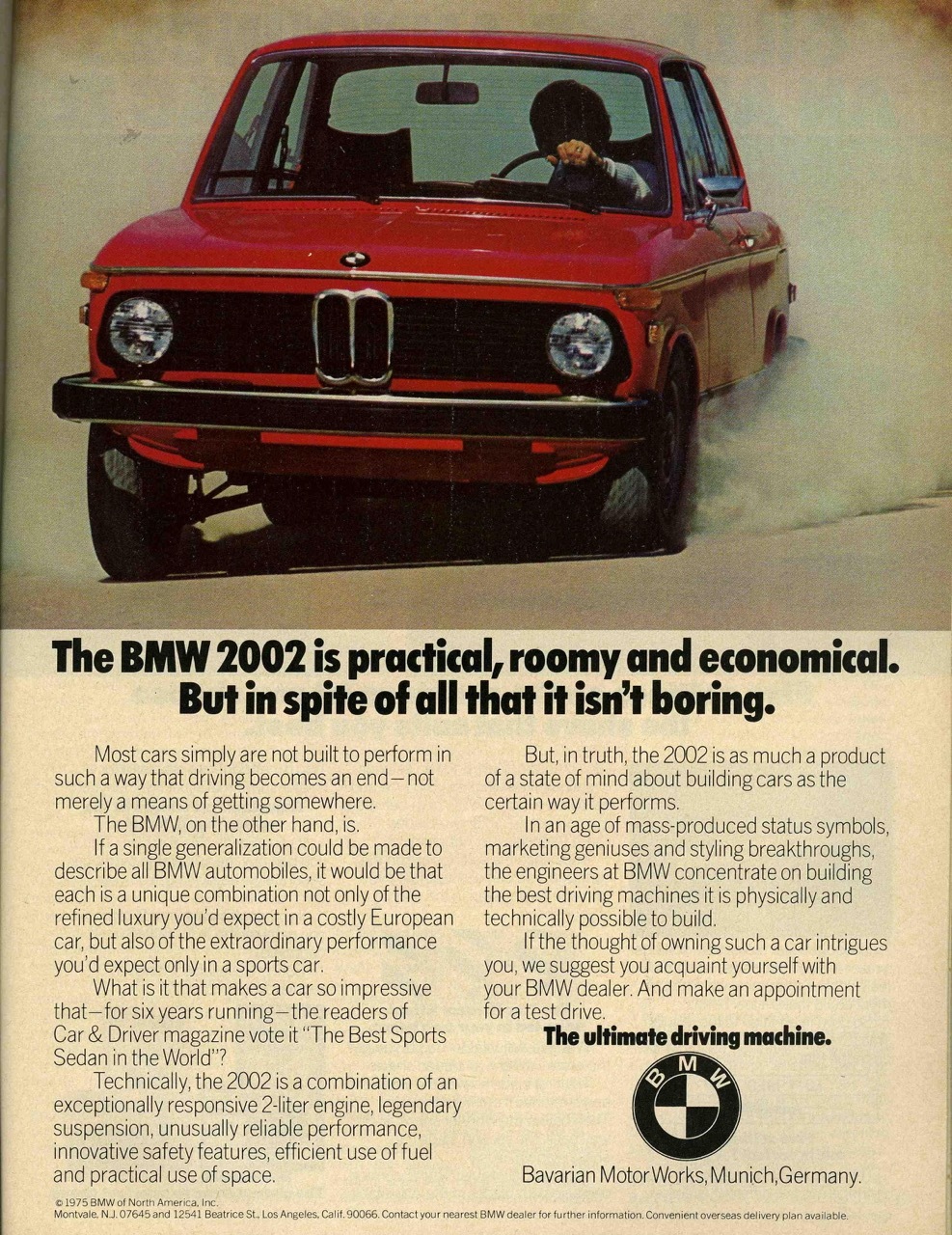
The line was therefore both a positioning statement and an editorial instruction. It instructed every advertisement that followed to argue the brand through driving behaviour rather than through ownership status. Print work of the late 1970s and early 1980s under Ammirati Puris AvRutick treated the car as a working object. Photography sat in motion, copy described handling characteristics and engine response, and the line carried the category claim. The visual grammar of BMW advertising for the next twenty years was set in that period.
The numbers that followed the line
The commercial trajectory of BMW of North America through the second half of the 1970s confirmed the move. Unit sales rose from 15,007 cars in 1974 to 19,419 in 1975 and to 26,040 in 1976, a 73 per cent increase over two years against the established American import market. The growth was disproportionately concentrated in the 3 Series segment, the entry point of the BMW range, where Ammirati Puris AvRutick concentrated the brand's print investment. The line was therefore not only an editorial frame but a sales mechanism. It gave the dealer network a single, repeatable argument to use against Mercedes and against the American premium incumbents, and it gave the brand an entry argument for buyers who had not previously considered a European car.
The agency relationship lasted into the late 1990s. Ammirati Puris AvRutick was eventually folded into Lintas and later acquired by Interpublic Group, and the BMW account moved through a sequence of subsequent agencies, but the line remained. It survived the introduction of the M division, the launch of the BMW i electric sub brand, the global re alignment of marketing under the BMW Group in Munich and the iterative redesign of the BMW roundel. It was extended into German language markets as Freude am Fahren, a translation that retained the strategic intent while taking on a softer register, and into a single global English version that BMW adopted across all markets in the early 2010s.
The shape of the legacy
The Ultimate Driving Machine is the longest serving tagline in the modern global automotive market. The American Association of Advertising Agencies records the line as one of the most durable positioning statements in the trade. The 4As timeline entry on the agency cites the line as the foundational work that established Ammirati Puris AvRutick as a serious challenger to the New York network agencies, and it credits Martin Puris with the authorship that was for several years attributed only to the agency. The St John's University Ammirati Puris archive holds the working manuscripts and the original print proofs of the 1975 campaign.
Beyond the agency record, the line continues to shape how the BMW brand argues itself. The marque's current global communication leans on the driver as protagonist, on the engineering as a means rather than an end, and on a competitive register that does not name the competitor. Each of those moves is implicit in the five words that Martin Puris wrote in 1974 and that BMW of North America first published in the spring of 1975.
Written with AI assistance, edited by a human. Find out more about our Use of AI.