
The mark before it was a mark
The three stripes are among the most valuable trademarks in apparel, yet adidas did not create them. In 1952 the company acquired the rights to the three-stripe device from the Finnish sports brand Karhu, in a transaction whose modest terms have become part of company legend.1 By securing the stripes, Adolf Dassler turned a shared design detail into an exclusive asset, and set the course for how adidas would be recognised for the rest of its history.
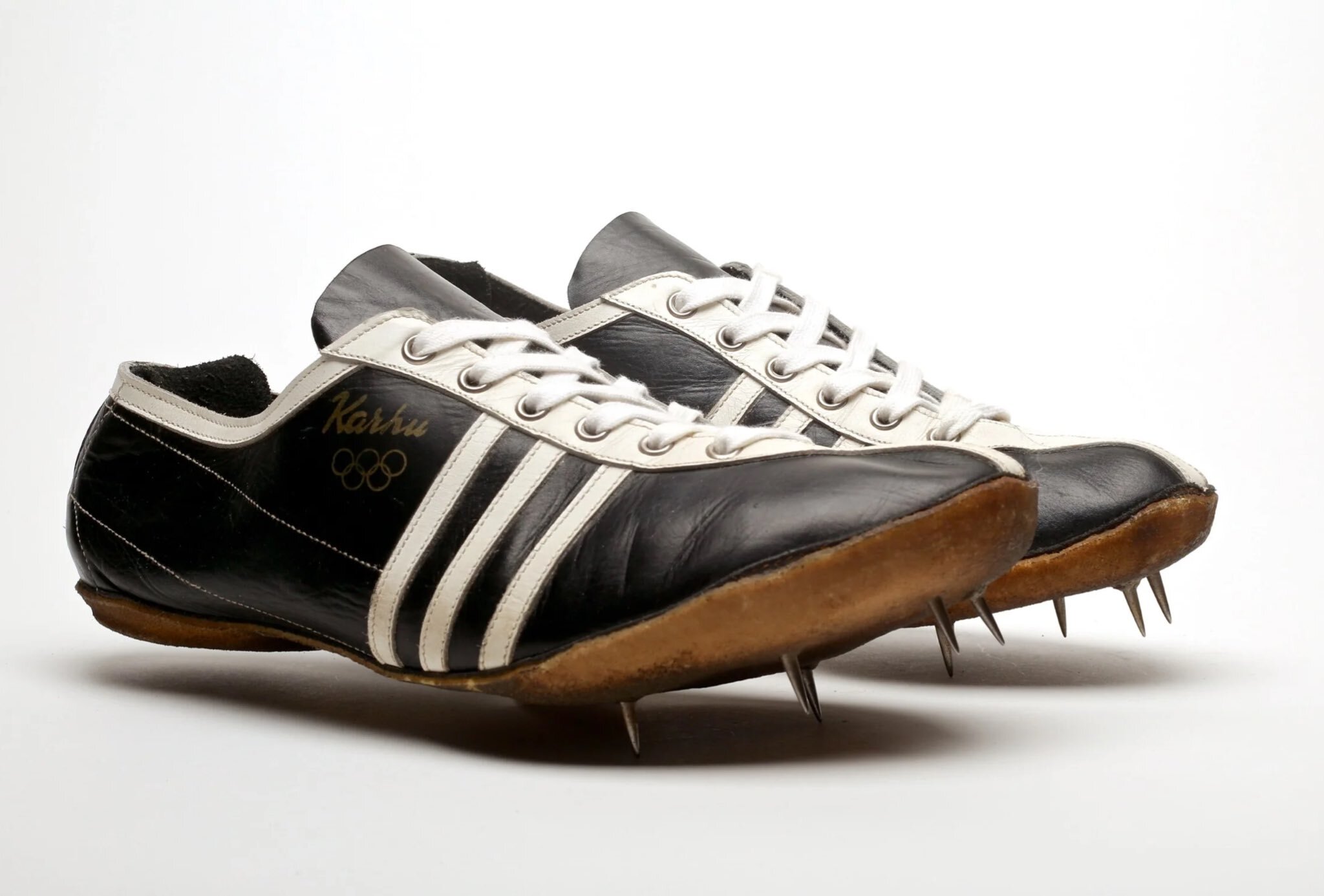
Karhu, founded in Helsinki in 1916, had used stripes on its athletic footwear and had built a reputation in running, including at the 1952 Summer Olympics held in Helsinki.2, 3 Stripes on the side of a shoe were not unusual at the time; they reinforced the upper and helped hold the foot in place.3 What Karhu held was the right to that particular configuration in its markets, and it was that right adidas set out to buy.
A deal remembered for its price
The most repeated account holds that adidas obtained the three stripes for the equivalent of a small sum and two bottles of whisky.4 The figures are often cited as around 1,600 euros in later currency plus the whisky, though the precise terms are difficult to verify and have been retold many times.1, 3 Whatever the exact price, the story endures because the contrast is so striking: a trademark that would come to underpin a global brand changed hands for a token amount.
The disproportion is the point. In 1952 the stripes were a functional feature with modest commercial value. Their worth was created afterward, through decades of consistent use, athletic success and advertising that made the three parallel bars instantly legible as adidas. The deal is remembered not because adidas paid so little, but because it recognised, early, that owning a distinctive mark outright was worth securing.
From function to identity
Once the stripes were its own, adidas applied them with discipline. They ran along the side of every shoe, where they served the original supporting purpose while doing the work of a logo. This dual role, structural and symbolic at once, gave the mark an authenticity that a purely graphic emblem would have lacked. The stripes were part of the product, not merely printed on it.
That consistency compounded over time. As adidas footwear appeared at Olympic Games and World Cups through the 1950s and 1960s, the three stripes became shorthand for the brand across languages and markets.5 The mark needed no wordmark to be understood, and it adapted to every category the company entered. When adidas expanded into apparel in the early 1970s, the stripes provided the foundation for the Trefoil, and later for the three-bar Performance logo, both of which were built directly from them.6, 1
Protecting a defining asset
The 1952 purchase also set the tone for how seriously adidas would defend its identity. Because the stripes were a registered trademark rather than a common decoration, the company could act against imitations, and it has litigated repeatedly over the years to protect the device against similar striped designs.1 That protection rests on the foundation laid in 1952, when the mark was consolidated in the company's hands.
The consistency of that protection has kept the stripes distinctive over time. By treating the three bars as a core trademark rather than a decorative flourish, adidas ensured that the mark remained closely associated with the brand even as countless striped designs appeared across the market. The discipline required to defend a simple geometric device is considerable, and the company's willingness to sustain it is part of why the stripes still read unmistakably as adidas.
The episode is a clear example of how brand value is built rather than bought. adidas did not acquire a famous symbol; it acquired an ordinary one and made it famous. The stripes carried no meaning at the point of sale in 1952, and enormous meaning decades later, and the difference was the result of sustained, consistent use. Few acquisitions in branding illustrate the principle so plainly.
Seen from the present, the deal reads as one of the more consequential decisions in the company's early history. For a token sum, adidas secured the single element from which its entire visual identity would grow. The three stripes remain the constant across every adidas logo and product, and the arrangement that made them exclusive dates to a quiet 1952 agreement with a Finnish rival that had used them first.1
Written with AI assistance, edited by a human. Find out more about our Use of AI.
1. Wikipedia, "Three stripes", accessed 8 October 2026, for adidas having acquired its three stripe branding from Karhu Sports in 1952, "following the 1952 Summer Olympics in Finland", "for two bottles of whiskey and the equivalent of €1,600"; for the pair of Karhu footwear from the 1940s with the three stripes held by the Finnish Sport Museum, which shows Karhu using the stripes before the purchase; for the Trefoil designed in 1971 and launched in 1972 and the three stripe Performance logo introduced in 1991; and for the shoe designs with the stripes registered in 1949 and the long run of disputes in which adidas has acted against striped designs, among them O'Neill, Marca Mode, Fitness World and Payless ShoeSource. The page also records, "according to another source", that the mark was created by Adolf Dassler and first used on footwear in 1949. https://en.wikipedia.org/wiki/Three_stripes
2. Wikipedia, "Karhu", accessed 8 October 2026, for Karhu having been established in Helsinki in 1916 as Oy Urheilutarpeita and renamed Karhu in 1920, for a company "focused on running", and for Karhu having sold the "three stripes" trademark to adidas in 1952 for "the equivalent of 1,600 euros and two bottles of whiskey". The page does not mention the 1952 Helsinki Games. The address listed in the sources, en.wikipedia.org/wiki/Karhu_(brand), could not be fetched on 8 October 2026; the same article was reached at the address below. https://en.wikipedia.org/wiki/Karhu_(sports_brand)
3. VinePair, Hannah Holladay, "Adidas Bought Its Iconic Logo for Two Bottles of Whiskey and 1,600 Euros", 21 September 2021, added during the retrofit, off whitelist and used for corroboration only, for Karhu as "the footwear of choice for Finnish Olympic athletes at the time", whose wearers "won a total of 15 gold medals" at the 1952 Helsinki Summer Olympics; for stripes used on running shoes "as stabilizing strips", with two, three and four stripes tried to find which gave the best support for track spikes; and for the uncertain terms of the deal: "Adidas has never officially confirmed the story of how it bought its logo", and a former Karhu brand manager is reported as saying "there is no proof that whiskey was included in the deal". The page does not say how common side stripes were at the time. https://vinepair.com/articles/how-adidas-bought-its-iconic-logo/
4. Wikipedia, "Adidas", accessed 8 October 2026, for "The three stripes are Adidas's identity mark", and for adidas having acquired its signature 3-stripe logo from the Finnish athletic footwear brand Karhu Sports after the 1952 Summer Olympics "for two bottles of whiskey and the equivalent of €1,600". https://en.wikipedia.org/wiki/Adidas
5. adidas Group, "History", undated, accessed 8 October 2026, resolved from the adidas newsroom homepage listed in the sources, which carries no page on the stripes or the Karhu purchase, for Adi Dassler having registered in 1949 "a shoe that features the soon-to-become-famous adidas 3-Stripes", for the 1954 World Cup final in Bern, for the 3-Stripes that "keep expanding to more and more sports throughout the years", and for the late 1960s athletes Bob Beamon, Rod Laver and Dick Fosbury in adidas shoes. The page names no Olympic Games of the 1950s and 1960s. https://www.adidas-group.com/en/about/history
6. Sneaker Freaker, Minh Vuong, "The Story Behind Iconic adidas Logos", 8 September 2022, off whitelist and used for corroboration only, for the Trefoil having been "introduced in 1972 to launch their foray into apparel and accessories", for the three-stripe motif that "still runs through the 'leaves' of the trefoil", and for the angled "Three-Bar" logo that today "denotes the adidas Performance line". https://www.sneakerfreaker.com/news/adidas-three-stripe-equipment-trefoil-logo-history