
A car sold on punishment
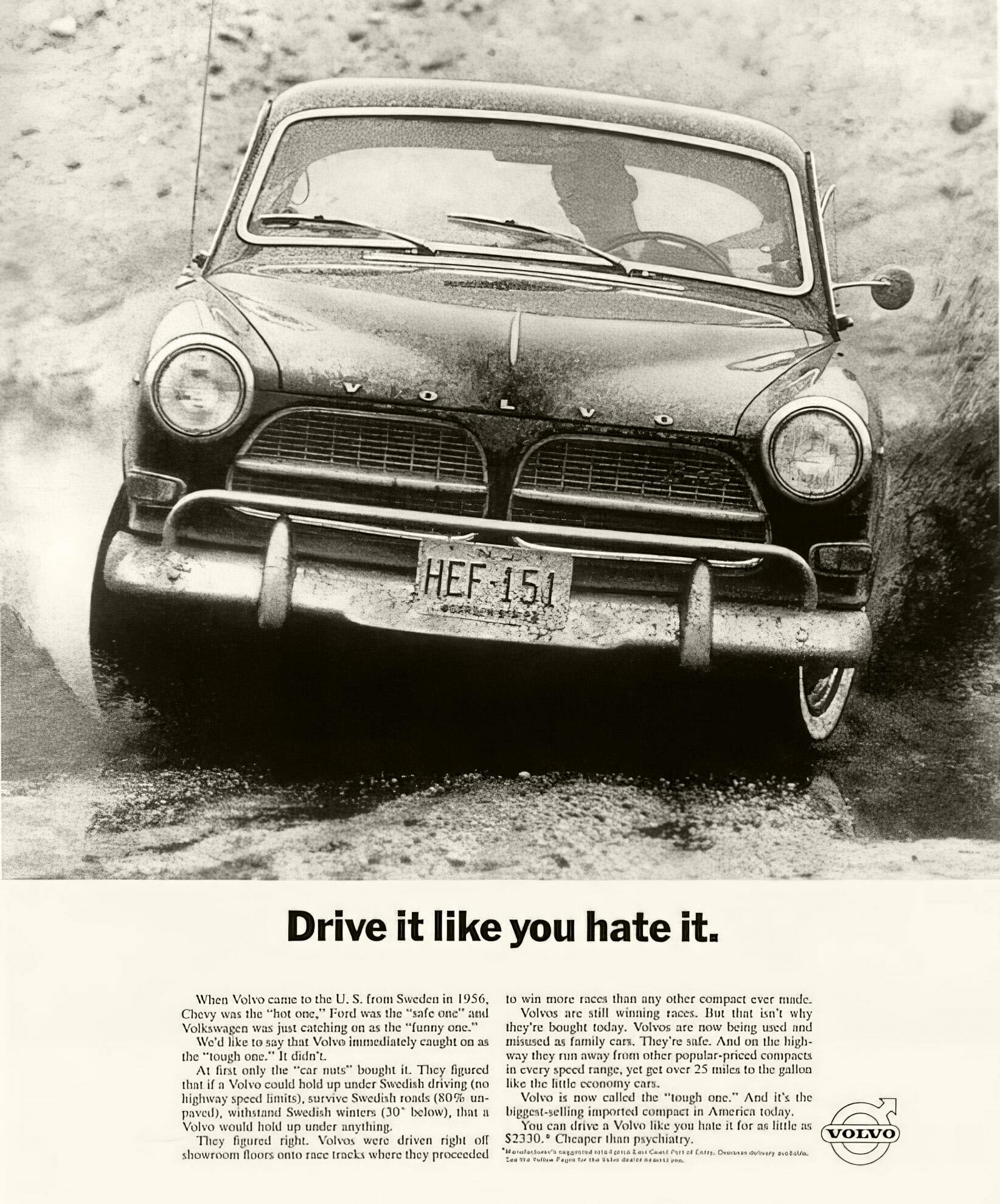
In 1962 Carl Ally and Amil Gargano founded an advertising agency in New York, and Volvo was its only account at the time. Carl Ally, Inc. was founded on 26 June 1962, with Carl Ally as CEO, Gargano as creative director and Jim Durfee as copy chief.2 The agency introduced the Swedish car to American buyers with the line "Drive it like you hate it."
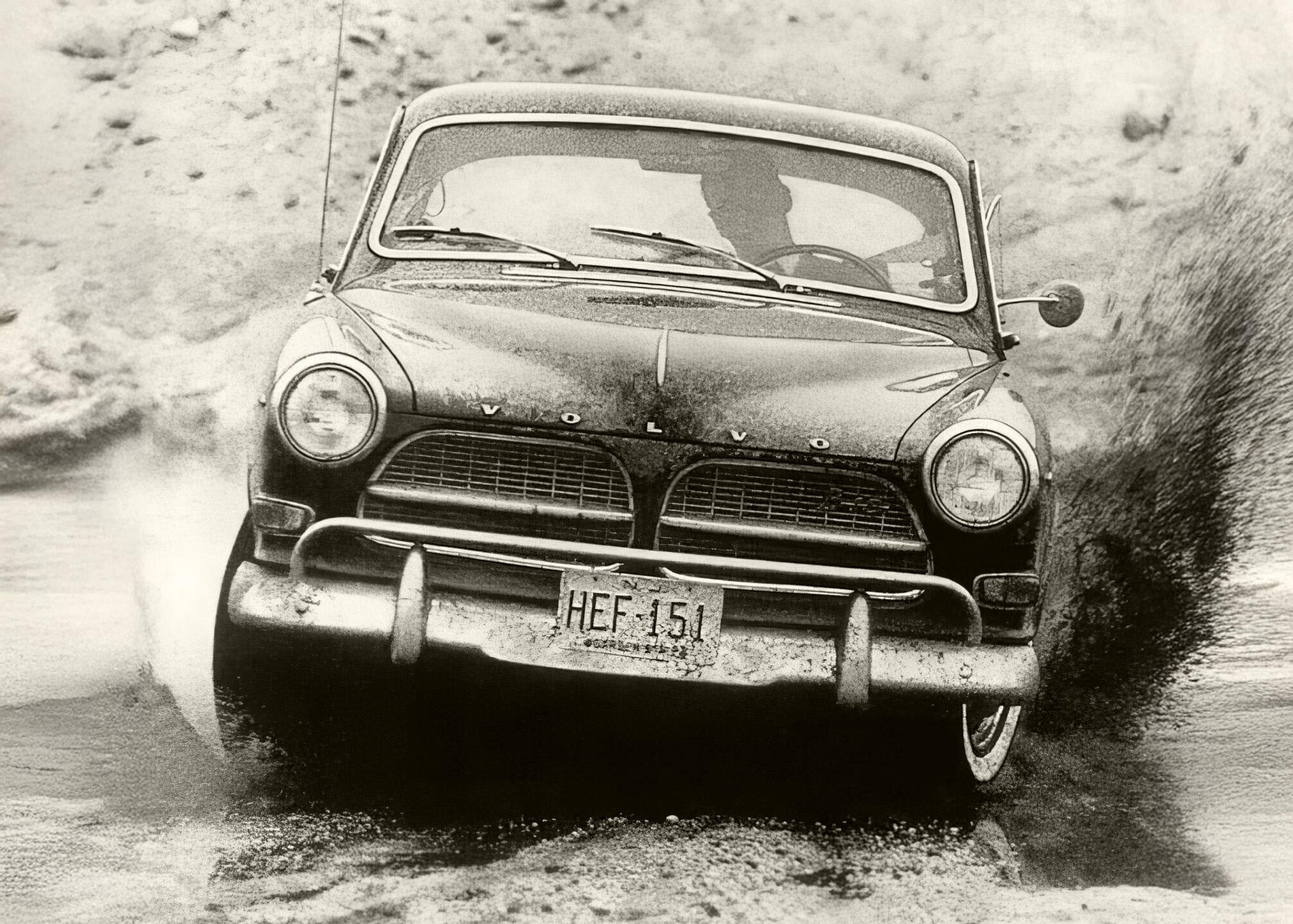
The television commercial of that year showed a Volvo Amazon driven hard across a dusty landscape: a hard stop, a fast reverse, a tail out slide down a dirt hill and a jump.3 Gargano was the original art director, and the car was driven by a rally driver.4 The copy claimed the car "runs away from other popular priced compacts in every speed range" and closed on a joke: "You can drive a Volvo like you hate it... Cheaper than psychiatry."3 The aim was to persuade Americans that the car could perform well, reliably and for a long time under stress. For an unknown import, the campaign set the terms on which the brand would be judged: not looks or prestige, but what the car could survive
Source: Project ReBrief Youtube
Longevity against the yearly model change
The durability argument soon turned against Detroit's habit of restyling every year. A 1966 print advertisement ran the headline "Your car is obsolete. Again." and pointed out: "We make a car that hasn't been given a 'big new look' in over 9 years."5 The copy claimed the car "won't become obsolete in '68" and that a Volvo "lasts an average of eleven years in Sweden", a country with no highway speed limits and many miles of unpaved roads.5 Another ad of the same year told owners: "Your neighbors won't notice its age any more than you will."6 In this framing, the unchanging shape of the car stopped being a weakness and became evidence of honesty.
A new agency keeps the argument
In 1967 five partners, four of them from the agency PKL, founded Scali, McCabe, Sloves; it started with no billings and quickly won Volvo.7 Its copy director Ed McCabe had earlier worked at Carl Ally.8 The agency kept the account for more than two decades.9 Lines credited to McCabe sharpened the old theme with wit: "Fat cars die young", "The roads of America are strewn with broken promises" and "Volvos last a long time. Isn't that bad for business?"8 The tone was dry and self aware, which gave the brand a voice as distinct as its body shape.
From strong bodies to safe ones
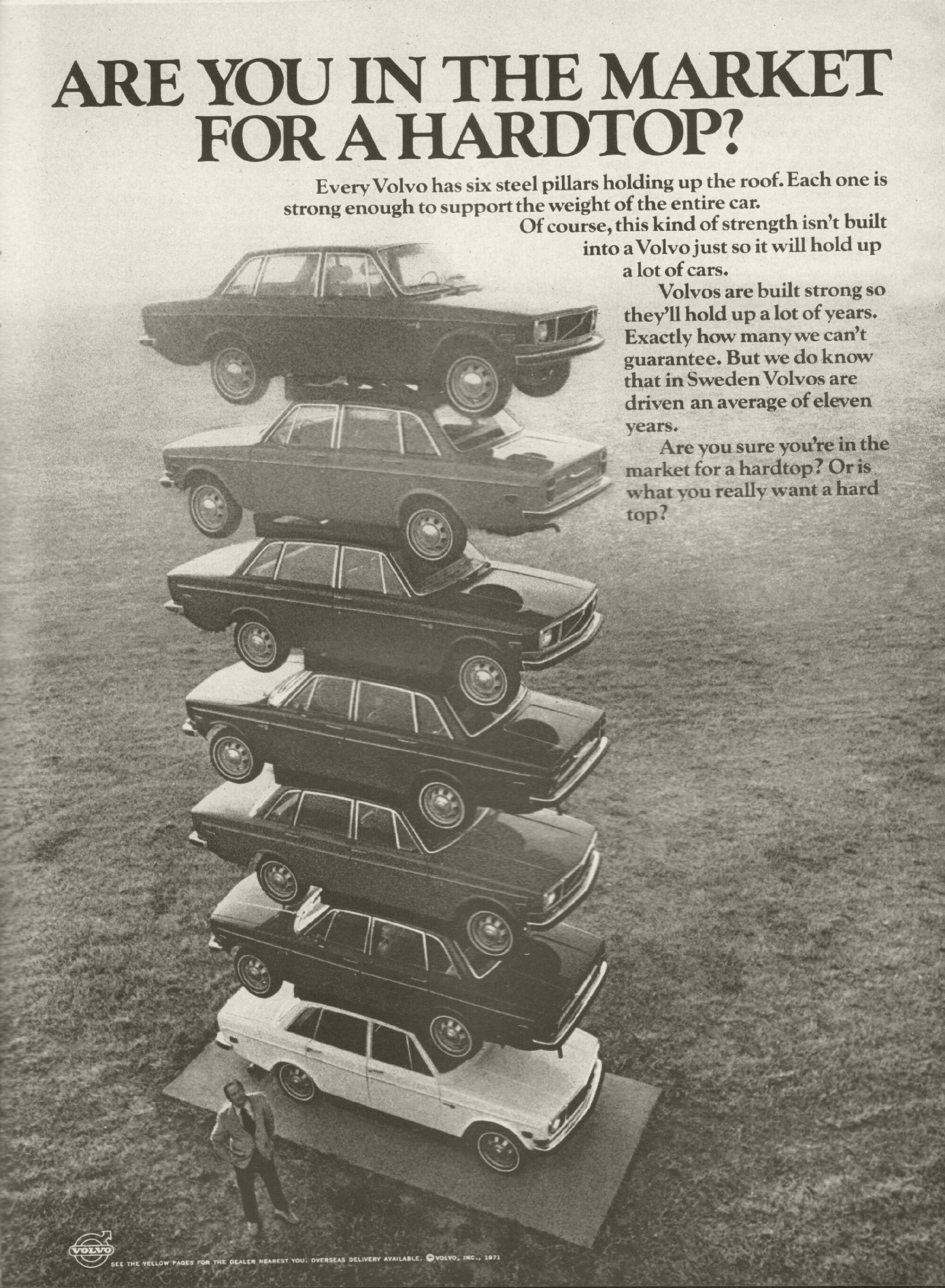
The proof of strength gradually became proof of protection. In one well known print ad, Volvos were stacked on top of one another; according to Curbside Classic, the image came about by accident, using water damaged cars that could not be sold, and it showed the construction and the "safety cage".10 McCabe's work also put a person into the demonstration: "We've strapped John Cameron Swayze to this stock, standard Volvo to demonstrate just how much this man can take."8 A Scali, McCabe, Sloves television spot titled "Act of Congress" listed safety features, such as padded dashboards and seat belts, that Volvo had fitted before carmakers were required to.11 The same physical toughness that once promised a long life now promised that the people inside would survive.
Statistics as a promise
In 1980 Volvo launched a North American ad campaign for the 200 Series built on longevity, partly because its fuel economy figures were weak.12 One print ad put Volvo's life expectancy in Sweden at 18.7 years and added a careful disclaimer: "Driving conditions in the United States may differ. So your Volvo may not last as long. Then again, it may last longer."12 In 1981 the claim changed to a life expectancy one third longer than the average for all other cars on the road.12 By the late 1980s the tagline was "A Car You Can Believe In", and Volvos had long been seen as "boxy but nice".13 The boxiness and the belief belonged together: the plain shape signalled a car built for use, not fashion.
When the demonstration broke
A brand built on demonstrations depends on their truth. In 1990 Scali, McCabe, Sloves produced an ad in which a monster truck crushed a row of cars and left the Volvo largely intact; an investigation by the Texas Attorney General's office found that the Volvo had been reinforced and the other cars weakened.9,13 The agency resigned the account.9 Its successor, Messner Vetere Berger Carey Schmetterer, adopted the tagline "Drive Safely".13 The rigged ad damaged trust, but it did not change the position. Three decades of advertising had already made durability and safety the reason Americans chose a Volvo.
In 2012 Google's Project Re:Brief returned to the 1962 starting point and asked Gargano to rework the original ad for the digital age.1,4 The new version followed Irv Gordon and his 1966 Volvo P1800 on its way to three million miles, a story of endurance that "Drive it like you hate it" had first set out to tell.4
Written with AI assistance, edited by a human. Find out more about our Use of AI.
2. Wikipedia, "Ally & Gargano", accessed 1 November 2026, for the founding date of Carl Ally, Inc. on 26 June 1962 and the roles of Carl Ally, CEO, Amil Gargano, creative director, and Jim Durfee, copy chief. https://en.wikipedia.org/wiki/Ally_%26_Gargano
3. Rivers, The Autopian, "We Need More Commercials Like This Drive It Like You Hate It Volvo Ad From 1962", 2 October 2024, for the 1962 Volvo Amazon commercial, its driving scenes, the hero image, and the quoted copy lines. https://www.theautopian.com/we-need-more-commercials-like-this-drive-it-like-you-hate-it-volvo-ad-from-1962/
4. Joanne Del Gigante, MDG, "Google's Project Re:Brief, Volvo's Classic Advertising Reimagined for the Internet", 8 May 2012, for the 1962 commercial with a rally driver, Amil Gargano as original art director, and the Re:Brief version following Irv Gordon and his 1966 Volvo P1800. https://www.mdgsolutions.com/learn-about-multi-location-marketing/googles-project-rebrief-volvos-classic-advertising-reimagined-for-the-internet-video/
6. Grace Jarvis, Hagerty, "10 fantastic vintage Volvo ads", 30 April 2020, for the quoted 1966 copy line. https://hagerty.com/media/?p=50883
7. ADC Hall of Fame, "Sam Scali", biography as published in 1984, for the founding of Scali, McCabe, Sloves in 1967 by five partners, four from PKL, and its early win of Volvo. https://creativehalloffame.org/inductees/sam-scali/
8. ADC Hall of Fame, "Edward McCabe", biography as published in 1974, for Ed McCabe's earlier work at Carl Ally, his role as vice president and copy director of Scali, McCabe, Sloves, and the quoted Volvo lines. https://creativehalloffame.org/inductees/edward-mccabe-adc/
9. MediaPost, "'Mad Men'-Era Ad Man Marvin Sloves Dies At 88", no date given, for the agency holding the Volvo account for more than two decades, the 1990 monster truck ad, the Texas Attorney General's investigation, and the resignation of the account. https://www.mediapost.com/publications/article/364224/mad-men-era-ad-man-marvin-sloves-dies-at-88.html
10. Curbside Classic, "Classic Volvo advertising of the 1970s", no date given, for the stacked Volvos ad, its origin with water damaged cars, and the quoted phrase "safety cage". https://www.curbsideclassic.com/blog/classic-volvo-advertising-of-the-1970s
11. Lürzer's Archive, "Volvo: Act of Congress", no date given, for the Scali, McCabe, Sloves television spot and its listing of safety features fitted before they were required. https://www.luerzersarchive.com/work/volvo-30/
12. Máté Petrány, The Drive, "Ad of the Week: The Amazing, Long-Lasting Volvo", 15 January 2021, for the 1980 longevity campaign for the 200 Series, the 18.7 year figure, the quoted disclaimer, and the 1981 claim. https://www.thedrive.com/news/38492/ad-of-the-week-the-amazing-long-lasting-volvo
13. Eric Friedman, Jalopnik, "How Volvo Lost The Plot", 28 June 2017, for the tagline "A Car You Can Believe In", the phrase "boxy but nice", the rigged monster truck ad, and the successor agency's tagline "Drive Safely". https://jalopnik.com/how-volvo-lost-the-plot-1796486519