
A 1950s musical icon brought into a 2005 product film
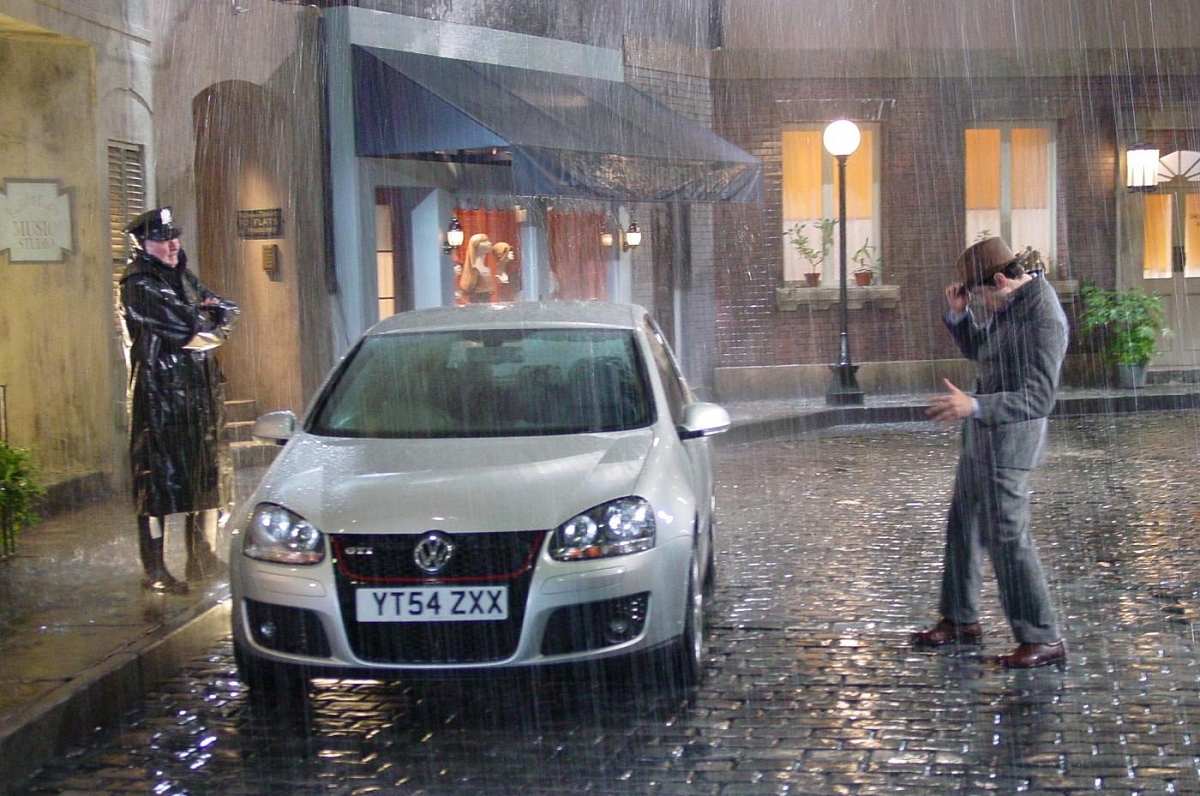
On 28 January 2005 Volkswagen UK released a television commercial for the fifth-generation Golf GTI that opened on a rain-soaked city street and a man in a 1950s grey suit and trilby. The man stepped under a lamppost, splashed once through a puddle, looked up at the camera, and started to dance. Within seconds the dance shifted from a soft-shoe routine into breakdancing, popping and locking. The face was that of Gene Kelly, lifted in post-production from the 1952 MGM musical Singin' in the Rain. The body, the choreography, and the contemporary movement vocabulary were those of David Bernal, the dancer better known as Elsewhere, working alongside British dance group Tha Featurez. The sixty-second spot carried a remix by Mint Royale of Arthur Freed and Nacio Herb Brown's 1929 song, and it closed on the line The original, updated, set above the Volkswagen logotype.
The commercial was created by DDB London under creative directors Jeremy Craigen and Ewan Paterson, with art director and writer team Justin Barnes and Toby Allen on the brief. The director was the duo NE-O, Jake Knight and Ryoko Tanaka, working through Stink Films of London. Patrick Duroux served as director of photography. The post-production house was The Mill, with the visual effects supervisor Russell Tickner leading a team of more than thirty artists across face-replacement, motion-tracking and digital compositing tasks. The dance choreography was created by Litza Bixler with input from David Bernal. The score was a Mint Royale remix of the title song from the 1952 film, commissioned specifically for the campaign and later released as a single on Faith & Hope Records that reached number one on the UK Singles Chart in March 2005.
The licence negotiations that made the spot possible
The commercial could not have been produced without the personal authorisation of Patricia Kelly, Gene Kelly's widow and the executor of his estate. DDB London approached Patricia Kelly in 2004 with a written treatment, a storyboard, and a commitment that the commercial would honour her late husband's screen legacy. Patricia Kelly travelled to London, reviewed the early animatic, and granted the licence on condition that the choreography retained the elegance of Kelly's original routine and that the spot would not be played for ironic effect. The estate also approved each subsequent cut of the film during post-production.
The 1952 MGM film required a separate licence from Warner Bros., which by 2004 held the MGM library through its 1986 acquisition. The original song, written for The Hollywood Revue of 1929 by Arthur Freed and Nacio Herb Brown, required a publishing licence from EMI Music Publishing and Warner/Chappell Music. The Mint Royale remix required a master licence from Warner Music Group and an agreement with the duo's recording label. The combined rights package was reported by industry trade press at the time as the largest single film and music licence ever assembled for a European automotive television commercial.
The production at Shepperton Studios
Principal photography took place over three days at Shepperton Studios in Middlesex, England. A stage was prepared with a rebuilt section of the original Singin' in the Rain street set, including the lamppost, the storefronts, the kerb and the road camber. The set was rigged for flooding from above. David Bernal performed the dance routine multiple times wearing the same grey suit, trilby and shoes as Kelly in the 1952 film. Patrick Duroux shot the routine from the same camera angles used by Harold Rosson in the original picture, which was a deliberate creative decision intended to preserve the visual grammar of the source for the post-production team.
The Mill then worked for approximately three months on the face replacement. The technique required matching the lighting of the original Singin' in the Rain footage to the Shepperton stage in such a way that Kelly's facial reference could be tracked onto Bernal's body across every frame. The team built a digital head model from photographs and film stills of Kelly and tracked the model onto Bernal's movement using a combination of motion-capture markers on the dancer's face during shooting and frame-by-frame manual painting in post. The final master delivered in late January 2005 contained more than 1,400 individually composited frames of digital Kelly across the sixty-second duration.
The reception and the awards
The commercial premiered on 28 January 2005 on UK terrestrial television and was rolled out across European markets through February and March of that year. The Mint Royale remix single rose to number one on the UK Singles Chart in March 2005, and the spot took the Gold Lion in Cyber and the Bronze Lion in Film at the Cannes Lions International Festival of Creativity in June 2005. The commercial also received the Gold at the British Television Advertising Awards, the Gold at the Clio Awards, and the Bronze at the One Show. The Mill's visual effects team received industry recognition through several technical award programmes for the face-replacement work.
The Golf GTI Mark V launched in the UK market in February 2005 immediately after the broadcast premiere. UK Golf GTI sales reached 8,400 units in 2005 against an internal Volkswagen UK target of 6,500 units, and the model retained its position as the volume hot-hatch leader in the British market through the model cycle. The commercial was credited internally as the primary driver of brand awareness for the launch, and the strategy of pairing a classical cinema reference with a contemporary remix of a recognised song was repeated across several subsequent Volkswagen UK commercials through the remainder of the decade.
The platform line and the longer arc
The closing line, The original, updated, performed a dual function. It described the digital reconstruction of Kelly within the commercial itself, and it described the fifth-generation Golf GTI as the contemporary continuation of the original 1976 Mark I Golf GTI. The Mark I had defined the hot hatch category three decades earlier, and the Mark V launched in 2005 was Volkswagen's attempt to reclaim a segment that had drifted toward Ford and Renault during the Mark III and Mark IV years. The advertisement and the product brief were aligned across the same conceptual frame, and the campaign demonstrated that a single line could anchor both the creative argument and the product positioning of a major launch in one stroke.
Source: The Hall of Advertising Youtube
Written with AI assistance, edited by a human. Find out more about our Use of AI.