
A roadside chain comes to the city
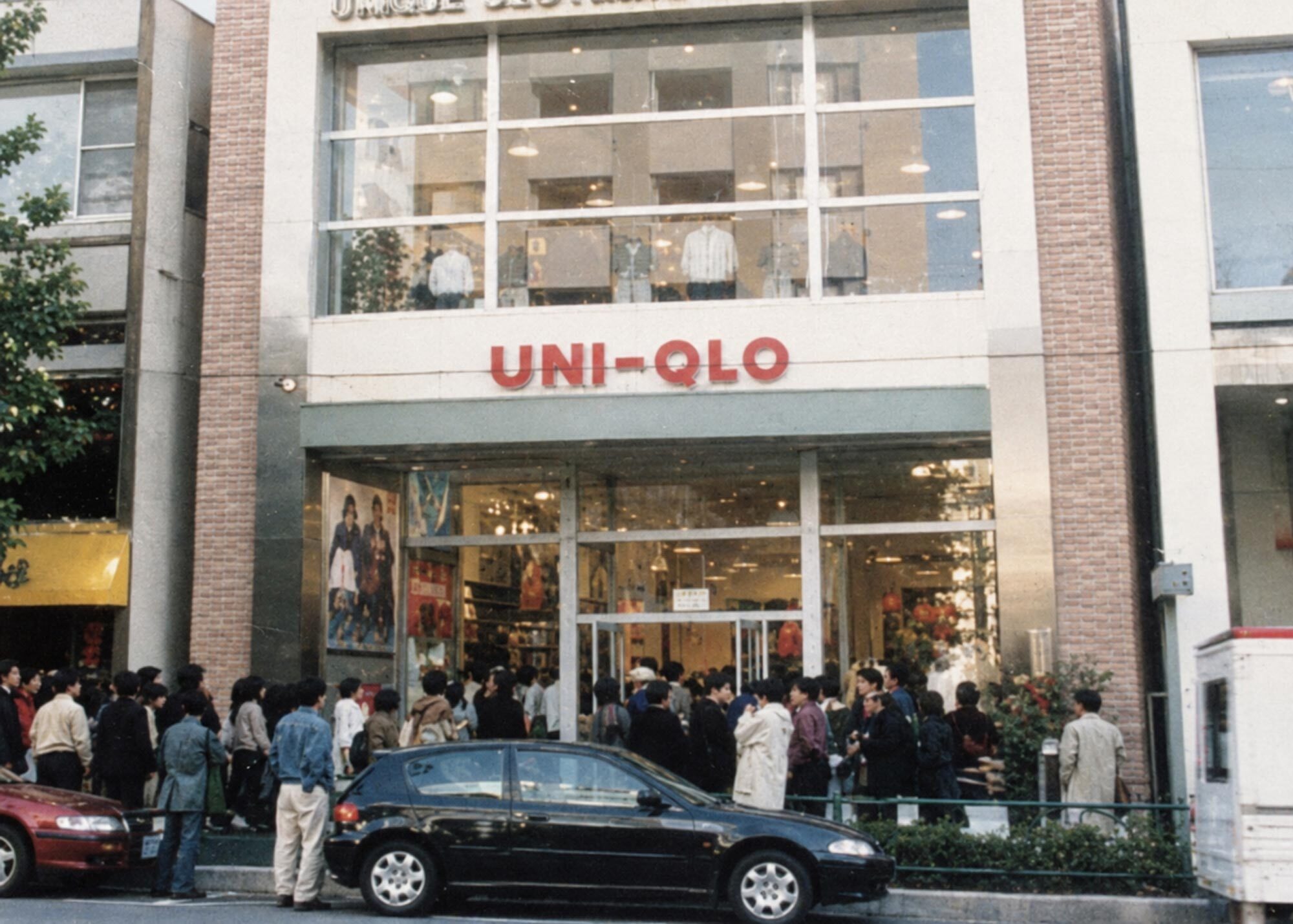
By the late 1990s Uniqlo was a chain built on roadside stores in Japan, run from Yamaguchi Prefecture, where a new head office building was completed in February 1998. It had opened a Tokyo office in Shibuya in November 1996 to strengthen its own product planning and development.1 In November 1998 it opened its first urban store, in Harajuku, Tokyo's best-known youth fashion district.1 The store stood on Meiji-dori and had three floors.2 One month earlier, in October 1998, Uniqlo had started a campaign for a single product: a fleece jacket for 1,900 yen.1
Tadashi Yanai, then President and CEO of Fast Retailing, later counted the two together as a turning point. "The third turning point in the company history came with the opening of the Harajuku store in Tokyo in 1998," he said in 2001, "and the success of our fleece campaign, which confirmed to all that the 'casual direct' era had finally come of age."3
One product, one price
Fleece was not new to Uniqlo. The company had sold it since 1994.4 What changed in 1998 was its role. Fleece had been sold as outdoor wear for limited occasions; after the Harajuku opening, Uniqlo sold it as casual clothing that anyone could wear every day.4 Fleece from outdoor brands typically cost more than 10,000 yen.5
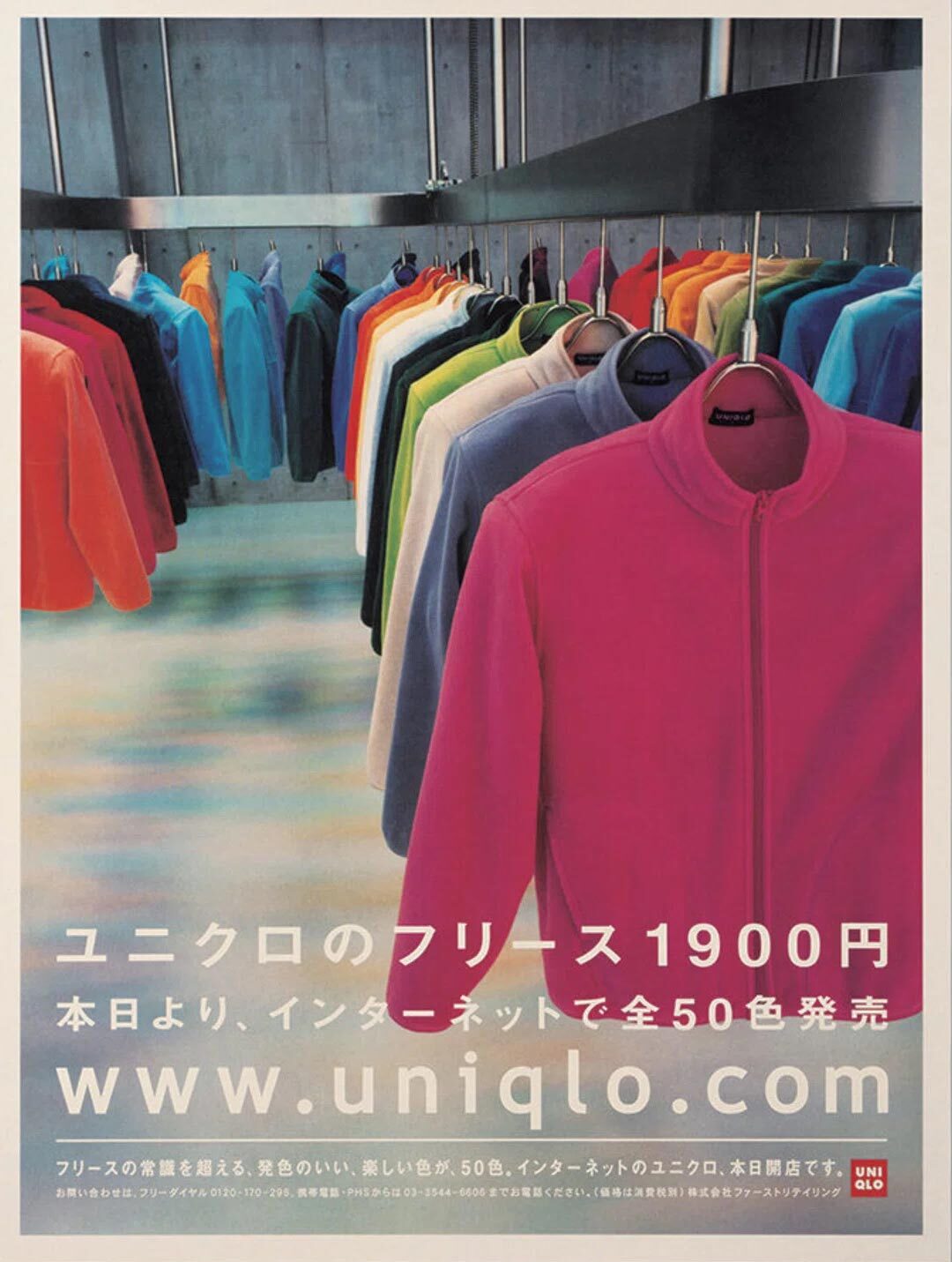
The campaign was built around that gap and nothing else. Posters reading "Uniqlo fleece. 1,900 yen" went up in large numbers at Shibuya and Harajuku stations and in cars on the Ginza and Marunouchi subway lines.6 The catchphrase "We have confidence in our fleece" ran in the television commercials.7 The product and its price were the whole message.
Speaking at the same 2001 seminar as Yanai, the commentator Hiroshi Tsukiizumi put Uniqlo's advertising spend at about 18 billion yen, at a time when comparable retailers rarely spent more than 10 billion, and named television and posters as the key to the brand's success.3
Yanai described what he was aiming at. "At that time the prevailing image of casual clothing was as 'trendy' apparel and the sole preserve of young people," he said. "The image I was aiming to project was that casual clothing is perfect for everyday use."3 His goal in the same talk was plain: "I would like to make Uniqlo a nationally recognized brand."3
From 2 million to 26 million
The numbers followed. Uniqlo sold around 2 million fleece items in 1998, 8.5 million in 1999 and around 26 million in 2000, according to the Porter Prize case on the company.8 Within two seasons the volume had grown more than tenfold. WWDJAPAN describes the 2000 season as a social phenomenon, and calls Uniqlo a child of the deflation of Japan's long recession.5 That year's range came in around 50 colours,7 and its television commercial featured the singer Yumi Matsutoya.6
The advertising matured with the sales. Wieden+Kennedy Tokyo, where John C. Jay was executive creative director from 1999, created the agency's first Uniqlo campaign, for fleece. It recommended casting no stars, and the people in the spots never talked about the garments.9 The company moved with its customers too. Its shares, listed on the Second Section of the Tokyo Stock Exchange since April 1997, moved to the First Section in February 1999, and in April 2000 the headquarters functions for merchandising and marketing moved to Tokyo.1
What Harajuku did to the brand
Before 1998 Uniqlo was widely seen as cheap and unfashionable. Within months of the Harajuku opening, the magazine Weekly SPA! judged in March 1999 that Uniqlo had reached a brand image roughly on a par with Muji, and in February 2000 the women's magazine Olive asked why the popular brand was cheap and yet not bad.2 Sold in a fashion district, the low price now read as good sense rather than as compromise.
The success carried its own cost. So many people wore the same fleece that a word came into use, "uni-bare", for the moment a garment is recognised as Uniqlo, and it hurt the brand's image.6 Company sales and recurring profit peaked in the financial year to August 2001; profits fell sharply in the following two years and recovered in 2004.6 The Harajuku store, where it began, closed in 2012.10
The pattern set in 1998 still describes the brand: one well-made basic, explained through its material and its price, offered to everyone rather than to a style tribe. Uniqlo itself calls fleece the product that symbolises LifeWear, the name it later gave that idea.4
Written with AI assistance, edited by a human. Find out more about our Use of AI.
1. Fast Retailing, "History 1949-2003", corporate history, read 8 October 2026, for the listing on the Second Section of the Tokyo Stock Exchange (April 1997), the first roadside store format (June 1985), the Tokyo office in Shibuya (November 1996), the head office building in Yamaguchi Prefecture (February 1998), the 1,900 yen fleece campaign (October 1998), the Harajuku store as the first urban Uniqlo store (November 1998), the listing on the First Section of the Tokyo Stock Exchange (February 1999), and the move of headquarters functions to Tokyo to promote merchandising and marketing (April 2000). https://www.fastretailing.com/eng/about/history/2003.html
2. Urban Life Tokyo, "“ちょいダサ”イメージから完全脱却 ユニクロが巻き起こした1998年11月「原宿事変」とは何か?", updated 14 October 2022, read 8 October 2026, off whitelist and used for corroboration, for the store on Meiji-dori with three floors, the earlier image of Uniqlo as cheap and uncool (安くてダサい), Weekly SPA! of 3 March 1999 placing the brand image roughly on a par with Muji, and Olive of 3 February 2000 asking why the popular Uniqlo was cheap yet not bad. https://urbanlife.tokyo/post/60622/
3. Research Institute of Economy, Trade and Industry (RIETI), BBL seminar "The Secret to Uniqlo's Overwhelming Success and Japan's Textile Industry", 8 June 2001, English transcript, read 8 October 2026, for the quotations from Tadashi Yanai, then President and CEO of Fast Retailing. https://www.rieti.go.jp/en/events/bbl/01060801.html
4. Uniqlo, press release "発売から20周年、新時代のユニクロのフリースが登場", 15 October 2014, read 8 October 2026, for fleece on sale since 1994, its repositioning after the 1998 Harajuku opening and the description of fleece as the product that symbolises LifeWear. Original wording: "1998年のユニクロ原宿店オープン後、それまではアウトドアウエアとして限られたシーン向けに流通していたフリースを、誰もが気軽に着られるカジュアルウエアとして販売し" and "フリースはユニクロの掲げる、あらゆる人の日々を彩り、生き方を豊かにしていく服、「LifeWear」を象徴する商品です。" https://www.uniqlo.com/jp/ja/contents/corp/press-release/2014/10/101511_fleece.html
5. WWDJAPAN, article on the Uniqlo fleece, 5 November 2018, read 8 October 2026, for outdoor brand fleece usually priced above 10,000 yen and the sale of around 26 million fleece items in the 2000 season described as a social phenomenon. https://www.wwdjapan.com/articles/733849
6. Wikipedia (Japanese), "ユニクロ", read 8 October 2026, for the poster "ユニクロのフリース。1900円" at Shibuya and Harajuku stations and in cars on the Ginza (銀座線) and Marunouchi (丸ノ内線) subway lines, the 2000 commercial with Yumi Matsutoya, the term ユニバレ (uni-bare) and its damage to the brand image, and company sales and recurring profit peaking in the financial year to August 2001, with profits falling in the following two years and recovering in 2004. https://ja.wikipedia.org/wiki/ユニクロ
7. Pen Online, article on the Uniqlo fleece, 25 October 2019, read 8 October 2026, for the catchphrase "フリースに自信あり。" (translated here as "We have confidence in our fleece") used in the television commercials, and for the range of around 50 colours in 2000. https://www.pen-online.jp/article/001039.html
8. Porter Prize, Hitotsubashi University ICS, case page on Fast Retailing, 2009, read 8 October 2026, for fleece sales of around 2 million (1998), 8.5 million (1999) and 26 million (2000) items. https://www.porterprize.org/pastwinner/2009/12/02111044.html
9. Wieden+Kennedy, "The Agency That Sticks Out", 25 October 2018, agency self-published, read 8 October 2026, for John C. Jay as executive creative director of Wieden+Kennedy Tokyo from 1999, the agency's first Uniqlo campaign for fleece, the recommendation to cast no stars, and talent that never talked about the garments. https://www.wk.com/news/the-agency-that-sticks-out/
10. Fast Retailing, Annual Report 2020, history section, read 8 October 2026, for the Harajuku store "in the fashionable Harajuku district of Tokyo (closed in 2012)". https://www.fastretailing.com/eng/ir/library/pdf/ar2020_en_11.pdf