
A brand character in a category without them
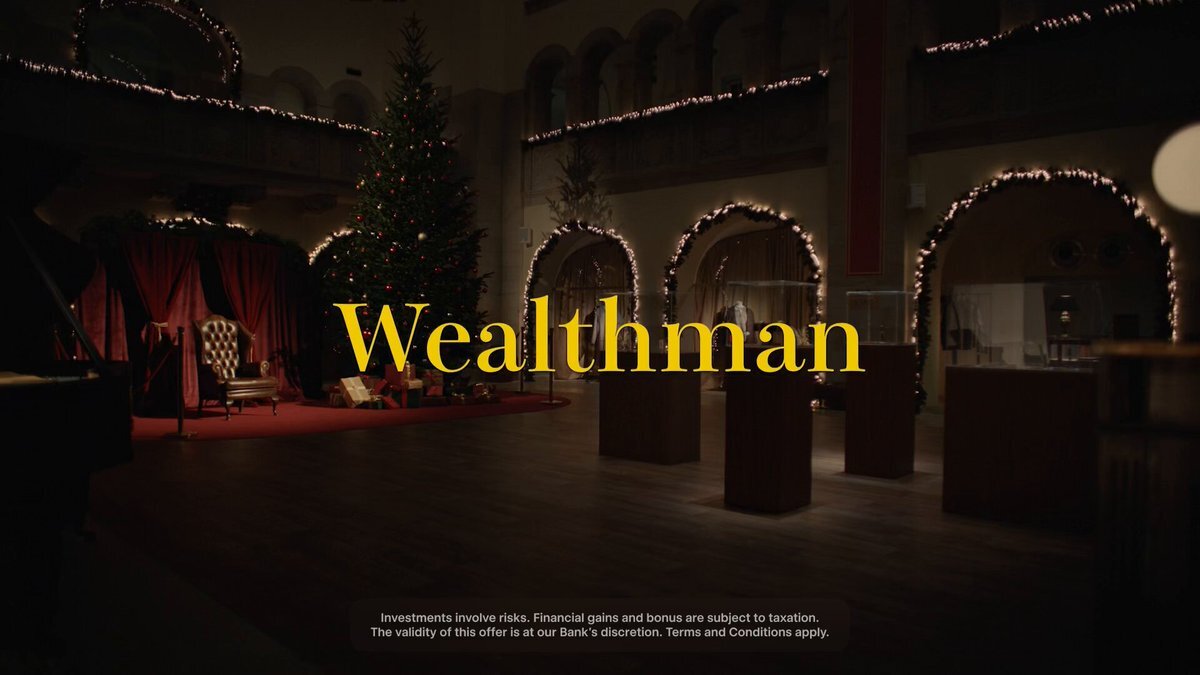
Trade Republic introduces stock gifting on 1 December 2024 and wraps it in a campaign named after a character: Wealthman.1 The film is shot in Berlin and carries the line "Stocks statt Socken", stocks instead of socks, positioning a share as a gift with a future.2
Financial brands rarely invent characters. The category runs on testimonials, on rates and on reassurance, and an invented figure sits awkwardly beside a regulated balance sheet. Trade Republic holds a full banking licence granted by the European Central Bank in December 2023 and operates in 17 European countries at the time of the launch.1, 3
Stocks instead of socks
The line does the positioning without a single product term. It names the enemy, which is the useless Christmas present, and it names the substitute without explaining it. There is no rate in the claim, no fee comparison and no mention of a portfolio. The argument is about gift-giving, a subject the audience is already occupied with in December, and the financial product enters as the answer to a domestic problem rather than as a category to be understood first.
The framing also solves a recruitment problem. A gift has a recipient, and the recipient of a gifted share has to be brought into the app to receive it. A campaign about presents is therefore a campaign about acquiring the giver's family, one household at a time, at the point in the year when gift-giving is already the occasion.
What the feature actually is
The mechanic is deliberately plain. A customer selects an asset, sets an amount, chooses a recipient and adds a personal message. The gift travels by email or as a printed gift card, and it can be scheduled in advance.1 Trade Republic attaches a December prize draw of up to 10,000 euros to the launch.1
Christian Hecker gives the reasoning: "Gifting your loved ones a stock, kicking off their savings journey, will have a lasting impact on their savings many years from now."1 The sentence restates a familiar everyday act as an act of long-term provision.
The release frames the feature against holiday consumption, presenting a gifted share as a lasting contribution to the recipient's financial independence rather than as seasonal spending.1 That framing is what the character has to carry on screen, because a transfer of securities between two app accounts has no visual form of its own.
Source: Trade Republic Youtube
Why a character and not a testimonial
A named character is a different class of asset from a celebrity or a claim. It belongs to the brand rather than being licensed, and it can be recast, redrawn or rewritten without renegotiating a contract. An ambassador brings their own associations and takes them away again when the contract ends. A character accumulates whatever the brand puts into it and keeps it.
Distinctive assets of this kind are common in food, insurance and telecommunications and rare in investing, where the prevailing register is sober. A character introduces humour into that register. For a product the company itself describes as needing to be made simple and unintimidating, that is a functional decision rather than a stylistic one.
The season as the argument
Christmas concentrates discretionary household spending into a few weeks and attaches it to gift-giving rather than to comparison. Placing a securities product inside that moment lets the brand argue against consumption without lecturing anyone, because the alternative it offers is still a present.
It is also a rare window in which a savings argument can be made without a rate. The company's advertising earlier that year had been built entirely on 4 percent interest and the terms attached to it.4 The Christmas film mentions no number at all, which suggests the character exists to carry the parts of the brand a rate cannot.
The return
The character returns. Trade Republic later publishes a further instalment on its own channel under the title "Wealthman is back", which is the point at which a one-off Christmas conceit becomes a recurring property.5
The Christmas campaign carries no external agency credit, as the company's first conventional campaign that May had not, and the same route produces the Brad Pitt film in 2026.1, 4, 6 What separates Wealthman from both is what it argues with. The May campaign was built on a deposit rate and the 2026 film on three product terms.4, 6 Wealthman is the first piece of Trade Republic advertising that exists purely as brand property rather than as a claim about conditions.
Source: Trade Republic Youtube
Written with AI assistance, edited by a human. Find out more about our Use of AI.
1. Business Wire, "Trade Republic Launches Stock Gifting, Ahead of the Christmas Season, to Allow Trade Republic Users to Support Their Family and Friends on Their Savings Journeys", 1 December 2024, wire distribution of Trade Republic's own release, of which the company's identically worded PDF is dated Berlin, 2 December 2024. Source for the launch of stock gifting and for the campaign name Wealthman, described there as a contrast to Santa Claus; for the mechanic of selecting an asset, setting an amount, choosing a recipient and adding a personal message, for delivery by email or as a printed gift card and for scheduling a gift in advance; for the December give-away of up to 10,000 euros; for the 17 European countries; for the release setting the feature against hurried Christmas shopping and in favour of gifts that last; for the film being "the first extended video format produced in-house", which is why the Christmas campaign carries no external agency credit; and for the quoted words and job title of Christian Hecker, Co-founder of Trade Republic, "Gifting your loved ones a stock, kicking off their savings journey, will have a lasting impact on their savings many years from now." https://www.businesswire.com/news/home/20241201901379/en/Trade-Republic-Launches-Stock-Gifting-Ahead-of-the-Christmas-Season-to-Allow-Trade-Republic-Users-to-Support-Their-Family-and-Friends-on-Their-Savings-Journeys https://assets.traderepublic.com/assets/files/241202_TradeRepublic_PressRelease_StockGifting_INT_EN.pdf
2. urbanuncut, "Trade Republic, Wealthman", the production company's case page for the campaign film, for the Berlin shoot, for the German line "Stocks statt Socken", rendered in the body as stocks instead of socks, and for the film positioning a share as a gift with a future. Off whitelist, and the only source for these three points; it is used as the film's primary production record under the precedent recorded in sources.md, no trade press having covered the work. https://www.urbanuncut.de/portfolio-item/trade-republic-wealthman/
3. Wikipedia, "Trade Republic", for the full banking licence granted by the European Central Bank in December 2023. Added during the footnote retrofit of 18 September 2026, because no source listed in sources.md covers the licence: the launch release names only supervision by the Bundesbank and BaFin. https://en.wikipedia.org/wiki/Trade_Republic
4. Trade Republic, "Wie viele Zinsen zahlt deine Bank? Trade Republic startet breite Zins-Kampagne mit TV-, Radio- und Plakatwerbung in den größten Städten Deutschlands", 2 May 2024, for the May 2024 campaign being the company's first conventional advertising campaign, "Die erste klassische Werbekampagne von Trade Republic"; for that campaign having been made by the same in-house route, "Das Konzept der Kampagne entwickelte die Bank wie immer intern."; and for it having been built on the deposit rate and its terms, "Aktuell erhalten Trade Republic Kunden 4 Prozent Zinsen p.a. auf das nicht investierte Geld bis zu einer Höhe von 50.000 Euro. Die Zinsen werden monatlich ausgezahlt.", passed on since January 2023 "ohne zeitliche Begrenzung, für Neu- und Bestandskunden". Added during the footnote retrofit of 18 September 2026. https://assets.traderepublic.com/assets/files/240429_4Percent_Interest_Campaign_PressRelease_DE_DE.pdf
5. Trade Republic, "Wealthman is back. | Trade Republic", the company's own YouTube channel, for the later instalment that brings the character back under that title. The watch page answered automated fetching with HTTP 429 on 18 September 2026, as it had when the verse was written; the exact title and the channel were confirmed through YouTube's oEmbed endpoint on that date, and the publication date of the instalment could still not be established, which is why the body describes the return without dating it. https://www.youtube.com/watch?v=QToV8E71K1w
6. Trade Republic, "Trade Republic Announces Brad Pitt as Global Brand Ambassador", 12 May 2026, for the 2026 Brad Pitt film having come by the same in-house route, "Like all Trade Republic campaigns, it was developed in-house", and for the three product terms its voiceover names, a free account with card, 2 percent interest and investing from as little as one euro. Added during the footnote retrofit of 18 September 2026. https://assets.traderepublic.com/assets/files/PressRelease_Brad_Pitt_DE_EN.pdf