
Five years without advertising, then a rate
Trade Republic launches its first conventional advertising campaign in Germany on 2 May 2024, five years after the app opened to the public.1, 2 The company describes it in its own announcement as the first classic campaign in its history, and it rests on a single number: 4 percent a year on uninvested cash, up to 50,000 euros, paid out monthly.1
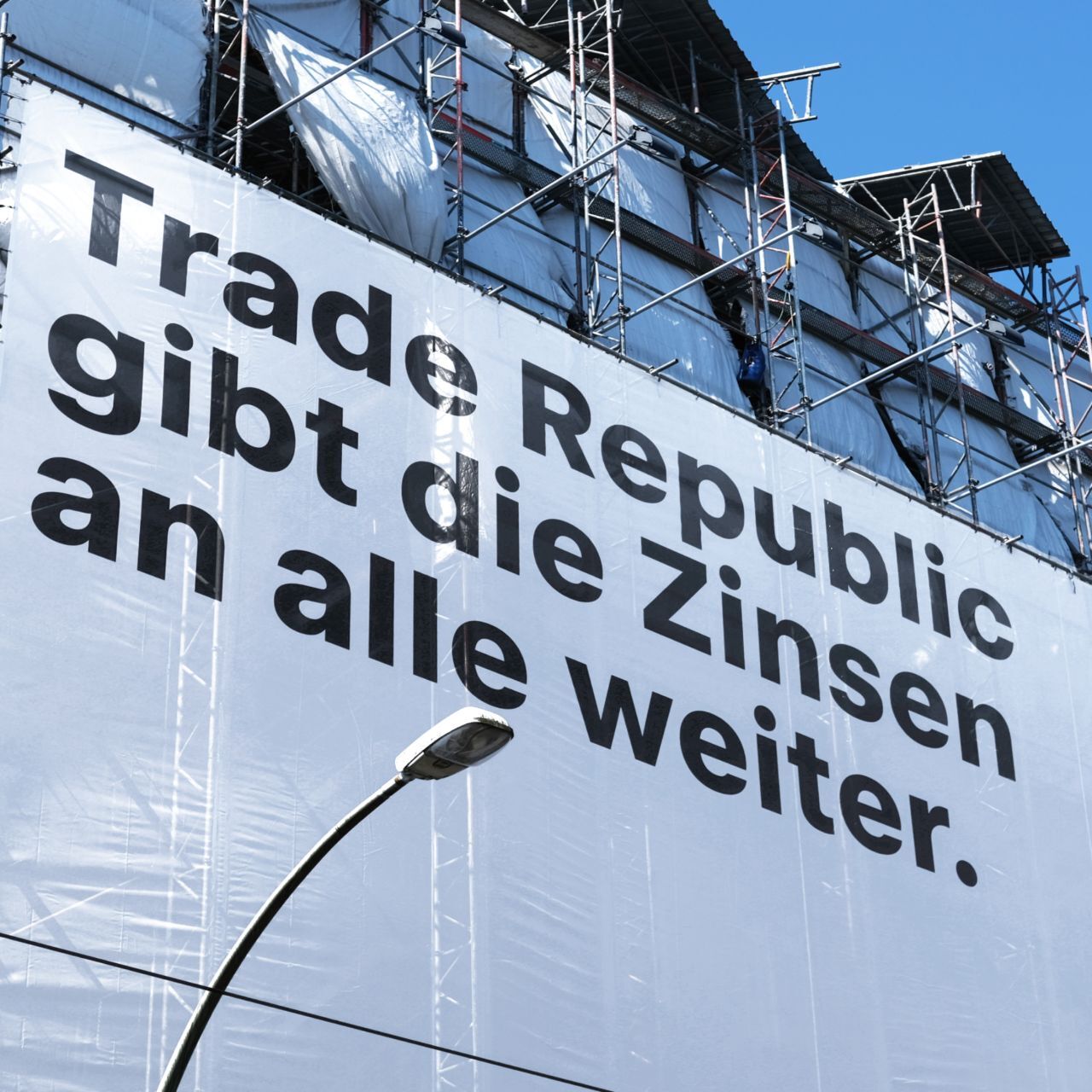
The work runs on television, including ARD, ZDF and Pro7, on radio, and on out-of-home sites in major German cities.1 Trade Republic develops it internally and credits no external agency.1
The claim is a question
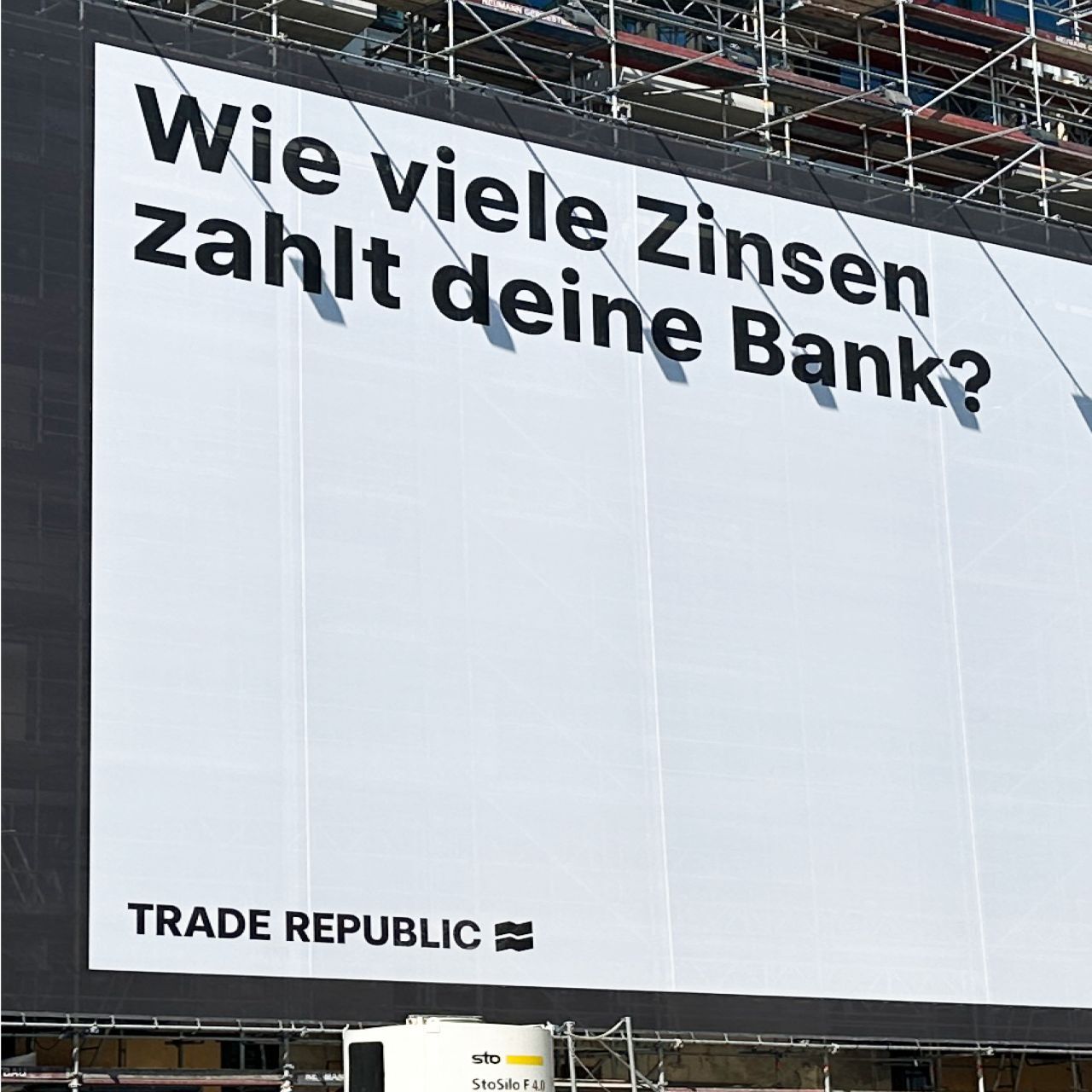
The line is "Wie viele Zinsen zahlt deine Bank?", or "How much interest does your bank pay?".1 It performs a specific manoeuvre. Rather than describing Trade Republic, it asks the audience to audit an incumbent, and it assumes the answer will be unflattering. The brand appears only as the party that would answer the question differently.
The framing also settles the competitive set. A broker advertising against other brokers would talk about order fees, instrument coverage or execution venues. A brand asking about a bank has decided that its rival is the current account most Germans already hold and rarely reconsider, which is a far larger group than the active retail investors competing neobrokers address.
Choosing a question as the claim also solves a problem specific to a first campaign. A brand nobody has heard of cannot open with a statement about itself, because the audience has no reason to accept it. A question about something the audience already owns needs no prior credibility to land, and the brand only has to be standing there when the answer disappoints.
A treatment reduced to the logo
Julian Collin, responsible for growth and international markets, describes the art direction in the announcement: "Visually, we focus puritanically on the Trade Republic logo."1 There is no lifestyle photography, no testimonial and no narrative device. The identity carries the frame and the number carries the message.
The restraint suits the argument. A campaign built on a rate gains credibility from looking like a statement of terms rather than like advertising, and a brand that reduces itself to a mark and a figure implies it has nothing that needs dressing up. It is also a low-cost format to run across television, radio and posters at once, which matters for a first campaign with no established advertising infrastructure behind it.
A rate as a permanent promise
Collin draws the distinction the campaign depends on: "Unlike many banks and fintechs, this isn't a limited offer or short-term action. Trade Republic is a promise: customers can rely on receiving the best terms simply and clearly. Our brand stands for a new kind of trustworthy bank."1
Introductory rates are the standard instrument in retail deposits, offered to new customers for a fixed window and quietly withdrawn afterwards. Trade Republic applies the 4 percent to new and existing customers alike, with no end date announced.1 The company also points back to January 2023, when it began passing European Central Bank rate rises through to customers ahead of established banks.1
Advertising a rate this way converts a pricing decision into a positioning claim. The number itself can move with the central bank, and it later does.3 The rule behind it, that customers receive the prevailing terms without having to ask for them, is the part being advertised, and it does not expire when the rate changes.
The vocabulary shift
Co-founder Christian Hecker ties the campaign to the company's stated purpose: "The first classic advertising campaign has clear ties to our mission: helping people make their money work."1 He lists the proof points as commission-free stock trading, a free card and full interest pass-through, which is the offer of a bank rather than the offer of a brokerage.1
The pieces have arrived in quick succession. A full banking licence from the European Central Bank came in December 2023, and the Visa debit card with its Saveback reward in January 2024.2, 4 By May the company holds the licence, the payment product and the deposit rate, and the campaign is where it begins describing itself accordingly. The phrase Collin uses, a new kind of trustworthy bank, would have been unavailable a year earlier.1
The timing also settles a question the company had left open. A licence permits a brand to call itself a bank; it does not oblige it to. Trade Republic could have kept the broker framing and treated the account, the card and the rate as features attached to an investment app. The campaign chooses the other reading, and it does so in the medium with the widest reach available to it, which makes the choice difficult to walk back.
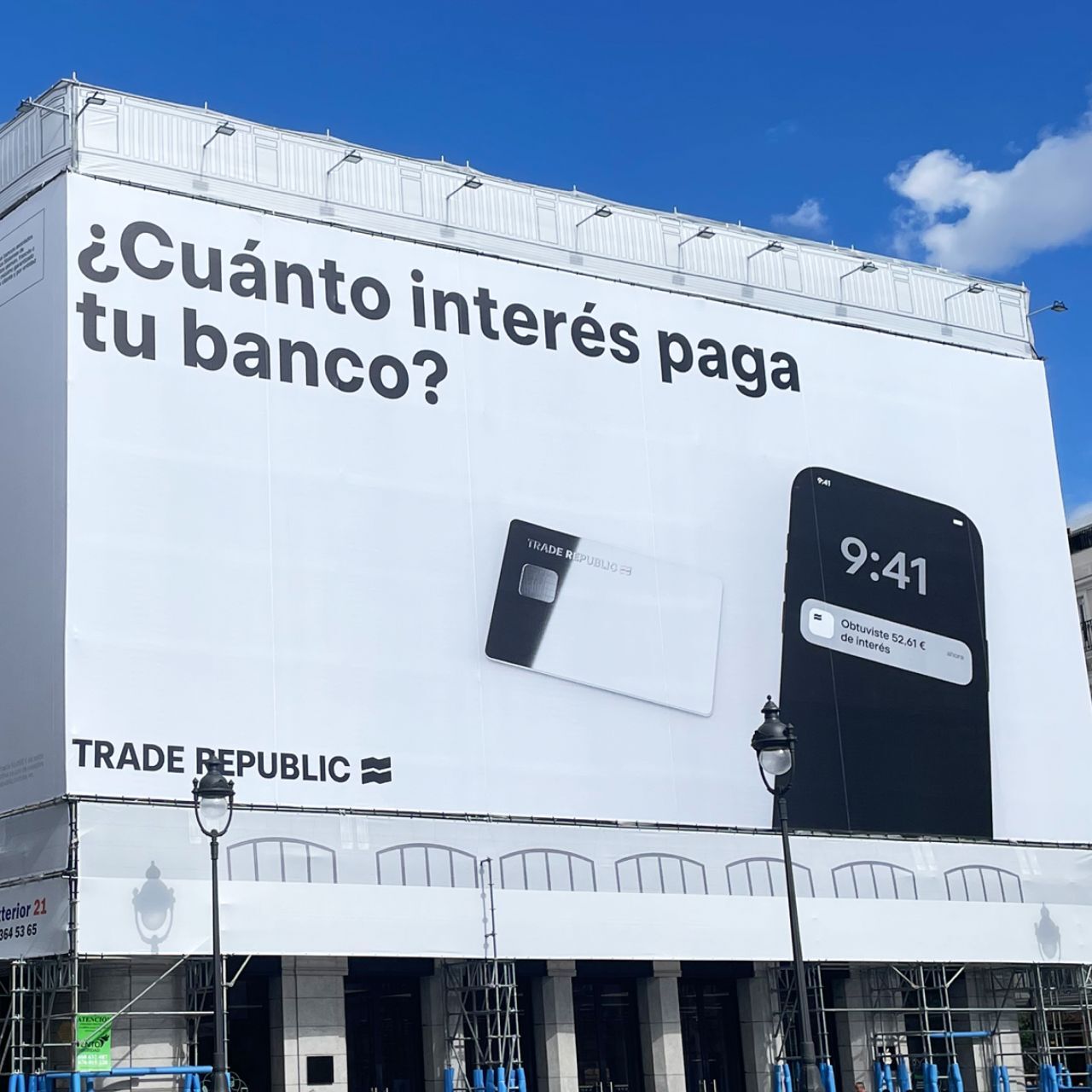
The construction returns at European scale in the company's 2026 campaign.3
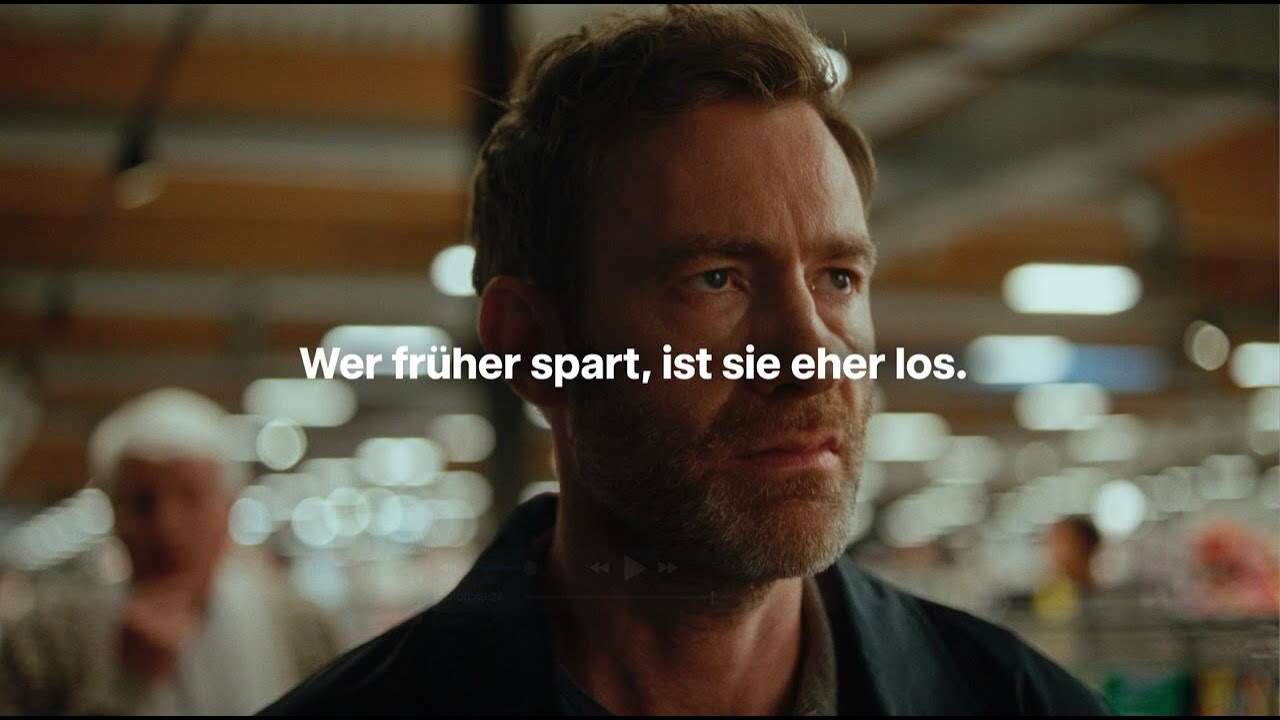
Source: Trade Republic Youtube
Written with AI assistance, edited by a human. Find out more about our Use of AI.
1. Trade Republic, "Wie viele Zinsen zahlt deine Bank? Trade Republic startet breite Zins-Kampagne mit TV-, Radio- und Plakatwerbung in den größten Städten Deutschlands", 2 May 2024, for the campaign starting in May 2024 and being the company's first conventional one, "bei seiner ersten klassischen Werbekampagne"; for the campaign line, "Wie viele Zinsen zahlt deine Bank?"; for the terms of the offer, "Aktuell erhalten Trade Republic Kunden 4 Prozent Zinsen p.a. auf das nicht investierte Geld bis zu einer Höhe von 50.000 Euro. Die Zinsen werden monatlich ausgezahlt."; for the media plan, "Die TV-Spots laufen zur Prime Time unter anderem auf Sendern wie ARD, ZDF und Pro7.", alongside radio and out-of-home placements in the largest German cities; for the work having been made in house, "Das Konzept der Kampagne entwickelte die Bank wie immer intern.", no external agency being named anywhere in the document; for the rate applying without an end date to new and existing customers, "ohne zeitliche Begrenzung, für Neu- und Bestandskunden"; for the January 2023 pass-through, "Schon im Januar 2023 hat Trade Republic als Erster in Deutschland die gestiegenen Zinsen an seine Kunden weitergegeben. Anders als die etablierten Banken"; and for both quotations, which the body carries in English translation. Julian Collin, "Director of Growth und General Manager International Markets von Trade Republic", is quoted in the original as: "Visuell liegt der Fokus puristisch auf dem Trade Republic Logo. Anders als viele Banken und Fintechs, geht es hier nicht um ein Lockangebot oder eine kurzfristige Aktion. Trade Republic ist ein Versprechen: Der Kunde kann sich darauf verlassen, die besten Konditionen einfach und verständlich zu erhalten. Unsere Marke steht für eine neue Art von Bank, der man vertrauen kann." Christian Hecker, "Mitgründer von Trade Republic", is quoted as: "Die erste klassische Werbekampagne von Trade Republic hat einen klaren Bezug zu unserer Mission: Wir helfen Menschen, ihr Geld für sich arbeiten zu lassen. Heute bieten wir das beste Angebot für das eigene Geld. Dies zeigen wir mit dem provisionsfreien Aktienhandel, einer kostenfreien Karte und vor allem der vollen Weitergabe der Zinsen. Unsere Maßgabe ist es, allen Kunden die besten Konditionen fair und transparent anzubieten." https://assets.traderepublic.com/assets/files/240429_4Percent_Interest_Campaign_PressRelease_DE_DE.pdf
2. Wikipedia, "Trade Republic", for the app having opened to the public in 2019, securities trading by app offered to a closed user group from February 2019 and without user restrictions from May 2019, which is the five year interval the opening sentence refers to; for the full banking licence granted by the European Central Bank in December 2023; and for a debit card launched in 2024. The article names neither Visa nor Saveback and gives no month for the card, which is why that sentence also carries footnote 4. https://en.wikipedia.org/wiki/Trade_Republic
3. Trade Republic, "Trade Republic Announces Brad Pitt as Global Brand Ambassador", 12 May 2026, for the deposit rate having moved after 2024, the release naming 2 percent interest on uninvested cash where the 2024 campaign advertised 4 percent; and for the same construction returning at European scale, a campaign running "across Europe on television, streaming platforms, and all relevant digital channels", made by the same in-house route, "Like all Trade Republic campaigns, it was developed in-house", and closing on the question "What does your bank offer?". Added during the footnote retrofit of 18 September 2026. https://assets.traderepublic.com/assets/files/PressRelease_Brad_Pitt_DE_EN.pdf
4. Trade Republic, "Trade Republic celebrates its 5th birthday with 4 million customers and introduces a new card with a 1 percent Saveback reward for every card payment", 9 January 2024, for the card having arrived in January 2024, for it being a debit card issued out of the "partnership between Trade Republic and Visa", and for the reward the body names, a "1 percent Saveback reward" paid into the holder's savings plan on every card payment. The same release carries the 4 percent rate the May campaign would advertise four months later. Added during the footnote retrofit of 18 September 2026. https://assets.traderepublic.com/assets/files/240109_TradeRepublic_PressRelease_Card_INT_EN1.pdf