

Raising the stone to raise the light
In 1886, Charles Lewis Tiffany introduced a new way of mounting a diamond that broke from the heavier, closed settings common at the time. Rather than surrounding a stone with metal that covered much of its lower surface, the new design held the diamond above the band on six thin, tapered prongs, exposing the stone to light from underneath as well as from above and increasing how much of the diamond's brilliance reached the viewer's eye.
Tiffany's own account of the design frames it as a direct response to the ornate, heavily worked settings fashionable in the mid-nineteenth century, which Charles Lewis Tiffany considered a distraction from the quality of the stone itself. Rather than competing on decoration, the six-prong mount competed on the quality and visibility of the diamond it held, a positioning choice that put Tiffany's gem-buying and cutting expertise, rather than its metalwork, at the centre of the product's appeal.
A design the market renamed after its maker
The design became successful enough, and was copied by enough other jewelers, that Tiffany began issuing public warnings against imitations, an unusually early instance of a jewelry house treating a specific setting as an asset worth defending rather than as a technique any competitor was free to use. Despite those warnings, the six-prong solitaire mount spread across the wider jewelry trade over the following decades, to the point that jewelers and customers alike began calling any ring built on the same principle a "Tiffany setting," regardless of which company had actually made it.
That informal renaming is, in trademark terms, a mixed outcome. It confirms that Tiffany originated a design significant enough to define an entire category, but it also means the company can no longer claim exclusive commercial use of the term "Tiffany setting" itself, since the phrase has become the generic name jewelers use for the technique rather than a brand reserved for Tiffany's own products. Tiffany continues to sell its own version of the setting as The Tiffany Setting, marketed as the authentic original rather than as one implementation among many that now carry the same descriptive name.
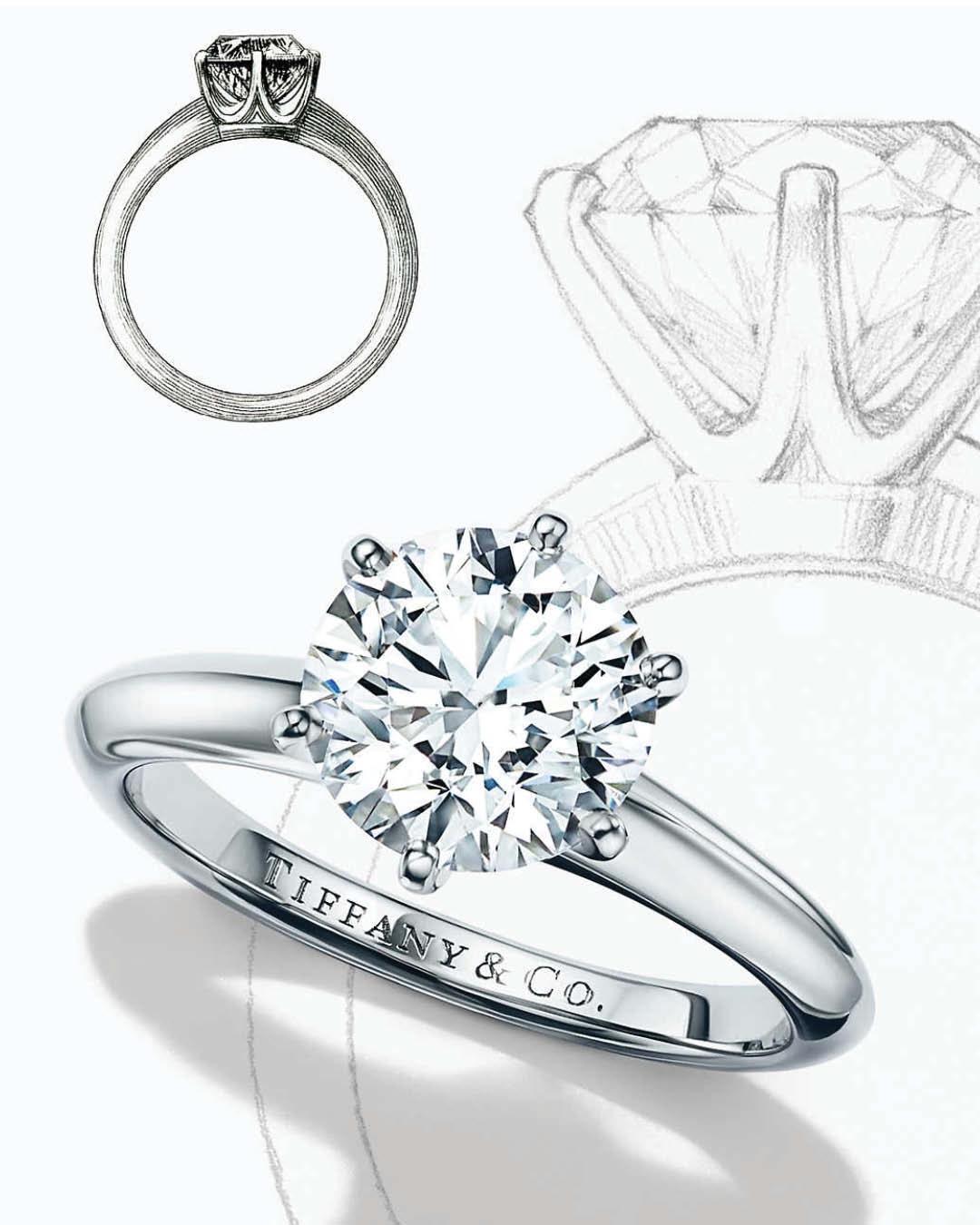
The template behind the modern engagement ring
More than 130 years after its introduction, the basic principle behind the 1886 design, a single stone raised above the band on slim prongs to maximise light return, remains the default expectation for a solitaire engagement ring across the jewelry industry, independent of price point or brand. Few nineteenth-century product designs have retained that level of market dominance for so long without significant structural change.
For Tiffany, the setting's legacy sits alongside the difficulty of monetising a category-defining idea once competitors have absorbed it into standard practice. The house's response has been to lean on authenticity and provenance rather than on the design alone, positioning The Tiffany Setting as the version customers should choose specifically because it traces back to 1886, even though the underlying six-prong idea itself now belongs to the entire industry.
The setting's continued dominance also illustrates a pattern common to several of Tiffany's oldest inventions: the specific object, in this case a particular arrangement of six prongs and a raised stone, outlived the house's ability to keep it proprietary, yet the story of its origin has remained valuable marketing material regardless. Tiffany can no longer sell exclusivity on the setting itself, but it can, and does, sell the claim to have invented it.
The episode also offers an early, pre-digital example of a problem brands now face constantly: a genuinely useful innovation, once it becomes an industry standard, is difficult to keep as a private asset no matter how clearly its origin is documented. Tiffany's answer, repeated across the setting, the blue box and its named-designer collaborations, has consistently been to compete on the strength of its own history rather than on legal exclusivity alone.
Tiffany has continued to defend related trademarks even as the setting itself became generic, most visibly around its name and its packaging rather than the six-prong technique, and the company has pursued legal action against retailers using the words Tiffany or Tiffany setting in ways it considers misleading about origin. Those cases have generally turned on whether a seller implied a connection to the house itself, rather than on the underlying six-prong technique, since courts have long treated the mounting method as a functional, generic term open to the whole trade.
The setting's history also offers a useful comparison for how differently two branding strategies age. Where the Tiffany Blue trademark succeeded because a colour, unlike a mechanical design, does not need to be copied to be useful and can therefore be defended almost indefinitely through consistent, exclusive use, a functional invention such as the six-prong mount inevitably diffuses into the wider industry once other jewelers recognise its practical advantage, regardless of how aggressively the originator polices it early on.
Written with AI assistance, edited by a human. Find out more about our Use of AI.