A watch with a job description
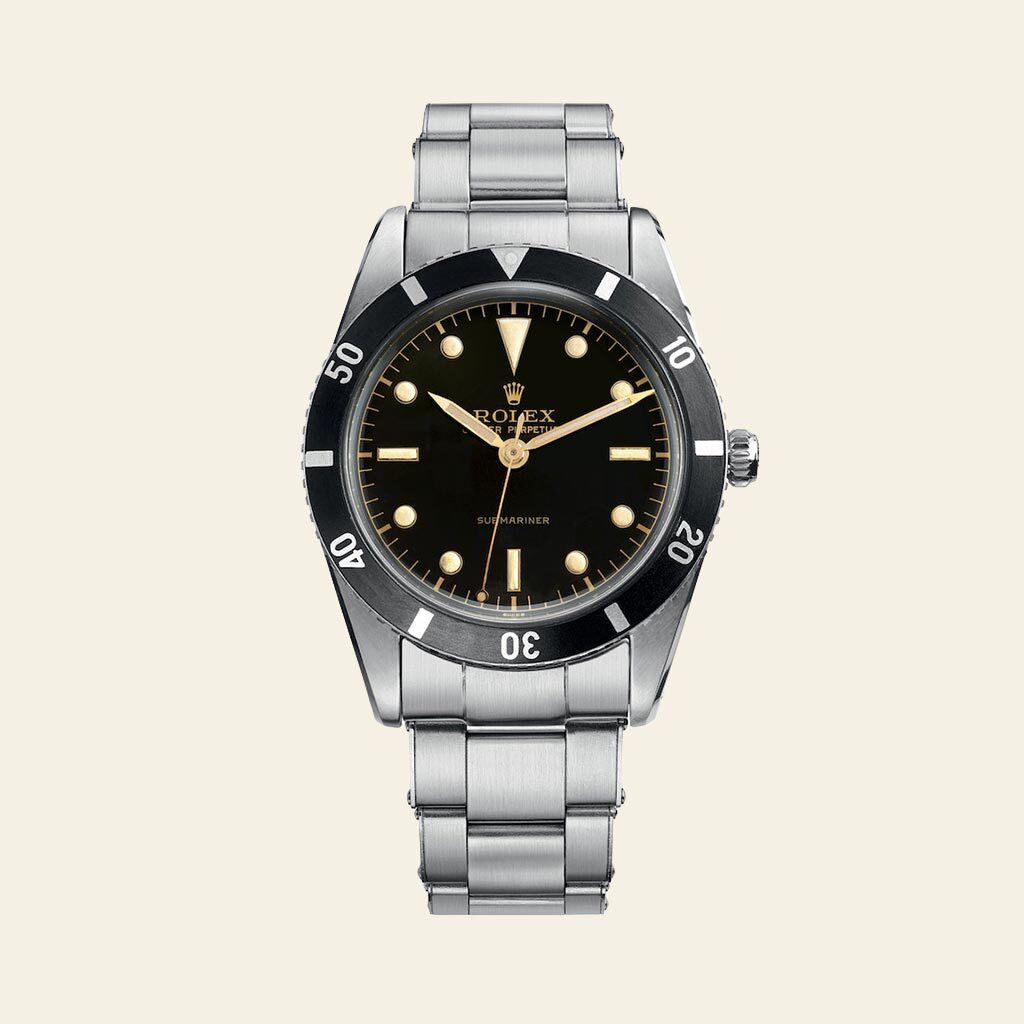
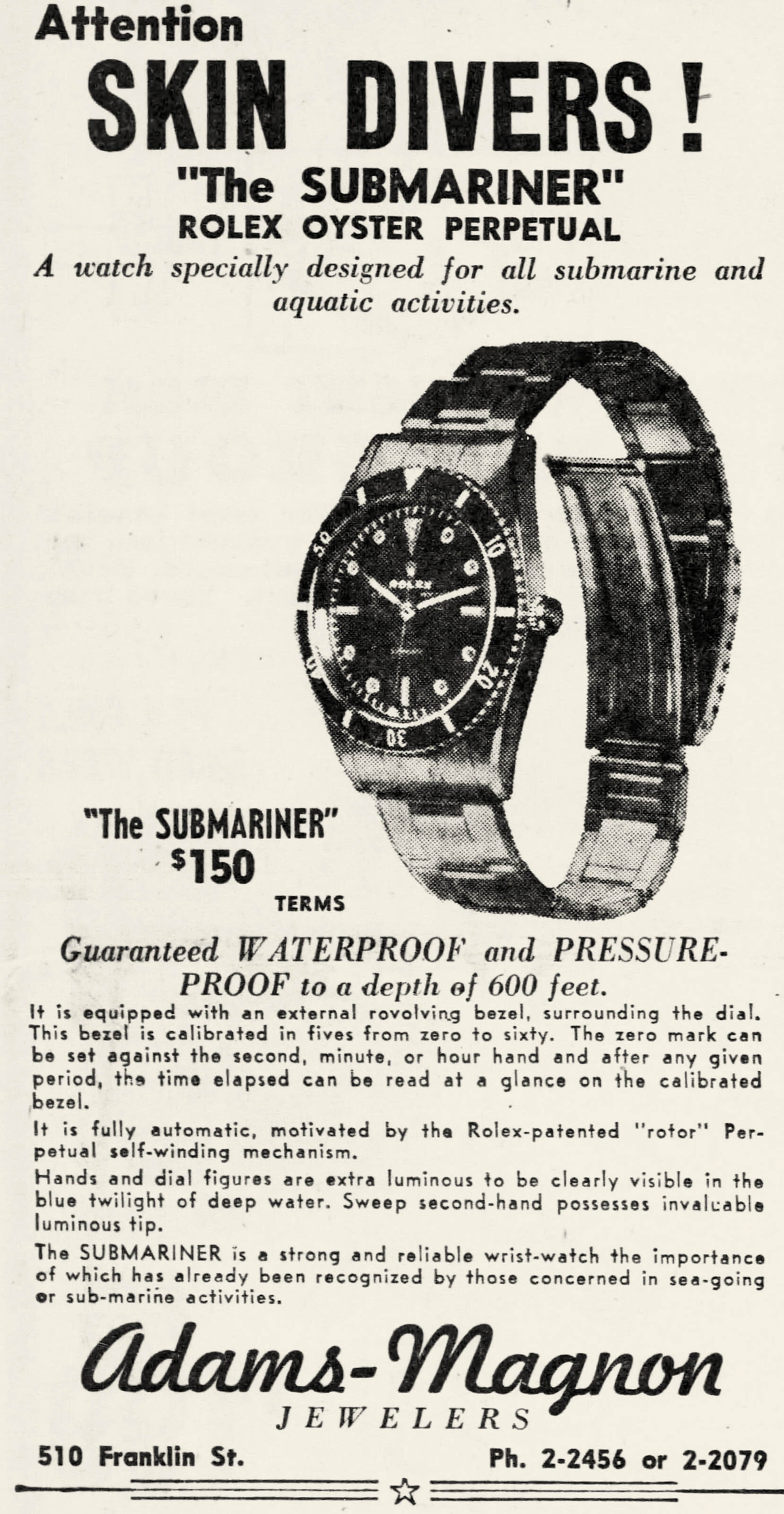
Rolex launched the Submariner in 1953, the first divers' watch waterproof to a depth of 100 metres, with a rotatable bezel that let a diver read immersion time off the dial.1
The name is the first thing that is unusual about it. It does not describe the watch. It does not say diver, or waterproof, or depth. It names a person: the one who goes under. A company that had spent twenty-five years naming its inventions after what they did, Oyster for the sealed case and Perpetual for the rotor, named this one after the customer
Rolex says what the category is for
The company is explicit about what it was building, and the wording matters. In the early 1950s, it says, it developed Professional watches "that served as tools and whose functions went far beyond simply telling the time", intended for professional activities such as deep-sea diving, aviation, mountain climbing and scientific exploration.1 Tools. Not better watches, not more accurate watches: instruments with a use.
That is a category claim rather than a product claim, and it is the more valuable of the two. A better watch invites comparison on the axis every competitor is already on. A tool for a named occupation changes the question from which watch is best to which watch is correct for this, and a brand that gets to define correctness for a job has removed most of the field from the conversation.
Source: Youtube
The bezel is the argument
The rotatable bezel is where the claim becomes physical. A diver sets it against the minute hand on entering the water and reads elapsed time as a position rather than a calculation, which under water, in cold, with a finite air supply, is the difference between a glance and an arithmetic problem.1
What that gave Rolex was a feature that cannot be read as decoration. Every other element of a luxury watch can be explained as taste. A timing bezel has one use, and the use is consequential. It is also visible from across a room, which meant the tool argument travelled to people who would never make the dive.
Naming the job, then owning it
Submariner set a pattern the company then ran for decades. Explorer arrived the same year for a different environment, and was launched to mark the Everest ascent.2 GMT-Master followed in 1955 as a navigation aid for professionals crossing time zones, its name taken from the reference standard rather than from the wearer. Sea-Dweller came in 1967, waterproof to 610 metres, with a helium escape valve so that gas absorbed during saturation diving could leave the case during decompression without damaging it.1
Each name stakes a claim on an occupation or a condition, and each is a Rolex trademark rather than a description anyone else may use. That is the second thing the naming decision bought. A watch called the Diver would have given the category away; a watch called the Submariner keeps it.
What the category did to the price
Selling equipment usually caps what can be charged for it, because a tool is judged against the job and the job has a budget. Rolex escaped that by keeping the Submariner inside a luxury house rather than spinning it into a professional line, so the watch carried an occupational justification and a jeweller's price at the same time.
That combination is the durable part of the 1953 decision. The professional claim gives the object a reason to exist that has nothing to do with status, and the status is what is actually being bought. Neither half would work alone: a pure instrument would have to compete on cost, and a pure luxury watch would have to argue for itself on beauty, where every competitor has an answer.
What happens when the tool is not needed
The proposition carried a problem inside it from the start. A tool is justified by necessity, and the necessity was already thin in 1953: most buyers of a 100-metre divers' watch were not diving. By the time dive computers made the mechanical timing bezel redundant for its stated purpose, the Submariner had become one of the most recognisable objects in the category, worn almost entirely by people with no operational use for it.
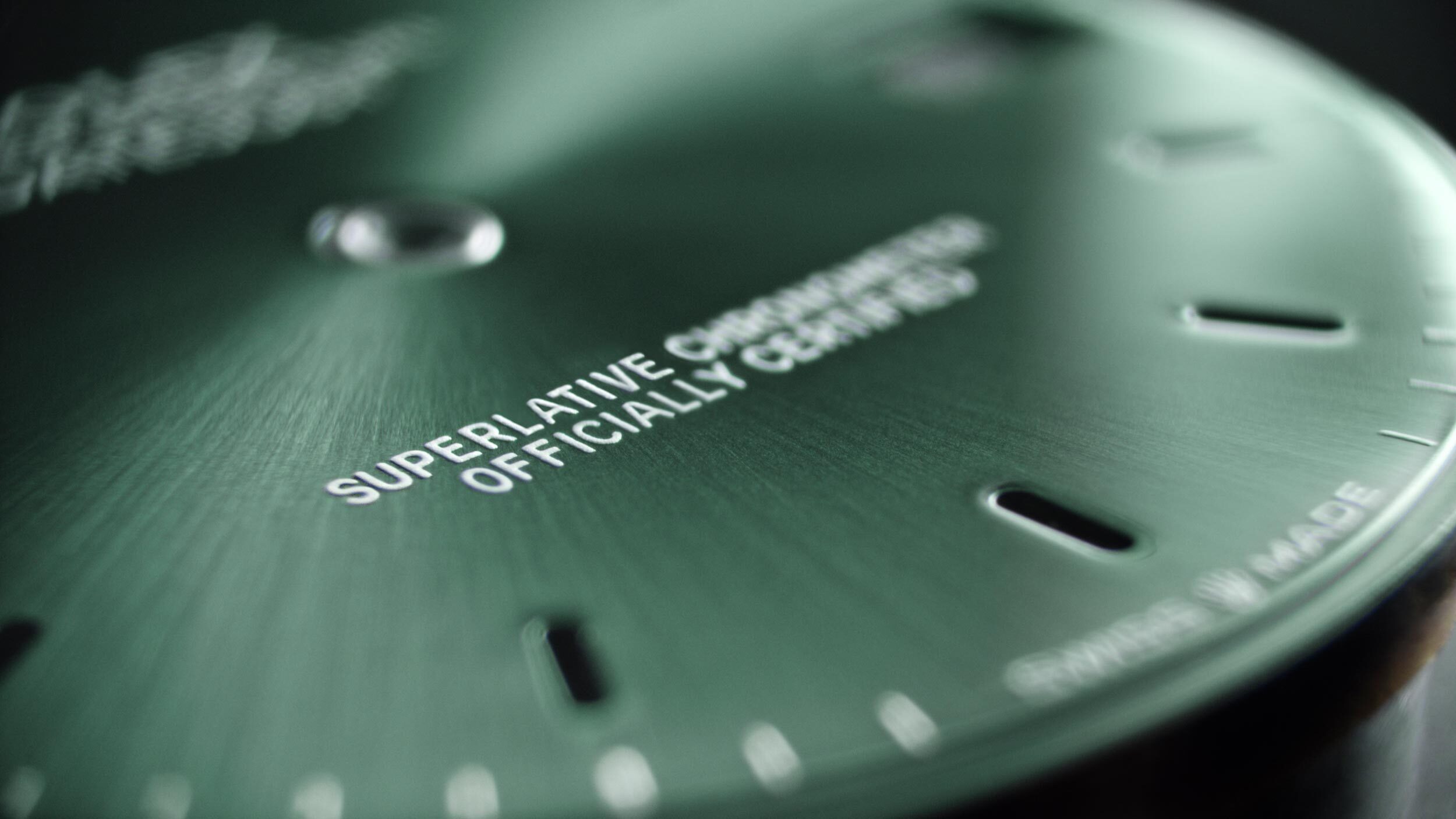
The brand's answer has been to keep deepening the professional claim rather than to quietly drop it. Rolex formalised a partnership with the French underwater engineering company Comex, equipping its divers and using the company's hyperbaric chambers to test waterproofness as part of its own Superlative Control process.3 The testing is real and the buyer will never need it, which is precisely the arrangement the 1953 naming decision set up: the watch is correct for a job, and the owner buys the correctness.
Written with AI assistance, edited by a human. Find out more about our Use of AI.
1. Rolex, "Rolex History, 1953 to 1967", retrieved 22 September 2026, for the Submariner launched in 1953 as the first divers' watch waterproof to a depth of 100 metres (330 feet) and for its rotatable bezel allowing divers to read their immersion time, for the account of Professional watches developed in the early 1950s that "served as tools and whose functions went far beyond simply telling the time" and were intended for professional activities such as deep-sea diving, aviation, mountain climbing and scientific exploration, for the GMT-Master of 1955 designed as a navigation aid for professionals crossing time zones, and for the Sea-Dweller of 1967 waterproof to 610 metres (2,000 feet) with a helium escape valve releasing helium from saturation-diving gas mixtures during decompression. https://www.rolex.com/en-us/about-rolex/history/1953-1967
2. Brandvelle, "Rolex launched the Explorer on a letter from Everest", for the Explorer launched in 1953 to mark the ascent of Mount Everest, which Rolex states on the same history page cited in note 1. https://www.rolex.com/en-us/about-rolex/history/1953-1967
3. Rolex, "Rolex Deepsea and Deepsea Challenge, Journey to the deep", retrieved 22 September 2026, for Rolex formalizing its partnership with Comex (Compagnie Maritime d'Expertises), the Marseille underwater engineering company, by equipping its divers with Professional watches, and for that partnership enabling the development of hyperbaric chambers used to test the waterproofness of Rolex watches as part of the Superlative Control process. The year labels on this page render out of step with the entries beneath them, so no year is taken from it and none is given in the body. https://www.rolex.com/en-us/watches/deepsea/deepsea-challenge/journey-to-the-deep