A letter, a drawing, a price
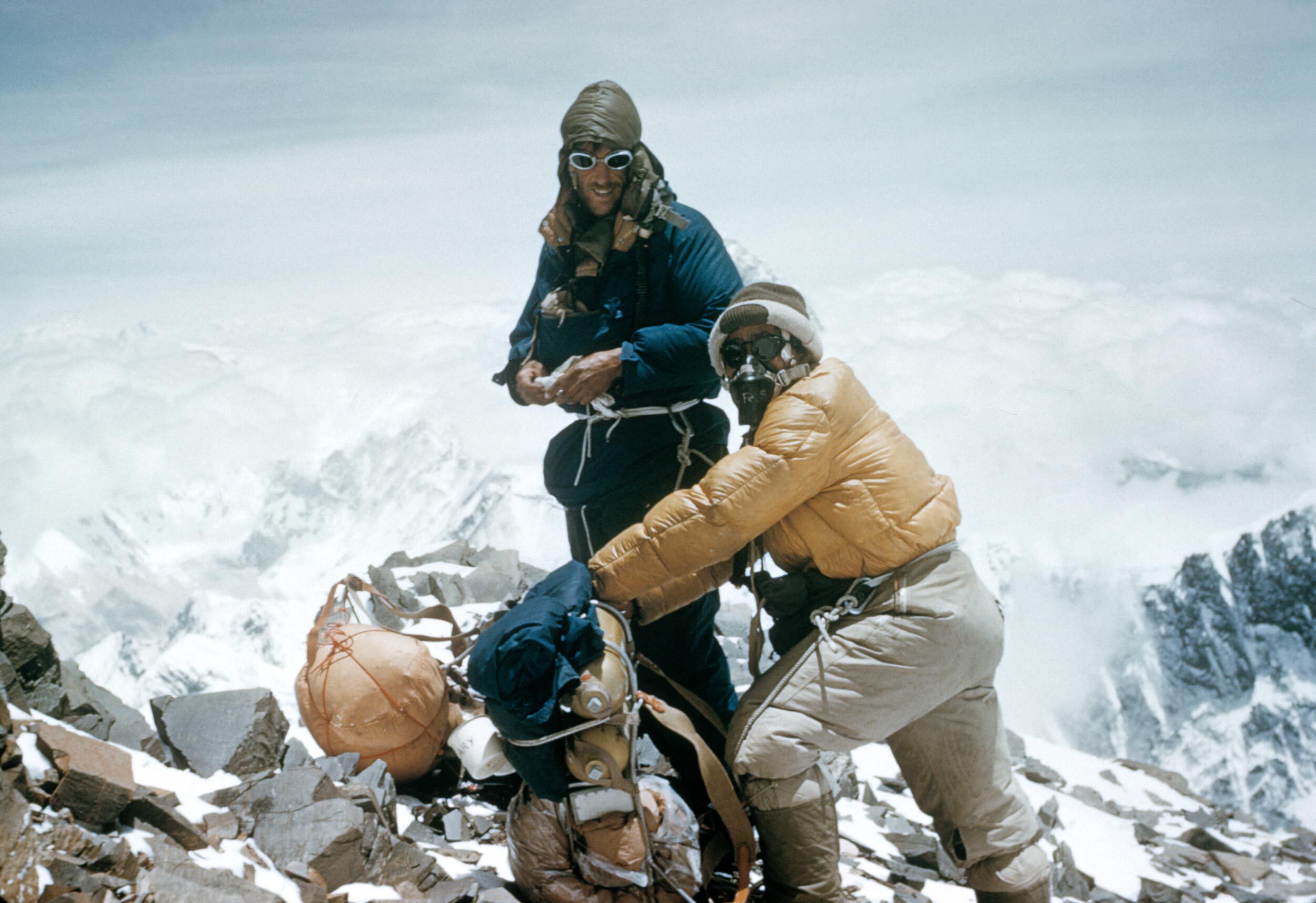
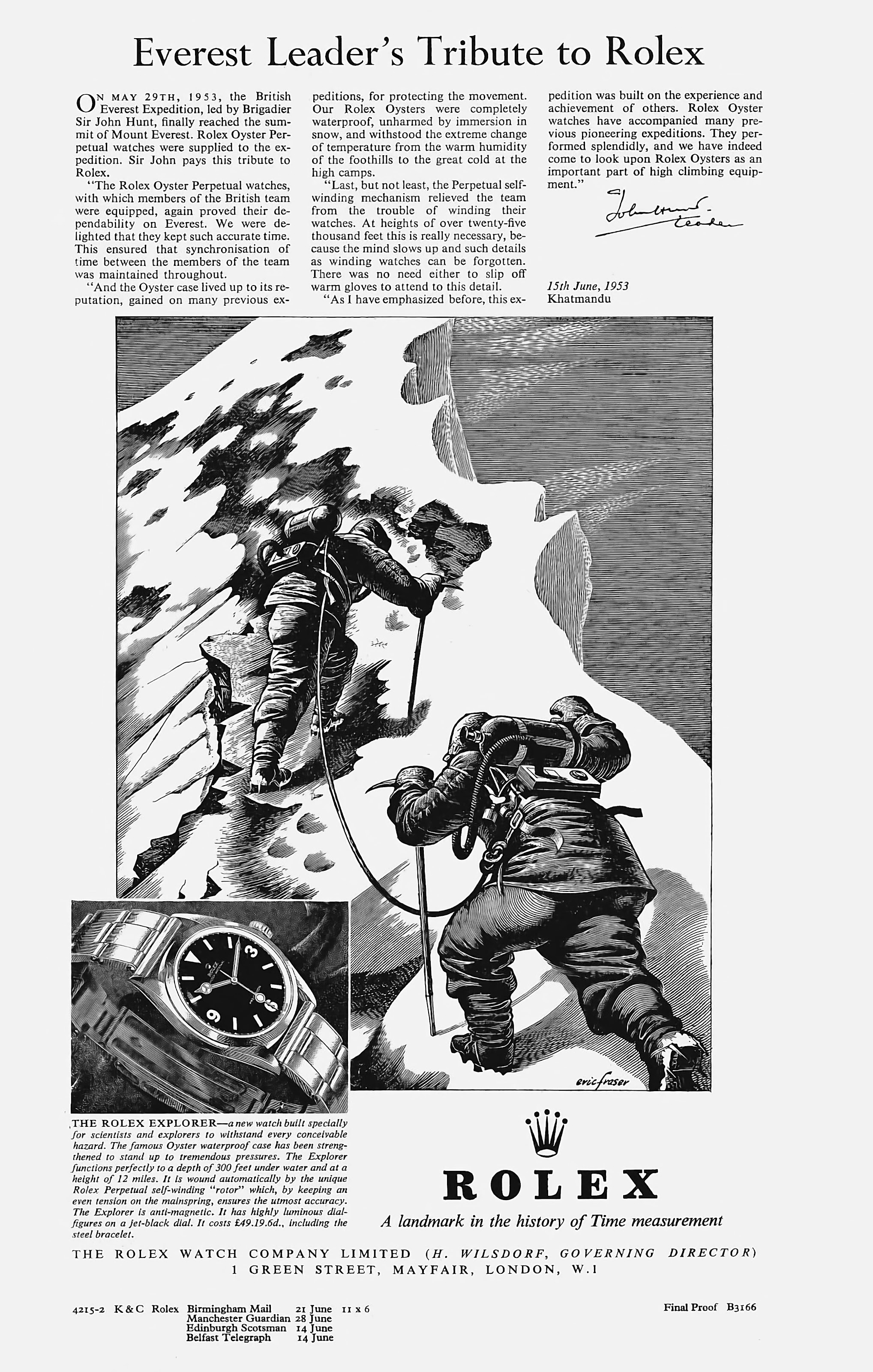
The advertisement was headed "Everest Leader's Tribute to Rolex". Beneath it ran three columns of a letter, dated "15th June, 1953" and datelined Khatmandu, with a signature reproduced at the end and the single word "Leader" under it. The writer was Brigadier Sir John Hunt, who had led the British expedition on which Sir Edmund Hillary and Tenzing Norgay reached the summit of Mount Everest on 29 May 1953.1
Underneath the letter sat an illustration of two climbers on a snow face, signed by Eric Fraser. And in the bottom left corner, in small italic copy at the foot of the page, Rolex introduced a watch that had not existed when the expedition set out.1
What the letter was asked to carry
Hunt's letter is a product report. It runs through three claims in order, each attached to a named feature. On accuracy: "The Rolex Oyster Perpetual watches, with which members of the British team were equipped, again proved their dependability on Everest. We were delighted that they kept such accurate time. This ensured that synchronisation of time between the members of the team was maintained throughout."1
On the case: "the Oyster case lived up to its reputation, gained on many previous expeditions, for protecting the movement. Our Rolex Oysters were completely waterproof, unharmed by immersion in snow, and withstood the extreme change of temperature from the warm humidity of the foothills to the great cold at high camps."1 On the rotor: "Last, but not least, the Perpetual self-winding mechanism relieved the team from the trouble of winding their watches. At heights of over twenty-five thousand feet this is really necessary, because the mind slows up and such details as winding watches can be forgotten. There was no need either to slip off warm gloves to attend to this detail."1
The closing sentence is the one Rolex was buying. "They performed splendidly, and we have indeed come to look upon Rolex Oysters as an important part of high climbing equipment."1 An expedition leader classified the watch as equipment, in writing, over his own signature, seventeen days after the summit.
The proof becomes a product
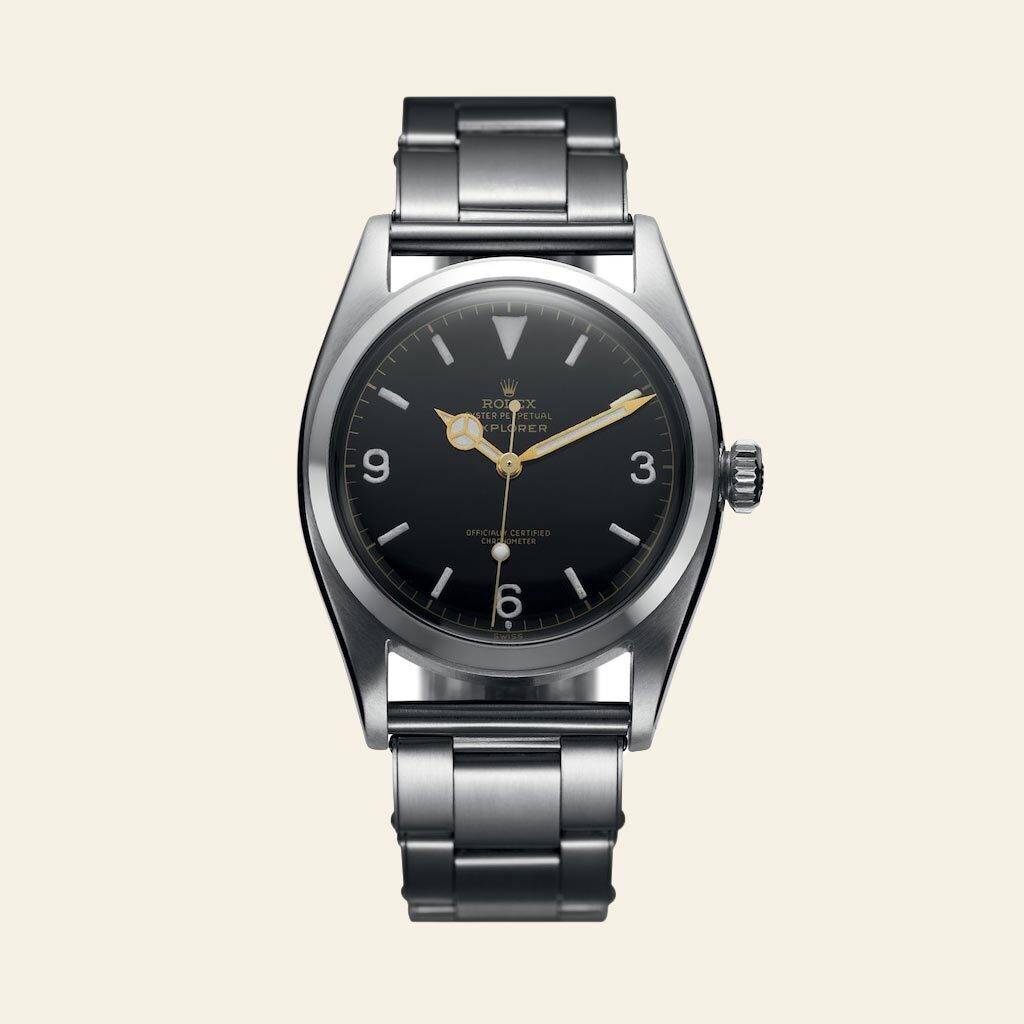
The small copy at the foot of the page does the commercial work. It introduces the Rolex Explorer as "a new watch built specially for scientists and explorers to withstand every conceivable hazard", states that the Oyster case "has been strengthened to stand up to tremendous pressures", and gives figures: the watch "functions perfectly to a depth of 300 feet under water and at a height of 12 miles". It is anti-magnetic, has luminous figures on a jet-black dial, and costs £49 19s 6d including the steel bracelet.1
Rolex's own history confirms the sequence and the intent: the expedition was equipped with Oyster Perpetual watches, and the Explorer was "launched in 1953 to celebrate the historic ascent of Everest".2 The advertisement is where the two halves meet. The testimonial validates the Oyster, which the expedition actually carried. The product copy sells the Explorer, which it did not. The reader is invited to complete the transfer without being asked to.
That transfer is the whole design of the page. Everything above the fold is evidence about a watch already in the catalogue; everything the buyer can act on is a watch that inherits the evidence by family resemblance. The Explorer arrived with a heritage on the day it went on sale.
Source: Rolex Youtube
The schedule is printed on the page
The surviving sheet is a final proof, and it carries its own media plan along the bottom edge: Birmingham Mail 21 June, Manchester Guardian 28 June, Edinburgh Scotsman 14 June, Belfast Telegraph 14 June, at a size given as eleven by six.1 Four regional and national titles, England, Scotland and Northern Ireland, within weeks of the summit. A national news event reached the press as a product launch in the same month it happened, which is a speed of response most advertisers of the period had no mechanism for.
The page is signed off by "THE ROLEX WATCH COMPANY LIMITED (H. WILSDORF, GOVERNING DIRECTOR)" at 1 Green Street, Mayfair, and closes with the line "A landmark in the history of Time measurement".1 Wilsdorf had been gathering proof from other people's undertakings since 1927, when he invited Mercedes Gleitze to wear an Oyster during her crossing of the English Channel and afterwards named her the first Rolex Testimonee.3 The difference here was that the proof arrived attached to a product launch rather than ahead of one.
The record is not uncontested. English Wikipedia's account of Smiths states that one of that company's De Luxe wristwatches was worn by Hillary on the ascent, adding that Rolex also supplied watches but that the only watch worn to the summit was a Smiths.4 The Rolex advertisement makes no claim about the summit itself. It quotes a leader on what the team used.
Written with AI assistance, edited by a human. Find out more about our Use of AI.
1. Rolex, "Everest Leader's Tribute to Rolex", newspaper advertisement, final proof B3166, reproduced in Chapter, "The most iconic Rolex vintage ads from the last 100 years", Repro Edition 8, text by Lejla Avdic, first published in Chapter No. XI, winter 2024/25, read 21 September 2026, for the opening sentence dating the summit of Mount Everest by the British expedition led by Brigadier Sir John Hunt to 29 May 1953, the headline, the letter dated 15th June 1953 and datelined Khatmandu with the signature and the word Leader beneath it, every passage of Brigadier Sir John Hunt's letter quoted in the body, the illustration signed by Eric Fraser, the product copy introducing the Rolex Explorer with its depth and altitude figures, its anti-magnetic and dial specifications and its price of £49 19s 6d including the steel bracelet, the imprint of The Rolex Watch Company Limited with H. Wilsdorf as governing director at 1 Green Street, Mayfair, the line "A landmark in the history of Time measurement", and the insertion schedule naming the Birmingham Mail on 21 June, the Manchester Guardian on 28 June, and the Edinburgh Scotsman and Belfast Telegraph on 14 June, at a size of eleven by six. The schedule is set in the smallest type on the sheet and a misreading of those dates off the reproduction cannot be excluded. The proof is read from the reproduction rather than from an original; small type is legible but not verifiable against an archive copy. Chapter captions this image 1955 while its own file name reads 1953; the artwork is internally dated by the summit of 29 May 1953 and the letter of 15 June 1953, which is what this verse follows. The product copy is joined to the model name by a dash in the original, which this journal does not reproduce, so the quotation begins after it. Chapter is a design magazine and is not on the journal's source whitelist; it is cited here as the publisher of the reproduced artwork, not as an authority on the facts. https://chapter.digital/en/watches-rolex-vintage-ads/
2. Rolex, "Rolex History, 1953 to 1967", retrieved 21 September 2026, for the 1953 expedition led by Sir John Hunt being equipped with Oyster Perpetual watches, for Sir Edmund Hillary and Tenzing Norgay reaching the summit, and for the Explorer being launched in 1953 to celebrate the ascent. https://www.rolex.com/en-us/about-rolex/history/1953-1967
3. Rolex, "Behind the crown, Rolex and Partners", retrieved 21 September 2026, for Hans Wilsdorf inviting Mercedes Gleitze to wear an Oyster during her crossing of the English Channel in 1927 and for her being named the first Rolex Testimonee. https://www.rolex.com/en-us/about-rolex/behind-the-crown/rolex-partners
4. Wikipedia, "Smiths Group", read 21 September 2026, for the statement that one of Smiths' De Luxe wristwatches was worn by Edmund Hillary on the ascent of Mount Everest, and that Rolex also supplied watches but the only watch worn to the summit was a Smiths. The article gives no account of Smiths advertising on the ascent, and none is claimed here. https://en.wikipedia.org/wiki/Smiths_Group