A watch on a ribbon
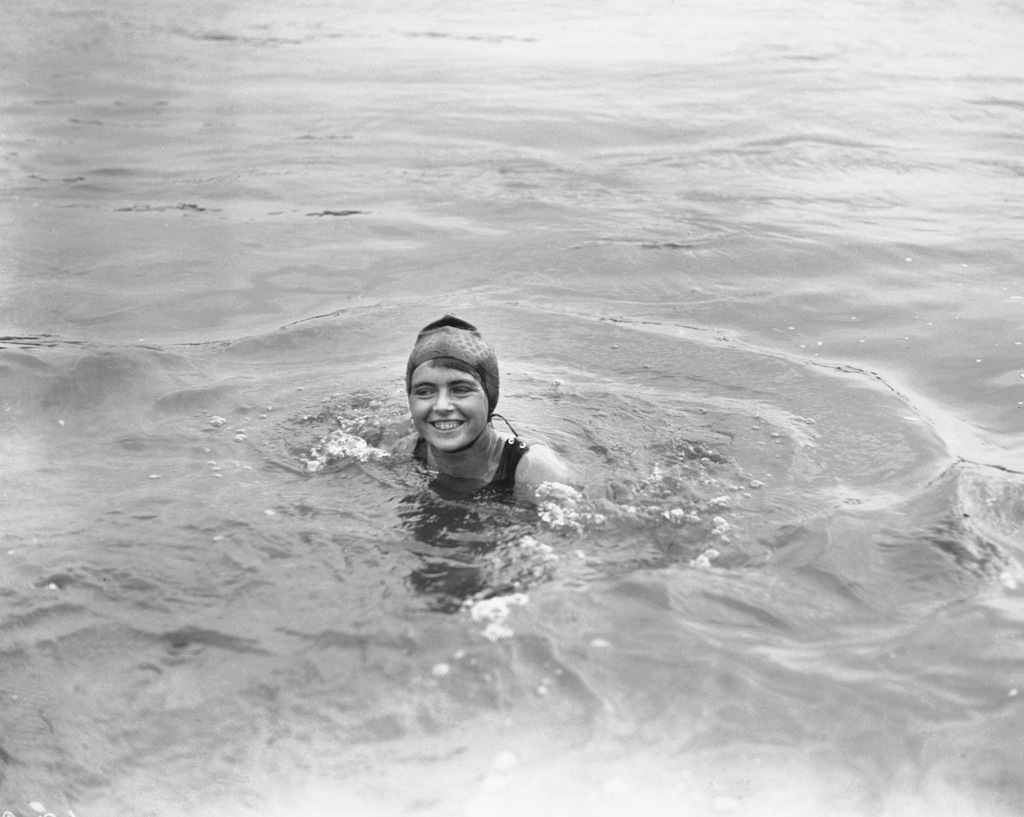
On 7 October 1927 Mercedes Gleitze became the first British woman to swim the English Channel, at her eighth attempt and after 15 hours and 15 minutes in the water, watched by an observer representing the Channel Swimming Association's predecessor committee.1 Days later a doctor, Dorothy Cochrane Logan, swimming under the name Mona McLennan, claimed a faster crossing and collected a prize of 1,000 pounds from the News of the World. On 17 October Logan told the paper's editor that she had faked the swim to show how easily a Channel crossing could be claimed without independent observers, and on 7 November she was fined 100 pounds for perjury. She had been in the water about four hours and spent the rest of the crossing on the support boat.1 The admission cast doubt on other recent claims, Gleitze's included.1
Under pressure from the media she agreed to swim again, in water much colder than when Channel swimming is normally attempted.2 She entered at Cap Gris-Nez at 4.21 on the morning of 21 October 19273 and was lifted out seven miles short of Dover after 10 hours and 24 minutes, by then slipping in and out of consciousness.1 She did not reach England. Her endurance of the cold convinced the doubters, and the October record was allowed to stand.2
Rolex supplied her with an Oyster for that second attempt, in exchange for a written testimonial. The Times reported: "Hanging round her neck by a riband on this swim, Miss Gleitze carried a small gold watch, which was found this evening to have kept good time throughout."3 The watch survives, a nine carat gold octagonal Oyster, reference 34075, and its case back carries the inscription Miss M. Gleitze The Companion "Oyster". Vindication Channel Swim. October 21st. 1927, which names the second swim and not the crossing. It passed by descent through Gleitze's family and was sold at Christie's in London on 12 June 2000, then held in a private collection for 25 years and sold again at Sotheby's in Geneva on 9 November 2025.4
The front page
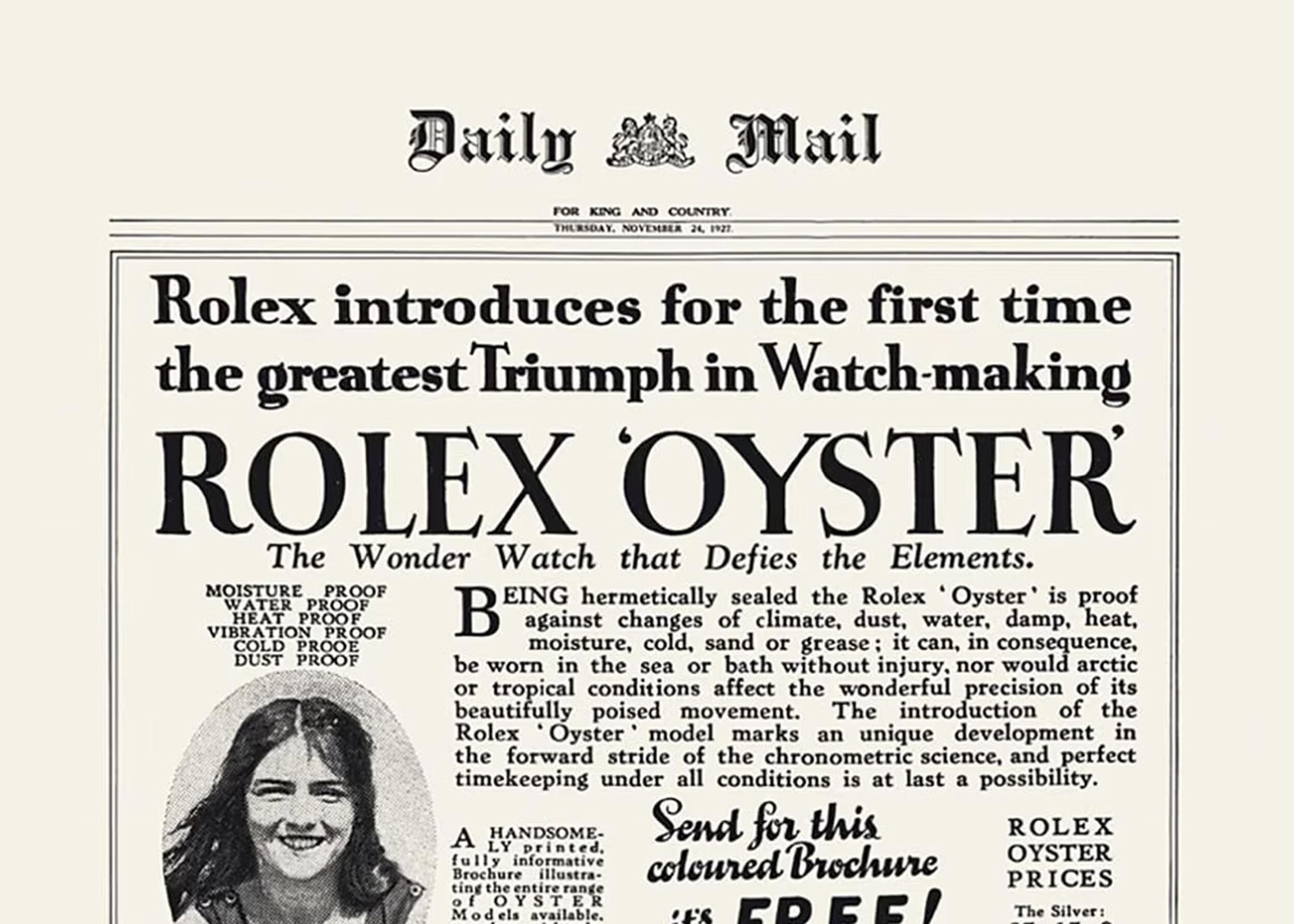
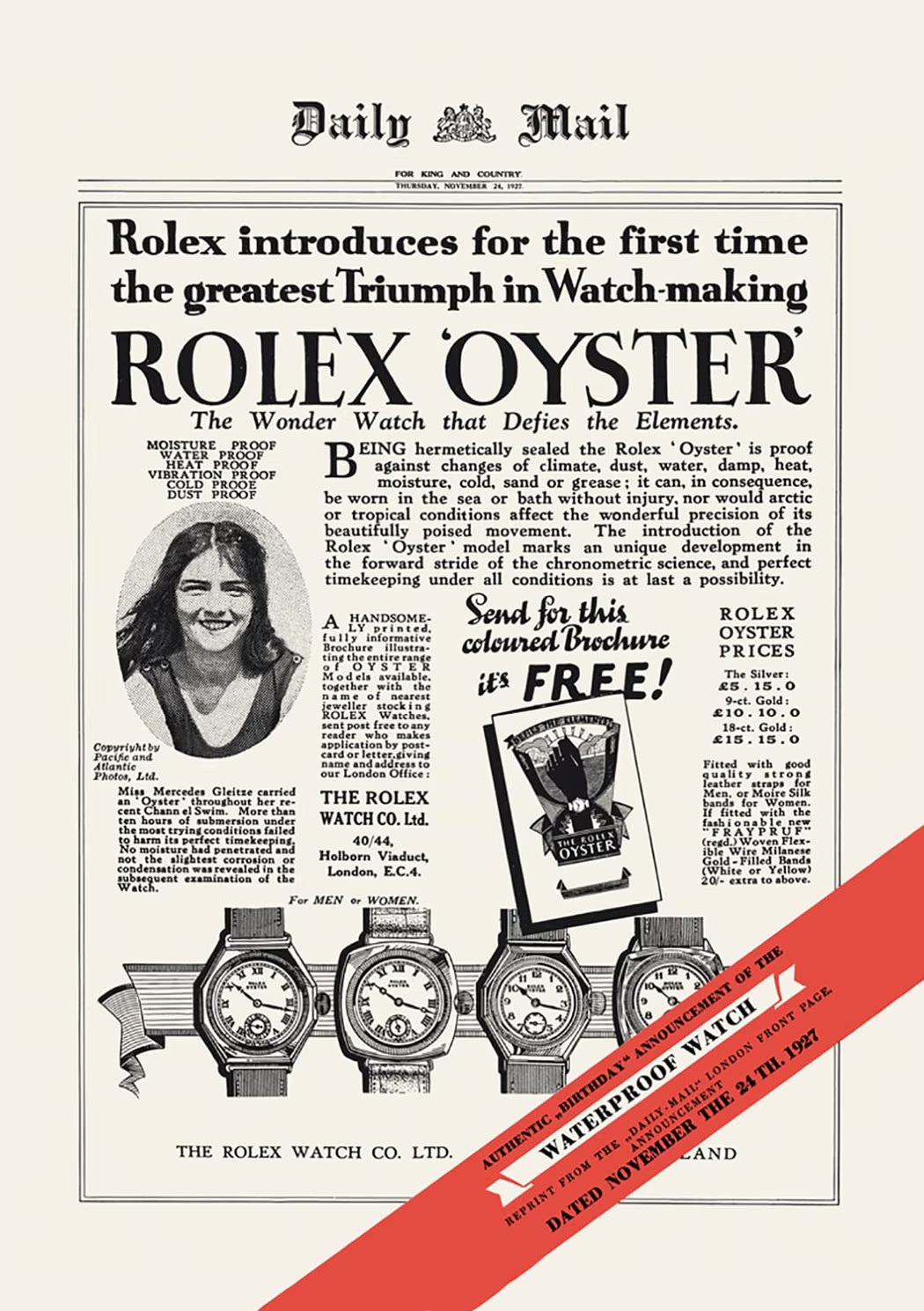
A month after the vindication swim Rolex bought the front page of the Daily Mail. Secondary accounts date the advertisement to 24 November 1927 and describe Rolex taking the entire page.5 English Wikipedia gives a longer version, a front-page advertisement in every issue for a month.6 Rolex publishes neither a day nor a duration, only the fact and what it takes from it: "To celebrate the crossing of the channel, Rolex published a full-page ad on the front page of the Daily Mail proclaiming the success of the waterproof watch. This event marked the birth of the Testimonee concept."7
On 25 October, four days after the swim, Gleitze wrote to the company that the Oyster "proved itself a reliable and accurate timekeeping companion even though it was subjected to complete immersion for hours in sea water at a temp of not more than 58 and often as low as 51".5 No archive consulted reproduces the advertisement's copy, so the letter is the only text from the campaign that can be read today.
Which swim
Rolex's current history page ends one paragraph with two statements. The first: "In 1927 a Rolex Oyster crossed the English Channel, worn by a young English swimmer named Mercedes Gleitze." The second: "The swim lasted over 10 hours and the watch remained in perfect working order at the end of it."7 The crossing Gleitze completed took 15 hours and 15 minutes.1 The inscription on the case back names the swim of 21 October, the one she did not finish.4
The word arrived afterwards
Rolex titles its page on her "The first Rolex Testimonee" and dates the birth of the concept to her swim. The term is the company's own, capitalised, and still in service: the page for its tennis partnerships is titled Rolex Testimonees in Tennis and lists 32 testimonees.8
Celebrity endorsement predated 1927. Lillie Langtry fronted Pears Soap in 1882, and Wedgwood had used royal endorsement in the eighteenth century.9 What Rolex claims is about its own practice: a named category of partner, which it dates to this swim.7 The proof the campaign rested on is in Gleitze's letter, which records an immersion, a duration and a water temperature in the swimmer's own words, written four days after she came out of the sea.5 Rolex also submerged Oyster models in aquariums displayed in the windows of its main points of sale, where the same demonstration was available to anyone walking past.6
Written with AI assistance, edited by a human. Find out more about our Use of AI.
1. World Open Water Swimming Association, "The Truth Behind Mercedes Gleitze's Vindication Swim and the Hoax That Changed Open Water Swimming", and Brighton & Hove Museums, "Champion swimmer and record breaker: Mercedes Gleitze", Brighton & Hove Museums for the 15 hours and 15 minutes of the 7 October 1927 crossing, the eighth attempt and Gleitze being the first British woman to complete it; the World Open Water Swimming Association additionally for the observer representing the Channel Swimming Association's predecessor committee, for Dorothy Cochrane Logan's claim, her prize from the News of the World, her roughly four hours in the water and the rest of the crossing spent on the support boat, her stated motive, her confession on 17 October 1927 and her fine on 7 November 1927, for the doubt her admission cast on other claimants, and for the 10 hours and 24 minutes, the seven miles short of Dover and her slipping in and out of consciousness on 21 October 1927. https://www.openwaterswimming.com/the-truth-behind-mercedes-gleitzes-vindication-swim-and-the-hoax-that-changed-open-water-swimming/ and https://brightonmuseums.org.uk/discovery/history-stories/champion-swimmer-and-record-breaker-mercedes-gleitze/
2. Wikipedia, "Mercedes Gleitze", for the vindication swim undertaken under pressure from the media in water colder than when Channel swimming is normally attempted, and for her endurance of the cold convincing the doubters so that the original record stood. https://en.wikipedia.org/wiki/Mercedes_Gleitze
3. Time+Tide, "Rolex myths: from Everest to The Great Escape to the English Channel", and LoneSwimmer, "Mercedes Gleitze and the Vindication Swim", Time+Tide for Rolex supplying the Oyster for the second swim in exchange for a written testimonial; LoneSwimmer additionally for the start at Cap Gris-Nez at 4.21 a.m. on 21 October 1927; both for the report in The Times quoted in the body. Neither source gives the issue date of The Times report. https://timeandtidewatches.com/rolex-myths-from-everest-to-the-great-escape-to-the-english-channel/ and https://loneswimmer.com/2013/10/18/mercedes-gleitze-and-the-vindication-swim/
4. Sotheby's, lot 134, "Important Watches Including the Gunter Sachs Cartier Portico Mystery Clock and the Mercedes Gleitze Rolex Oyster", Geneva, sale closed 9 November 2025, for reference 34075, the nine carat gold octagonal Oyster case, the case back engraving reading Miss M. Gleitze The Companion "Oyster". Vindication Channel Swim. October 21st. 1927, and for the provenance: from Gleitze by descent through her family, sold at Christie's London on 12 June 2000, held by a private collector for 25 years, and sold again in the Geneva sale that closed on 9 November 2025. https://www.sothebys.com/en/buy/auction/2025/important-watches-part-i-ge2504/the-companion-oyster-mercedes-gleitze-rolex-oyster
5. Rondeau, "The true story of Mercedes Gleitze and the Rolex Oyster", and Consuming Cultures, "Life's defining moments, ad of the week", for the dating of the advertisement to 24 November 1927, for Rolex taking the entire front page, and for Gleitze's letter of 25 October 1927 as quoted in the body including its temperature clause. Rolex itself publishes no date for the advertisement. https://rondeau.watch/2022/01/10/the-true-story-of-mercedes-gleitze-and-the-rolex-oyster/ and https://www.consumingcultures.net/2013/02/24/lifes-defining-moments-ad-of-the-week/
6. Wikipedia, "Rolex", for the account of a full-page front-page advertisement in every issue of the Daily Mail for a month, and for Rolex submerging Oyster models in aquariums displayed in the windows of its main points of sale. https://en.wikipedia.org/wiki/Rolex
7. Rolex, "History 1926-1945", retrieved 19 September 2026, for Rolex's own account of the Daily Mail advertisement and the birth of the Testimonee concept, and for the two sentences quoted in the body stating that a Rolex Oyster crossed the English Channel worn by Mercedes Gleitze and that the swim lasted over 10 hours and the watch remained in perfect working order at the end of it, and for Rolex dating a named category of partner to this swim. https://www.rolex.com/en-us/about-rolex/history/1926-1945
8. Rolex, "The first Rolex Testimonee, Mercedes Gleitze", and Rolex, "Rolex Testimonees in Tennis", both retrieved 19 September 2026, for the Testimonee label applied to Gleitze and dated to her swim, for the title of the tennis page and for its count of 32 testimonees. https://www.rolex.com/en-us/oyster-story/living-laboratory/mercedes-gleitze and https://www.rolex.com/en-us/rolex-family/tennis
9. Wikipedia, "Celebrity branding", for Lillie Langtry fronting Pears Soap in 1882 and for Wedgwood using royal endorsement in the eighteenth century. https://en.wikipedia.org/wiki/Celebrity_branding