The watch that was not allowed inside
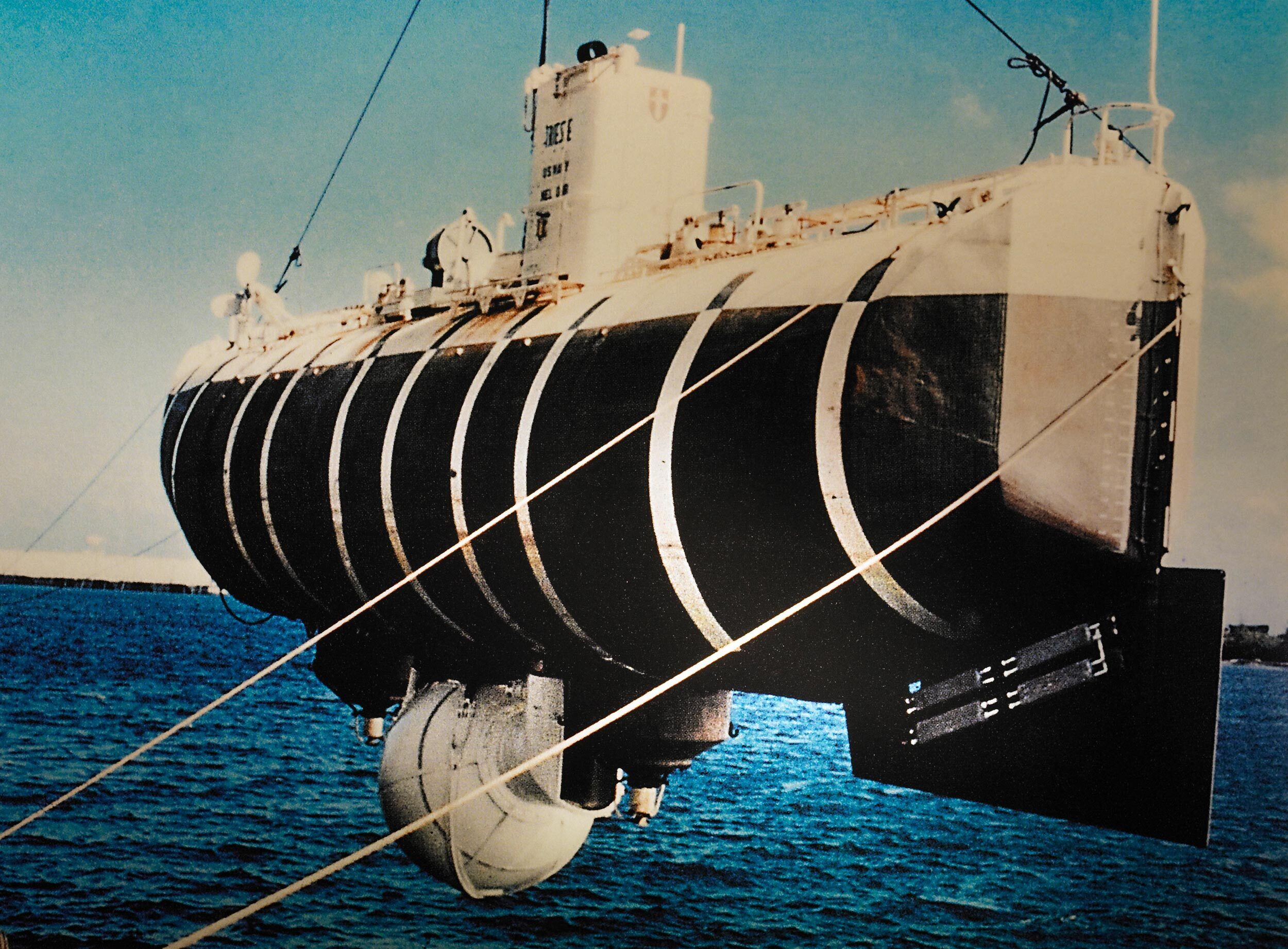
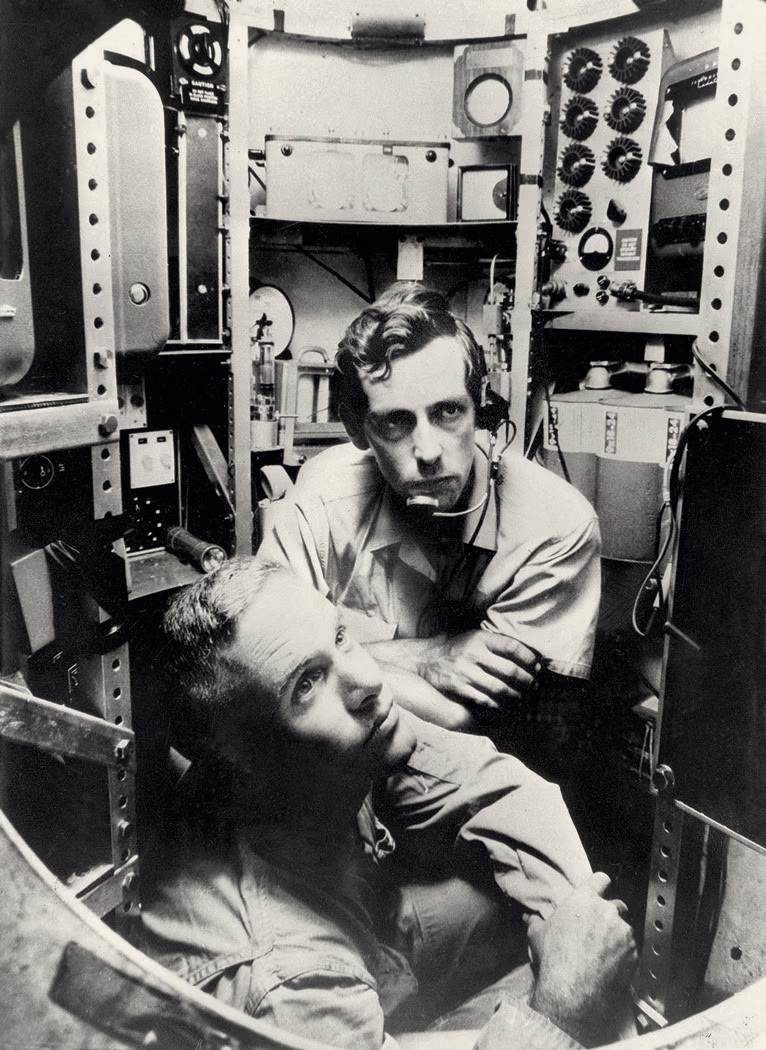
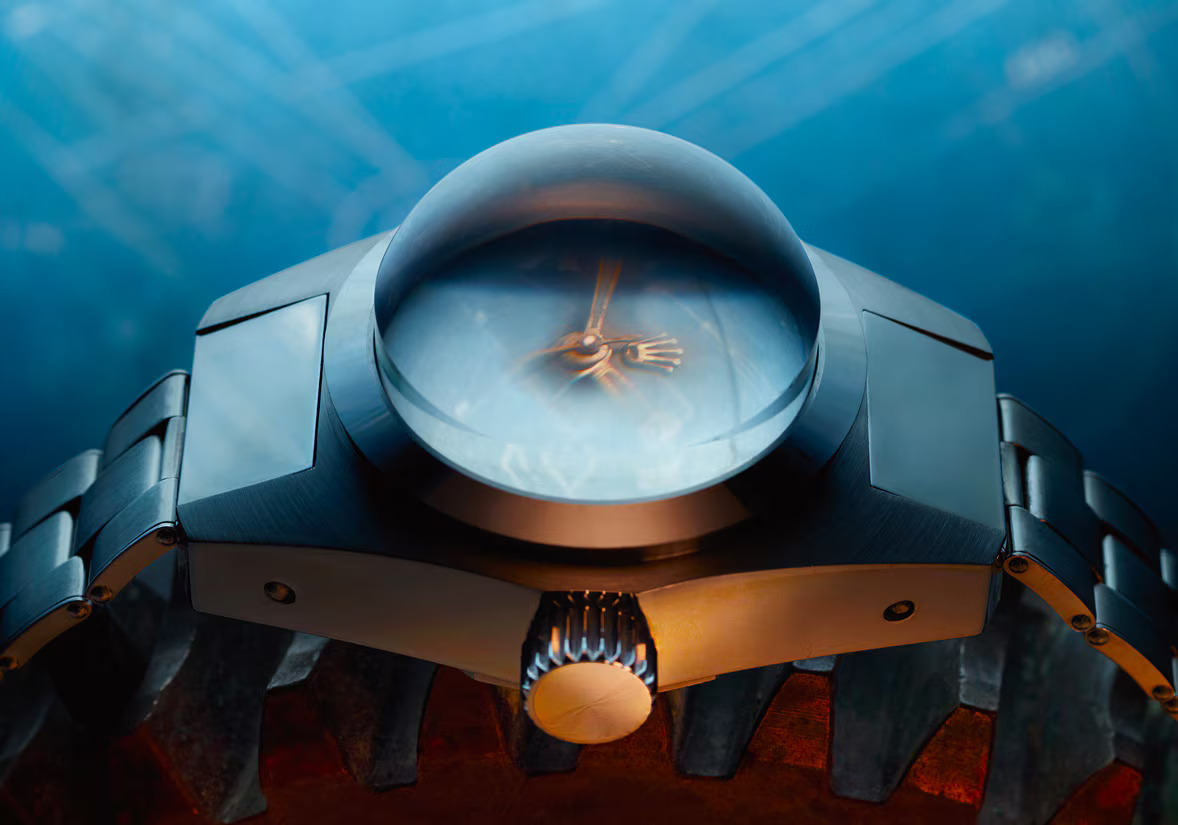
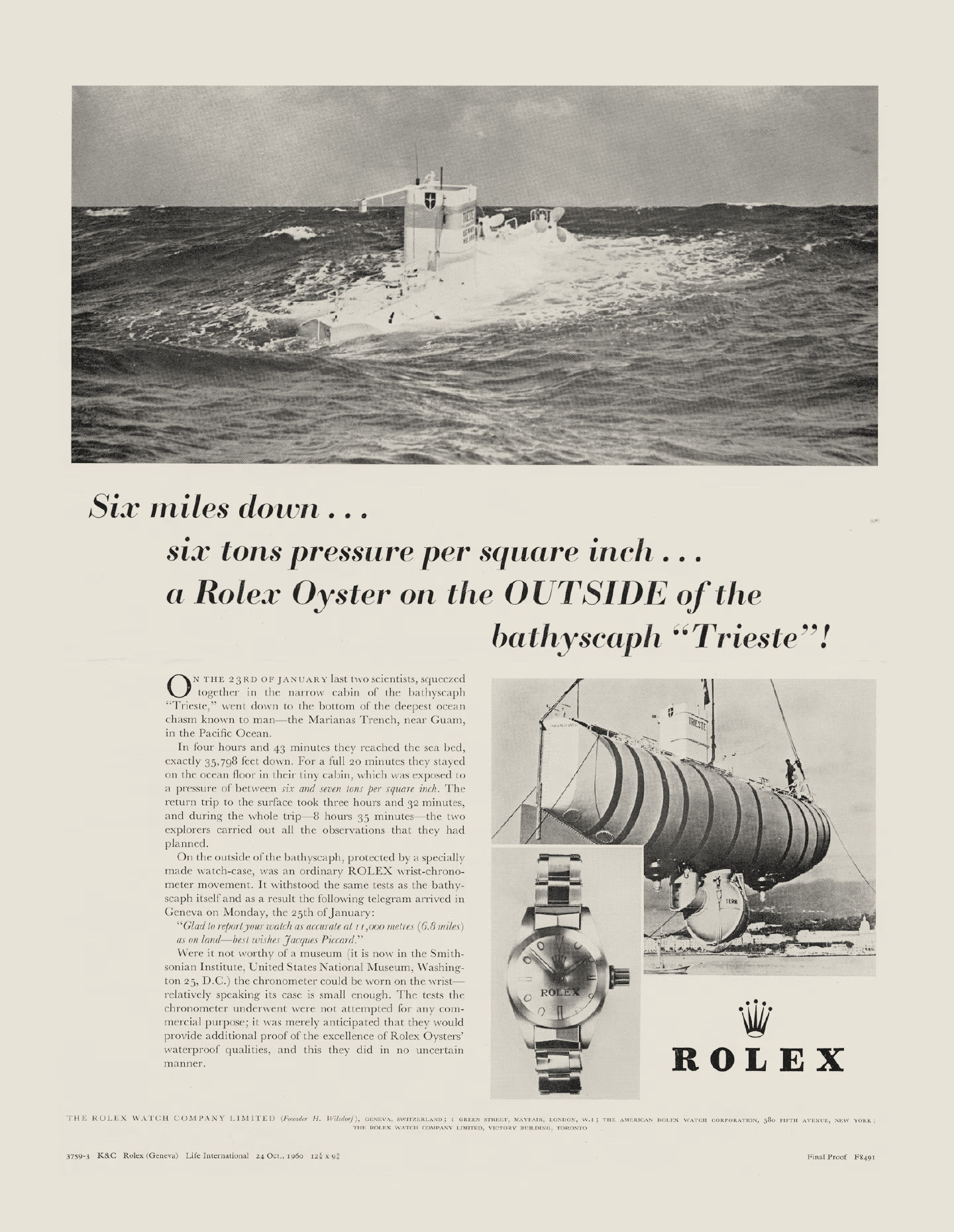
On 23 January 1960 Lieutenant Don Walsh of the United States Navy and the Swiss oceanographer Jacques Piccard took the bathyscaphe Trieste to the floor of the Challenger Deep, the deepest known point of the Mariana Trench. Rolex had an experimental watch on the dive, called the Deep Sea Special. It was not in the cabin. It was attached to the outside of the vessel, in the water, at the pressure the hull was built to keep out. The Trieste surfaced nearly nine hours later and the watch was intact.1
The placement is the whole of the branding decision. A watch worn by a crew member would have proved that the crew survived. A watch bolted to the hull proved only one thing, and proved it without a person in the way. Rolex had spent decades borrowing other people's achievements as evidence, from Mercedes Gleitze in 1927 onward.1 Here it removed the person and kept the test.
What the brand gains by removing the wearer
A testimonial is a loan. It carries the credibility of whoever gives it, and it carries their risk too: they can be disputed, they can be overtaken, they can turn out to be the wrong person to be standing next to. Every claim Rolex had built since 1927 was of that kind, and every one of them depended on a name the company did not own.
A watch on the outside of a hull is a different instrument. The figure it produces, 10,916 metres, belongs to nobody and can be repeated by anyone with the equipment.1 It needs no consent, no contract and no renewal. It is also the first Rolex proof that cannot be delivered by wearing the product at all, which is a strange thing for a wristwatch brand to want and a very durable thing to own: the claim outlives the news cycle, the crew and the expedition, because it is a specification rather than a story.
The third one built
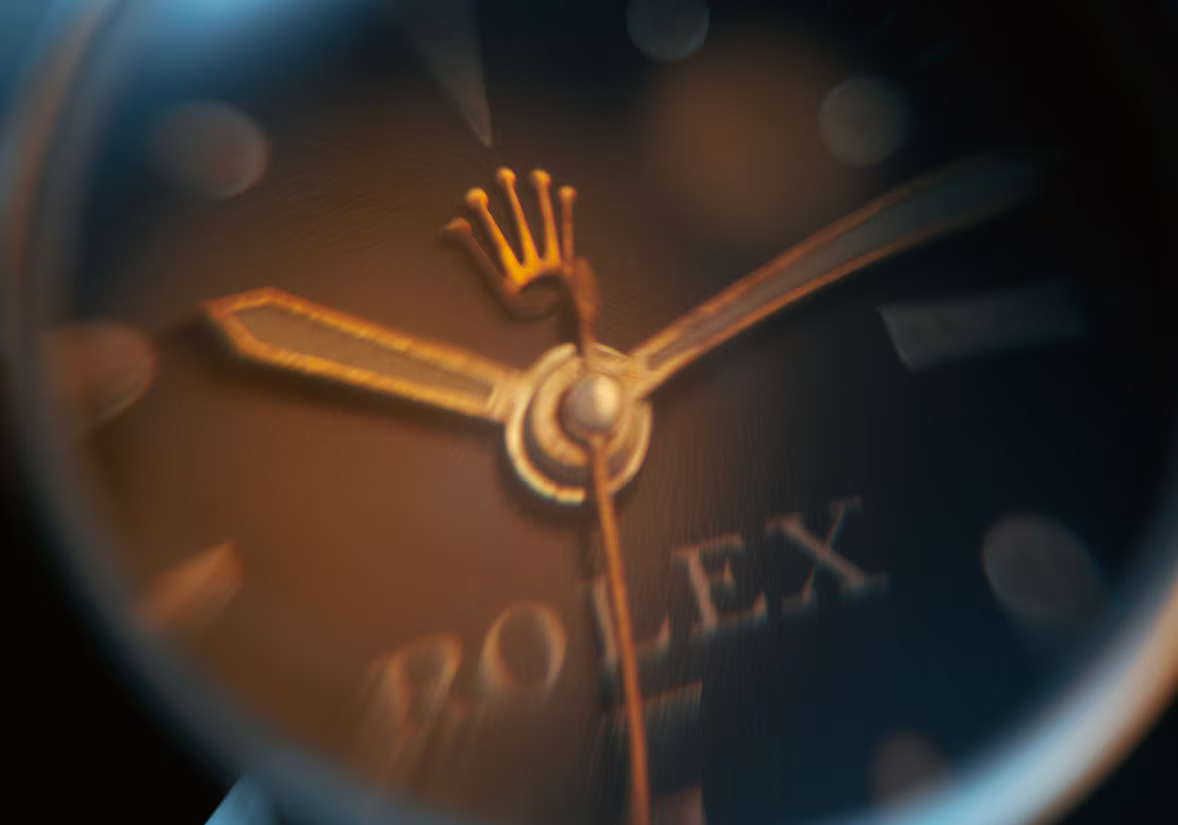
The watch on the hull was not a first attempt. Rolex describes testing an experimental watch called Deep Sea Special through the 1950s, and says the third of them was built using the knowledge gained from the first two, specifically for the Challenger Deep.2 The company was not improvising a publicity stunt around somebody else's expedition; it had a development programme running and a dive to finish it on.
That distinction matters for how the story is told afterwards. The Everest expedition of 1953 produced a testimonial from a man, printed as a letter over his signature and used to introduce a new model at a stated price.3 The Trieste dive produced a measurement, and a measurement does not need a signature.
The programme also had a commercial descendant within seven years. In 1967 Rolex launched the Sea-Dweller, waterproof to 610 metres, with a helium escape valve built into the case so that gas absorbed during saturation diving could leave during decompression without damaging the watch.2 That is a feature written for a working condition rather than for a record attempt, and it set the pattern the deep-water line has followed since: an extreme test first, a specification for professionals second, a model in the catalogue third.
Source: Rolex Youtube
The proof ends up engraved on a product
Rolex went back to the same trench with the same method. In March 2012 the company took part in James Cameron's DEEPSEA CHALLENGE expedition, and an experimental watch, the Rolex Deepsea Challenge, was again attached to the outside of the submersible for a descent Rolex gives as 10,908 metres, or 35,787 feet.4
Two years later the experiment became a catalogue model. Rolex presented the Deepsea Challenge in 2014, waterproof to 11,000 metres and made from RLX titanium, and engraved the back of its case with the words "Mariana Trench" and two dates: 23-01-1960 and 26-03-2012.4 The 1960 dive is no longer a story the company tells about itself. It is a line of type on the back of a watch that can be bought, sitting where a serial number might, carried by the owner as a record of something that happened before they were born.
Rolex has kept the habit of putting the evidence where it can be seen, and the caseback dates are the clearest case of it.4 What the Trieste added in 1960 was the demonstration that the brand's central claim could be tested without anyone wearing anything, and the company has been drawing on that particular dive for sixty-six years.
Neither Rolex's history nor its partners page names who decided to mount the watch externally, or who built the fixture. No advertisement from 1960 is cited here; the account rests on the company's own retrospective pages.1, 2, 4
Source: Rolex Youtube
Written with AI assistance, edited by a human. Find out more about our Use of AI.
1. Rolex, "Behind the crown, Rolex and Partners", retrieved 21 September 2026, for the dive of 23 January 1960 by Lieutenant Don Walsh of the US Navy and the Swiss oceanographer Jacques Piccard, for the Trieste reaching the sea floor of the Mariana Trench, for the depth given on that page as 10,916 metres and 35,800 feet, for the experimental Rolex Deep Sea Special being strapped to the hull rather than carried inside, for the Trieste surfacing nearly nine hours later with the watch intact, and for Hans Wilsdorf inviting Mercedes Gleitze to wear an Oyster during her crossing in 1927 and naming her the first Rolex Testimonee. https://www.rolex.com/en-us/about-rolex/behind-the-crown/rolex-partners
2. Rolex, "Rolex History, 1953 to 1967", retrieved 21 September 2026, for the account of the Deep Sea Special being tested through the 1950s with the third example built from the knowledge gained from the first two, specifically for the Challenger Deep portion of the Mariana Trench, and for the 1967 launch of the Sea-Dweller waterproof to 610 metres with a helium escape valve allowing helium from the gas mixtures used in saturation diving to be released during decompression without damaging the watch. https://www.rolex.com/en-us/about-rolex/history/1953-1967
3. Chapter, "The most iconic Rolex vintage ads from the last 100 years", Repro Edition 8, read 21 September 2026, for the 1953 final proof carrying Brigadier Sir John Hunt's testimonial letter over his signature and introducing the Rolex Explorer with its specification and its price. That advertisement is treated at length in Brandvelle, "Rolex launched the Explorer on a letter from Everest". Chapter is a design magazine and is not on the journal's source whitelist; it is cited as the publisher of the reproduced artwork. https://chapter.digital/en/watches-rolex-vintage-ads/
4. Rolex, "Rolex Deepsea and Deepsea Challenge, Journey to the deep", retrieved 21 September 2026, for the 2012 DEEPSEA CHALLENGE expedition with James Cameron and the depth of 10,908 metres and 35,787 feet, for the experimental Rolex Deepsea Challenge attached to the outside of the submersible, and for the 2014 presentation of the Deepsea Challenge in RLX titanium, waterproof to 11,000 metres, bearing the inscription Mariana Trench and the dates 23-01-1960 and 26-03-2012 engraved on the back of its case. The year labels on this page render out of step with the entries beneath them; every figure and date cited here is taken from the entry text and from the caseback inscription it describes, not from the headings. https://www.rolex.com/en-us/watches/deepsea/deepsea-challenge/journey-to-the-deep