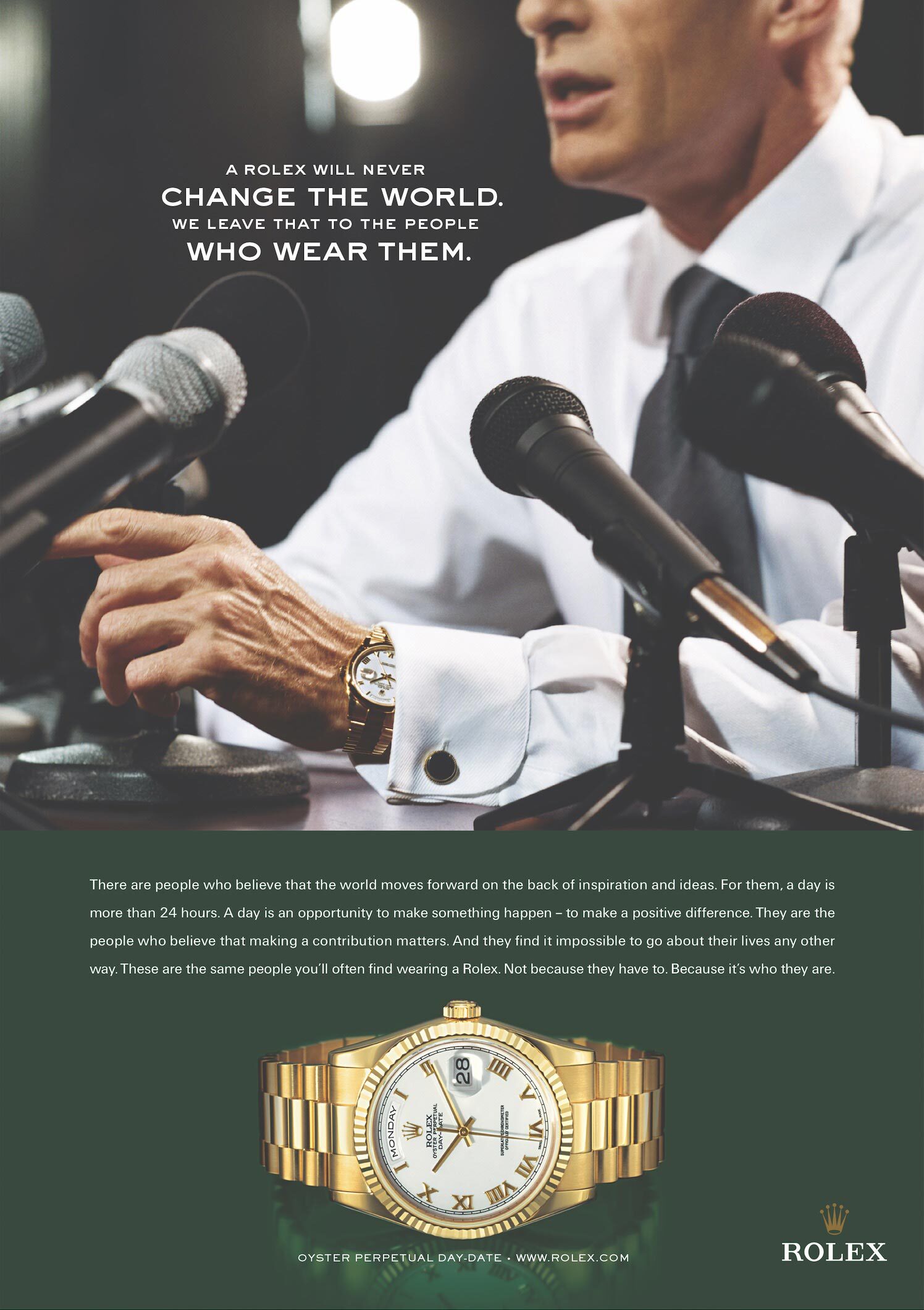
An advertiser argues against its own product
The headline ran across four lines, two of them set large: "A ROLEX WILL NEVER CHANGE THE WORLD. WE LEAVE THAT TO THE PEOPLE WHO WEAR THEM."1 The first clause withdraws the claim the category usually exists to make, and the second gives it away.
The photograph underneath shows no extreme setting. A man in a white shirt and dark tie sits behind a bank of microphones at what reads as a press conference, one hand on a stand, a yellow gold Oyster Perpetual Day-Date on a President bracelet showing at the cuff. No summit, no cockpit, no dive. The setting is a room in which somebody has to answer for something. The watch is signed off at the foot of the page as Oyster Perpetual Day-Date, above the rolex.com address.1
The copy names a disposition, not a buyer
The body copy runs eight sentences and never describes the watch. It opens: "There are people who believe that the world moves forward on the back of inspiration and ideas. For them, a day is more than 24 hours." It goes on that a day is an opportunity to make something happen, to make a positive difference.1
Then the close, which is where the mechanism sits: "They are the people who believe that making a contribution matters. And they find it impossible to go about their lives any other way. These are the same people you'll often find wearing a Rolex. Not because they have to. Because it's who they are."1
Three things are ruled out in those last two sentences. Not utility, since nothing is said about what the watch does. Not status, since nobody is said to buy it for effect. Not even aspiration, since the reader is not told to become anything. What is left is recognition. The watch is offered as a marker that a certain kind of person already is what they are, and the purchase is described as a consequence rather than a cause. It is also a line written for the model that spells the day out in full: a day being more than 24 hours lands on the one Rolex whose distinguishing feature is the word at the top of the dial.
The claim Rolex makes elsewhere
Rolex is less restrained about the Day-Date on its own pages. Rolex dates the model to 1956, available only in 18 carat gold or platinum, and describes it as the first wristwatch to display the date and the day of the week spelt out in full in a window on the dial, with the President bracelet created for it. It calls the model "the watch par excellence of influential people", and under a heading reading Leadership it writes that its watches "have long been associated with those who have, over time, guided the destiny of the world".2
The two sentences do not sit together easily. The advertisement says the watch will never change the world; the corporate history says the watches are associated with people who have guided its destiny. Both are Rolex's own wording, and the difference between them is the difference between a page written to be read by a buyer and a page written to be read as a record.
The motif also sits awkwardly against the era it belongs to. Chapter, which reproduced the artwork, describes Rolex's advertising from the 1980s onward as turning to more opulent and luxurious motifs that portrayed the watches as the insignia of success, with the Day-Date, the watch it calls the presidential one, at the centre of that turn.3 That is the account of a magazine rather than of Rolex, but the page in question does not behave the way it describes. The gold is there and the bracelet is there, and the copy spends its eight sentences refusing to trade on either.
What moved in half a century
In 1953 Rolex ran a letter from the leader of the British Everest expedition, over his signature, certifying that the Oyster kept time, resisted snow and wound itself, and used the page to introduce the Explorer at a stated price. The evidence ran from the expedition to the watch.4
By 2005 the direction had reversed. Nothing certifies the watch; the watch is produced as a detail that certifies a person. The proof has moved off the object and onto the owner, and the advertiser has stopped asking to be believed about the product at all.
The date is the one given by the magazine that reproduced the artwork, which prints a year and no publication. No campaign name, agency or writer was found for it in any permitted source.1
Written with AI assistance, edited by a human. Find out more about our Use of AI.
1. Rolex, Oyster Perpetual Day-Date advertisement, dated 2005, reproduced in Chapter, "The most iconic Rolex vintage ads from the last 100 years", Repro Edition 8, text by Lejla Avdic, first published in Chapter No. XI, winter 2024/25, read 21 September 2026, for the headline in its original capitals, every sentence of the body copy quoted in the body of this article, the photograph of a man behind a bank of microphones wearing a yellow gold Day-Date on a President bracelet, and the sign-off reading Oyster Perpetual Day-Date above the rolex.com address. Chapter prints the year 2005 and names no publication, no campaign, no agency and no writer, and none was found in the advertising or design trade press searched. The third sentence of the body copy joins two of its clauses with an en dash. That sentence is paraphrased rather than quoted, so no dash falls inside any quotation in this article and no quoted passage is split, elided or re-punctuated. Chapter is a design magazine and is not on the journal's source whitelist; it is cited as the publisher of the reproduced artwork, not as an authority on the facts. https://chapter.digital/en/watches-rolex-vintage-ads/
2. Rolex, "Rolex History, 1953 to 1967", retrieved 21 September 2026, for the Day-Date's debut in 1956, its availability only in 18 carat gold or platinum, its being the first wristwatch to display the date and the day of the week spelt out in full in a window on the dial, the President bracelet created for it, the description of it as the watch par excellence of influential people, and for the passage under the heading Leadership about watches long associated with those who have guided the destiny of the world. https://www.rolex.com/en-us/about-rolex/history/1953-1967
3. Lejla Avdic, "The most iconic Rolex vintage ads from the last 100 years", Chapter, Repro Edition 8, first published in Chapter No. XI, winter 2024/25, read 21 September 2026, for the magazine's own account of Rolex advertising from the 1980s onward turning to more opulent and luxurious motifs portraying the watches as insignia of success, with the Day-Date, which it calls the presidential watch, at the centre. This is the publication's reading of the period and is attributed as such, not asserted as fact. https://chapter.digital/en/watches-rolex-vintage-ads/
4. Chapter, "The most iconic Rolex vintage ads from the last 100 years", Repro Edition 8, read 21 September 2026, for the 1953 final proof carrying Brigadier Sir John Hunt's testimonial letter and introducing the Explorer with its specification and price. That advertisement is treated at length in Brandvelle, "Rolex launched the Explorer on a letter from Everest". https://chapter.digital/en/watches-rolex-vintage-ads/