
A drive-thru without the drive
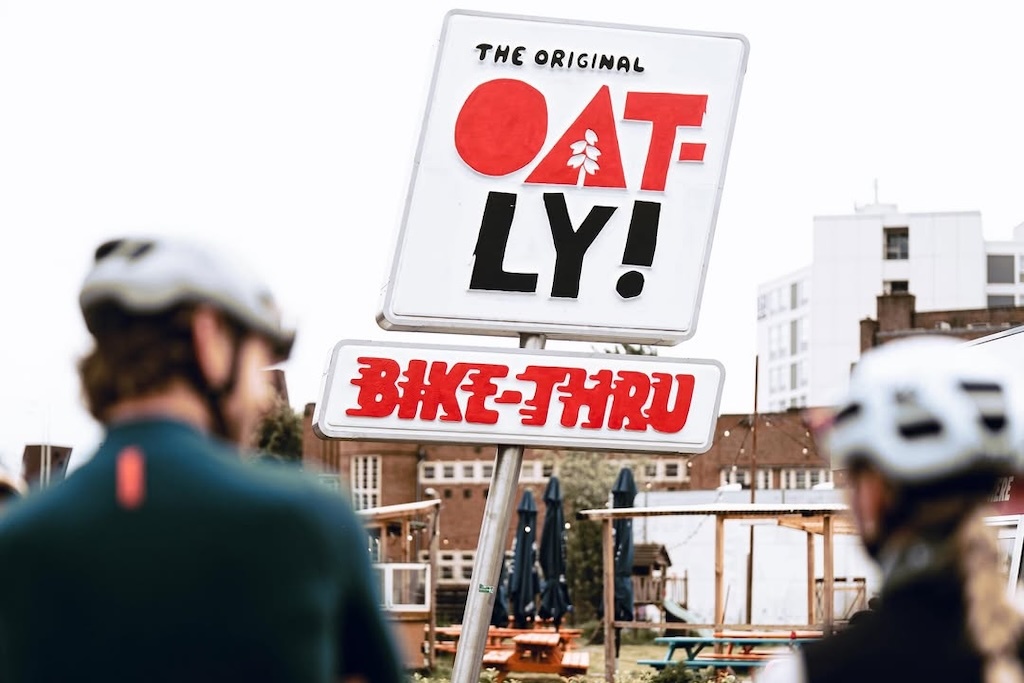
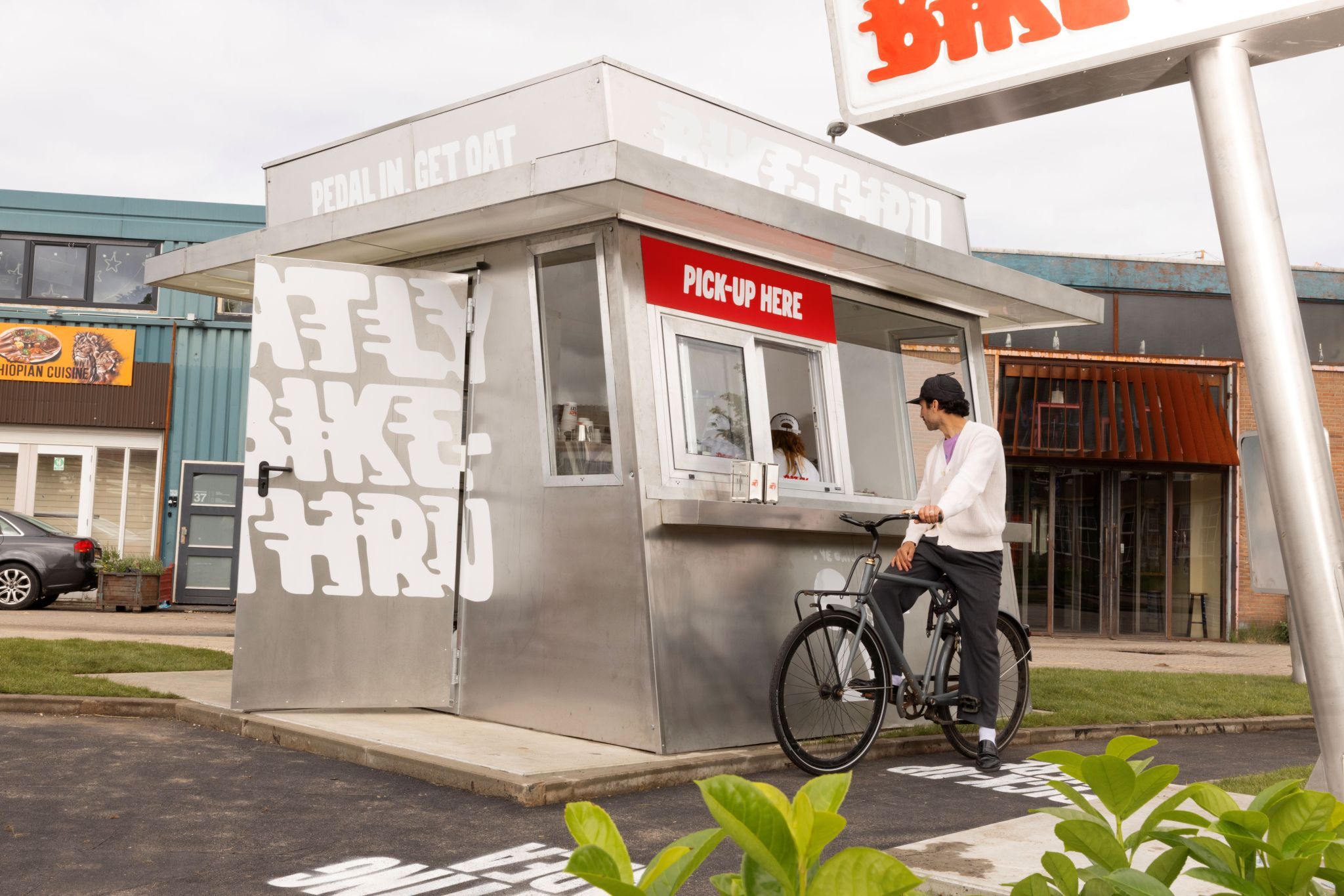
From 15 May to 7 June 2026, Oatly operates the Oatly Bike-Thru at Papaverhoek 24 in Amsterdam-Noord, a stainless-steel kiosk with its own cycle lane where riders pull up to a window, order, pay and pedal off.1, 2 The Swedish oat drink company describes it as the world's first bike-thru, a cycling-first reworking of the American drive-thru built for one of the most bike-dependent cities in Europe.1, 3 The kiosk carries bold white "Oatly Bike-Thru" lettering across its stainless body and a red "Pick-up here" sign over the service window.1
The temporary installation runs for 24 days and is operated in rotation with a curated lineup of specialty coffee roasters from across Europe, with the signature menu changing on a weekly cadence.3, 4 Visitors can also reserve five-minute pickup windows through the ClassPass app, which carries a 35 percent discount and keeps queues short for cyclists passing through the neighbourhood.3 The booking layer is what allows the format to operate as a true drive-thru analogue rather than as a pop-up café with a takeaway window.
For a brand built on a lighter environmental footprint, the format does what a conventional drive-thru could not. A queue of idling cars sits awkwardly against Oatly's editorial line on emissions and dietary impact. Replacing the car with the bicycle removes that contradiction and leaves the format itself, which in the Netherlands is the actual novelty, intact. The drive-thru, for many Amsterdammers, is a piece of Americana experienced from the saddle of the bike they were already on.
A menu built for the format
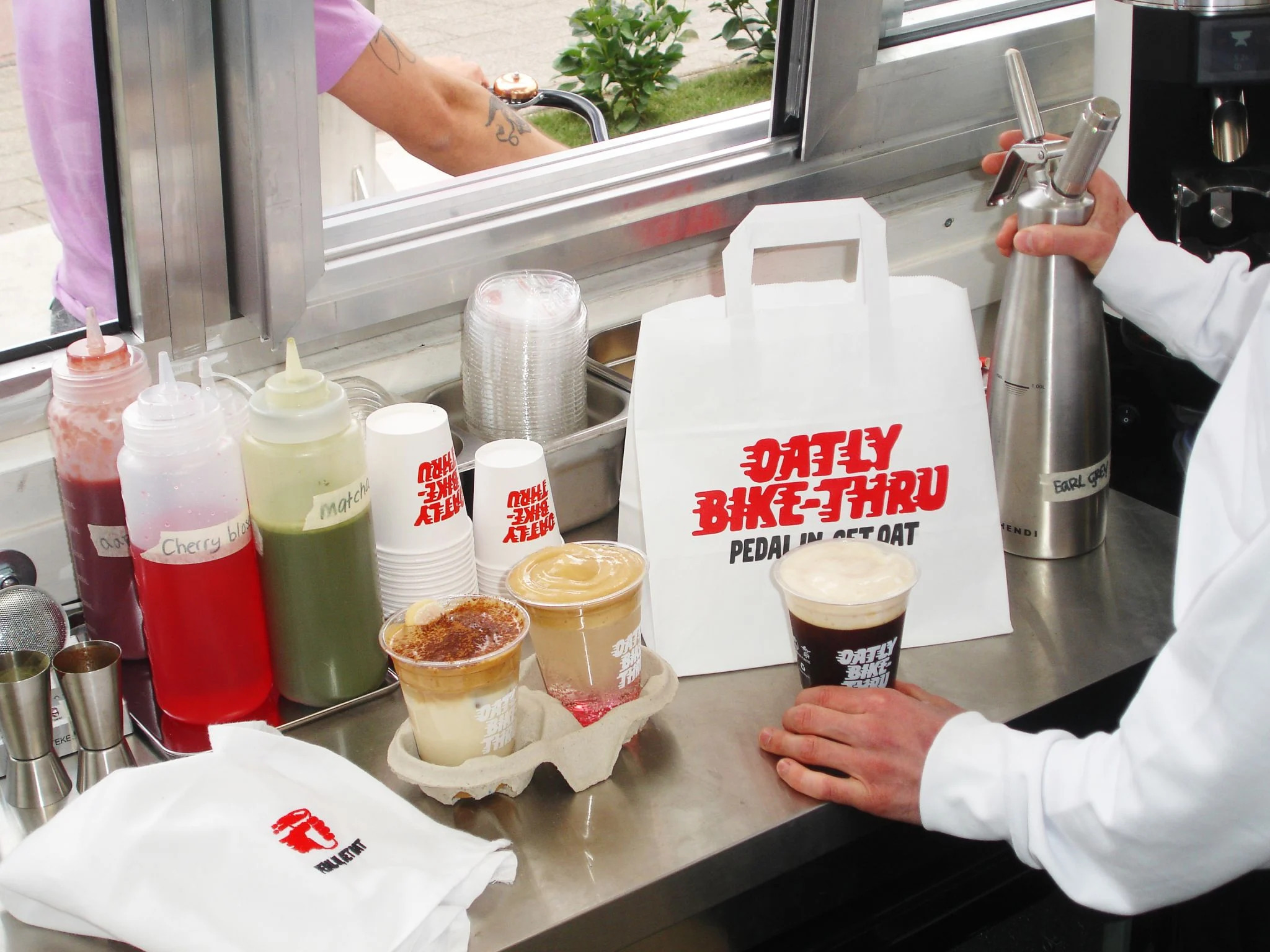
The drinks list reads as a deliberate departure from the convenience-store coffee menu the drive-thru format is normally associated with. Signature beverages rotate weekly and include a Salted Gochujang Barista Cacao, an Earl Grey Mont Blanc and a Strawberry-Sakura Genmaicha Matcha alongside a Hojicha Soft Serve developed with Oficina Hojicha.1, 3 A more conventional line of cortados, cappuccinos and lattes covers the everyday occasion.1 The signature drinks are the editorial reason to detour through Papaverhoek; the standard menu is the reason to make the kiosk a regular stop.
Each week brings a different roaster partner to the kiosk, which gives the installation a residency cadence that specialty cafés use to refresh their offer rather than the static menu of a quick-service drive-thru.3 The format is shop-window, not flagship, and is calibrated for repeat visits across the run rather than one-off discovery. Oatly's branding on cups, napkins and a custom takeaway bag carries the kiosk's editorial signature beyond the location and into the cyclist's onward route through the city.
An idea native to Amsterdam
The choice of city is not incidental. Amsterdam is one of the few European capitals where the bicycle outnumbers the car as everyday transport, and the city's cycle infrastructure makes a bike-thru operationally feasible in a way that few other places allow.5 Christiaan van Doornik, Oatly's Benelux general manager, frames the kiosk in those terms, describing the project as an attempt to meet Amsterdammers in the rhythm they already keep rather than asking them to adopt a different one.3
The location reinforces the brief. Amsterdam-Noord, formerly an industrial district across the IJ, has become the city's reference point for contemporary food and culture programming, and Papaverhoek sits within easy reach of the NDSM and Buiksloterham creative belt.6, 7 The kiosk lands in a part of the city already accustomed to short-run cultural pop-ups, which lowers the threshold for a Swedish food brand to test a new format on Dutch ground without the friction of an unfamiliar context.
Format as message
Read as a piece of brand activity, the Bike-Thru is consistent with the editorial line Oatly has held since John Schoolcraft restructured the brand's voice in 2014, the period covered in this archive's first Oatly verse. The company prefers to position itself through formats and writing rather than through media buys, and the Bike-Thru continues that pattern. Sustainability is not stated on signage; it is encoded in the format itself, and the brand argument is delivered by the absence of a parking lot rather than by a claim on the cup.
The cumulative effect, across the Look Book programme, the Oatly Spam editorial work and now the Bike-Thru, is a brand that uses temporary, location-specific installations as its primary public-facing instrument. The format is built to be photographed, shared and short-lived, and the editorial value travels further than the catchment area of a single kiosk in Amsterdam-Noord. The Bike-Thru is up for 24 days; the brand asset it produces is intended to last considerably longer.
Written with AI assistance, edited by a human. Find out more about our Use of AI.
1. TrendWatching, Liesbeth den Toom, "Pedal in, get oat: Oatly reworks the drive-thru for a city that runs on bikes", 19 May 2026, for the Bike-Thru's location at Papaverhoek 24 in Amsterdam-Noord, the run from 15 May to 7 June 2026, the stainless-steel kiosk with its own cycle lane, the bold white "Oatly Bike-Thru" lettering and red "Pick-up here" sign, the signature drinks (Salted Gochujang Barista Cacao, Earl Grey Mont Blanc, Strawberry-Sakura Genmaicha Matcha and Hojicha Soft Serve) and the conventional cortado, cappuccino and latte line. https://www.trendwatching.com/innovations/pedal-in-get-oat-oatly-reworks-the-drive-thru-for-a-city-that-runs-on-bikes
2. Plantaardig.org, Martijn, "Oatly opent 's werelds eerste Bike Thru in Amsterdam Noord", 15 May 2026, Dutch trade coverage, for the kiosk's address at Papaverhoek 24, 1032 JZ Amsterdam Noord, and for the run from 15 May to 7 June 2026. https://www.plantaardig.org/zuivel/oatly-bike-thru-amsterdam-noord/
3. Dexerto, Callum Doyle, "Oatly has opened the world's first bike-thru in Amsterdam", 17 May 2026, for Oatly's own description of the kiosk as the world's first bike-thru, the ClassPass booking of five-minute pickup windows at a 35 percent discount, the weekly roaster rotation (Nomad in Barcelona, April in Copenhagen, Wide Awake in Brussels and Dak Coffee Roasters in Amsterdam for the final weekend) and the Oatly x Oficina Hojicha soft serve available throughout the run, and for the job title and paraphrased framing attributed to Christiaan van Doornik, Oatly's general manager for Benelux. https://www.dexerto.com/entertainment/oatly-has-opened-the-worlds-first-bike-thru-in-amsterdam-3365584/
4. Momentum Magazine, "Oatly Opens the World's First Bike-Thru Coffee Experience in Amsterdam", for the coffee roaster partnership and weekly menu rotation, as originally cited in this file; page not reachable on 17 September 2026. https://momentummag.com/oatly-opens-the-worlds-first-bike-thru-coffee-experience-in-amsterdam/
5. Wikipedia, "Cycling in Amsterdam", for the bicycle's share of daily transport in Amsterdam, roughly two thirds, exceeding the car's share of about a fifth. https://en.wikipedia.org/wiki/Cycling_in_Amsterdam
6. Wikipedia, "Amsterdam-Noord", for the district's history as an industrial area across the IJ built around the Nederlandsche Dok en Scheepsbouw Maatschappij shipyard, and for the reclaimed Buiksloterham area nearby. https://en.wikipedia.org/wiki/Amsterdam-Noord
7. I amsterdam, "Art and culture in NDSM", for the former NDSM shipyard's redevelopment into a creative and cultural hub since the 1980s. https://www.iamsterdam.com/en/explore/neighbourhoods/ndsm/art-and-culture-in-ndsm