
A brand origin written for the cinema
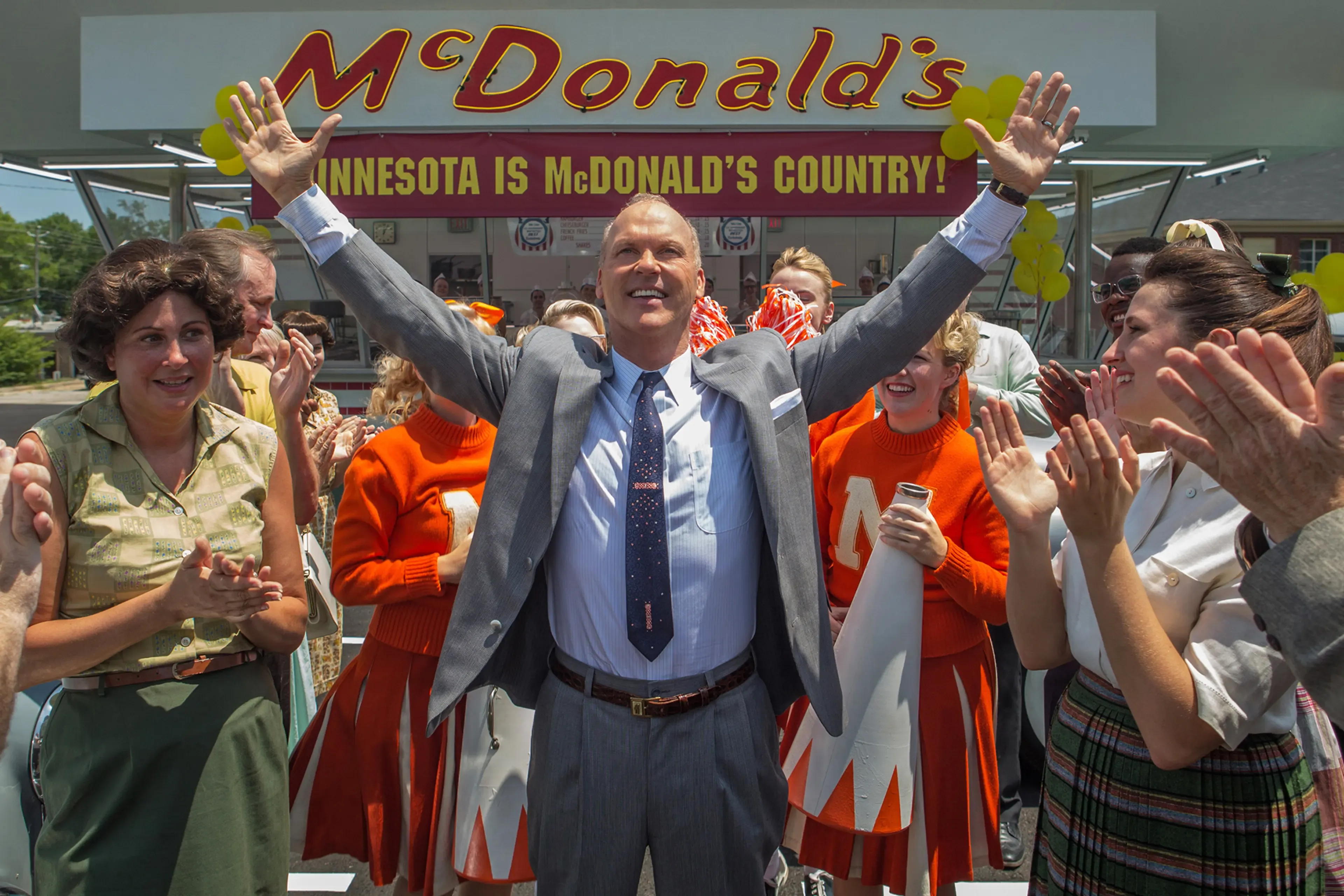
On 20 January 2017, The Weinstein Company released The Founder, a biographical drama directed by John Lee Hancock and written by Robert D. Siegel that dramatised the founding of the McDonald's restaurant chain. The film had received its premiere at the ArcLight Hollywood theatre on 7 December 2016. Michael Keaton played Ray Kroc, the Illinois milkshake-machine salesman who in 1954 visited Dick and Mac McDonald's high-volume hamburger restaurant in San Bernardino and subsequently bought the rights to the brand. Nick Offerman played Dick McDonald, John Carroll Lynch played Mac McDonald, Linda Cardellini played Joan Smith Kroc, and B. J. Novak played Harry J. Sonneborn, the financial executive who built the McDonald's real-estate model. The film grossed approximately 24 million US dollars worldwide and received broadly positive critical notices.
The Founder was the first feature film to take the McDonald's founding story as its primary subject. The brand had appeared in countless American films as a background or comic device since the 1960s, and as a documentary subject in Morgan Spurlock's 2004 Super Size Me. The Founder was different. It treated the brand's commercial architecture as its central narrative material: the Speedee Service System, the franchise contract, the standardised kitchen layout, the real-estate model and the renaming of the company from McDonald's Brothers to McDonald's Corporation.
The source material
Robert D. Siegel's screenplay was based on two written sources. The first was Ray Kroc's 1977 autobiography Grinding It Out: The Making of McDonald's, co-written with Robert Anderson and published by Henry Regnery Company in Chicago. The second was John F. Love's 1986 unauthorised brand history McDonald's: Behind the Arches, published by Bantam Books, which remains the most comprehensive third-party account of the company's first three decades. The two sources carry different framings of the Kroc-McDonald relationship. Kroc's autobiography presents himself as the rightful architect of the brand; Love's account presents Dick and Mac McDonald as the originators whose contributions Kroc systematically minimised. Siegel's screenplay borrowed structural elements from both and committed, in the second half of the film, to the Love framing.
The screenplay reproduced several brand-history specifics with documented accuracy. The 1948 redesign of the San Bernardino restaurant around the Speedee Service System was staged with period-correct kitchen choreography. The 1955 incorporation of McDonald's Corporation in Des Plaines, Illinois, was shown with the original franchise contract. The 1961 sale of the McDonald's name and operating rights to Kroc for 2.7 million US dollars was shown in its documented sequence, including the handshake agreement on a continuing royalty that Kroc subsequently declined to honour in writing.
The brand's public response
McDonald's Corporation took no public position on the film during its production, release or post-release period. The company did not licence its trademarks for the production, although the film was shot with restaurant exteriors and Golden Arches signage that approximated period-accurate brand assets without using the contemporary brand marks. McDonald's Corporation did not file a trademark or trade-dress action. The company's then chief executive Steve Easterbrook was asked about the film at the May 2017 annual shareholder meeting and declined to comment beyond noting that Kroc's story was a matter of public record.
The brand benefited from the film in measurable ways. Google search interest in the terms "Ray Kroc," "McDonald brothers," "Speedee Service System" and "San Bernardino McDonald's" rose by between 40 and 180 per cent during the film's theatrical and home-video release periods, according to Google Trends data for January through April 2017. The original Dick and Mac McDonald site at 1398 North E Street in San Bernardino, operated since the 1990s as the Juan Pollo Unofficial McDonald's Museum by franchisee Albert Okura, reported a visitor increase that Okura attributed directly to the film in subsequent press interviews.
The brand-architecture lessons the film made public
The Founder put a small set of branding decisions into mainstream cultural circulation that had previously lived in business-school case material. The first was the franchise-and-real-estate hybrid model that Harry Sonneborn built for the company in 1956, by which McDonald's Corporation would own or lease the land underneath each restaurant and charge the franchisee rent on top of operational royalties. The model gave the corporation a cash flow independent of restaurant operations and remains the structural foundation of McDonald's global business in 2026. The film's mid-section, in which Sonneborn explains the model to Kroc on the back of a napkin, took a piece of company history that had been carried mainly inside Harvard Business School teaching notes and turned it into a popular cultural artefact.
The second was the structural conflict between operational excellence and brand ownership. Dick and Mac McDonald's contribution to the restaurant system was operational: the Speedee Service System, the standardised kitchen, the limited menu, the assembly-line preparation. Kroc's contribution was brand-architectural: the franchise contract, the real-estate model, the master brand and the corporate growth path. The Founder presented the two contributions as separable and the eventual brand ownership as the more valuable. That framing entered the popular vocabulary of brand-architecture argument and continues to be referenced in trade press and management literature whenever a founder-operator relationship between an originator and a brand-builder is at issue. The film did not produce the framing; it gave the framing its widest public form.
Source: Rotten Tomatoes Trailers
Written with AI assistance, edited by a human. Find out more about our Use of AI.