
A royal seal on a leather workshop
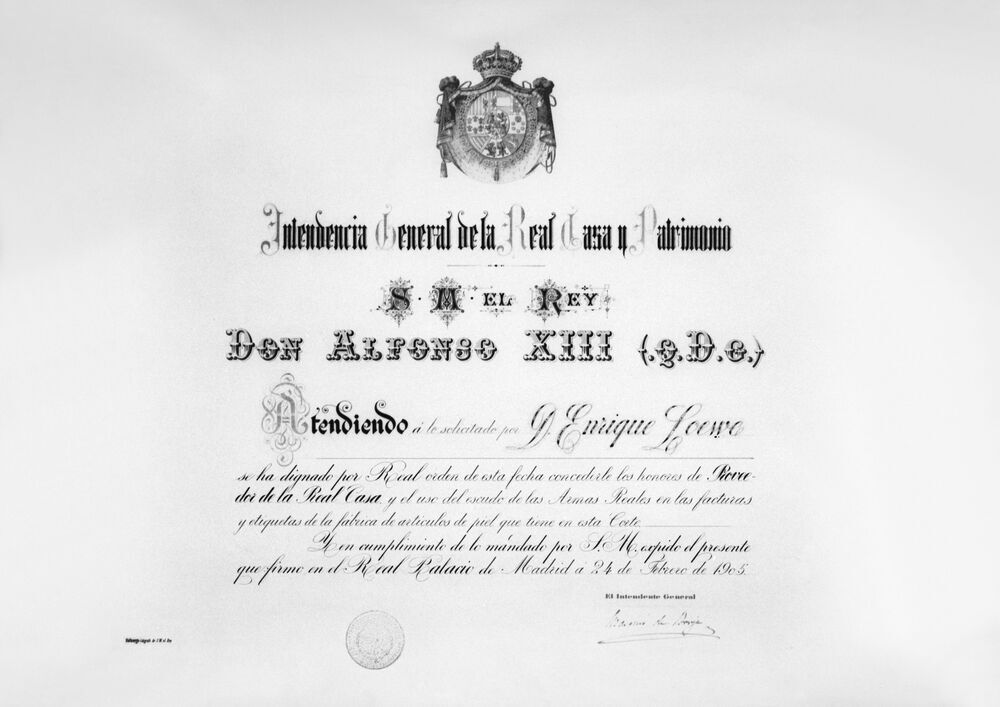
In 1905, King Alfonso XIII of Spain granted Loewe the Royal Warrant of Appointment, naming the house an official supplier, or purveyor, to the Spanish royal court. The honour was conferred on Enrique Loewe Hinton, grandson of the German merchant Enrique Loewe Roessberg who had consolidated the original Madrid leather workshop under the family name in 1872, and it formally recognised a relationship with the Spanish crown that had already been building for years.
The warrant followed a period in which Loewe's boutique on Calle del Príncipe in central Madrid had become a regular stop for the royal household. Queen Victoria Eugenie, Alfonso XIII's wife and a British-born granddaughter of Queen Victoria, was a frequent visitor to the shop, and her patronage, alongside that of other members of the court, had already established Loewe's reputation among Spain's aristocracy before the warrant made the relationship official.
What a royal warrant actually confers
A Spanish royal warrant of appointment is a formal designation, not merely a courtesy title, and receiving one required a demonstrable, sustained supply relationship with the royal household rather than a single notable sale. For Loewe, then a workshop still primarily known for saddlery, harnesses and leather goods rather than fashion, the warrant functioned as third-party validation from the highest possible domestic authority, at a time when the house had no international retail presence and no fashion runway to build reputation through instead.
The distinction mattered commercially. Nineteenth and early twentieth-century luxury leather goods makers built reputation primarily through court patronage and word of mouth among the aristocracy, decades before advertising campaigns, celebrity endorsement or fashion journalism became the primary channels for establishing a luxury house's status. A royal warrant was, in effect, the era's equivalent of a widely covered celebrity campaign: a signal from the most visible household in the country that a workshop's craft met the highest standard available.
An asset the house still cites today
Loewe continues to reference its royal warrant history as part of its official brand narrative, and members of the modern Spanish royal family, including Queen Sofía and Queen Letizia, have continued to be photographed carrying Loewe handbags more than a century after Alfonso XIII's warrant, extending an association the house has never had to manufacture through paid sponsorship. Few luxury houses can point to an unbroken royal connection spanning more than 120 years, particularly one that began with a formal state honour rather than a marketing partnership.
The warrant also anchors Loewe's identity in a specifically Spanish institutional history, distinguishing it from luxury houses whose founding prestige came from Parisian couture salons or aristocratic patronage in other European capitals. Where other heritage houses trace their earliest reputation to the general carriage trade or to a single staged fashion moment, Loewe's earliest brand asset is a specific, dated act of state recognition, tying the house's credibility from the outset to the Spanish crown rather than to fashion editors or a couture calendar.
That anchoring has proven durable precisely because it required no renewal or re-endorsement to remain relevant. A royal warrant, once granted and never revoked, continues to function as a historical fact the house can cite indefinitely, regardless of which designer or creative team happens to be running its collections in any given decade, giving Loewe a foundational credibility claim that has outlasted six changes in creative direction and two changes of ownership.
The Spanish system sits alongside similar royal warrant traditions elsewhere in Europe, most visibly the British "By Appointment" marks that companies still display on their packaging today. Both systems formalise a supply relationship rather than a one-off gift or a single photographed appearance, and both have proven unusually resistant to obsolescence precisely because they describe a documented commercial history rather than a mood or an aesthetic that can go out of fashion.
Loewe has never needed to renegotiate or defend the 1905 warrant the way it has had to defend other assets, such as its Anagram trademark against counterfeiters. A royal warrant carries no expiry date and generates no licensing dispute, making it one of the lowest-maintenance credibility assets any luxury house can hold, an unusual position for a company that has otherwise had to actively protect nearly every other element of its visual and product identity across the twentieth and twenty-first centuries.
The warrant's continued relevance says something about how differently royal and celebrity endorsement age. A celebrity campaign fronts a specific season and typically needs renewing every few years to stay culturally current, but a royal warrant is a matter of historical record rather than an ongoing relationship that requires refreshing, which is precisely why Loewe can still cite 1905 as a foundational credibility marker twelve decades later without the claim ever feeling dated.
Written with AI assistance, edited by a human. Find out more about our Use of AI.