
A pledge made against the market
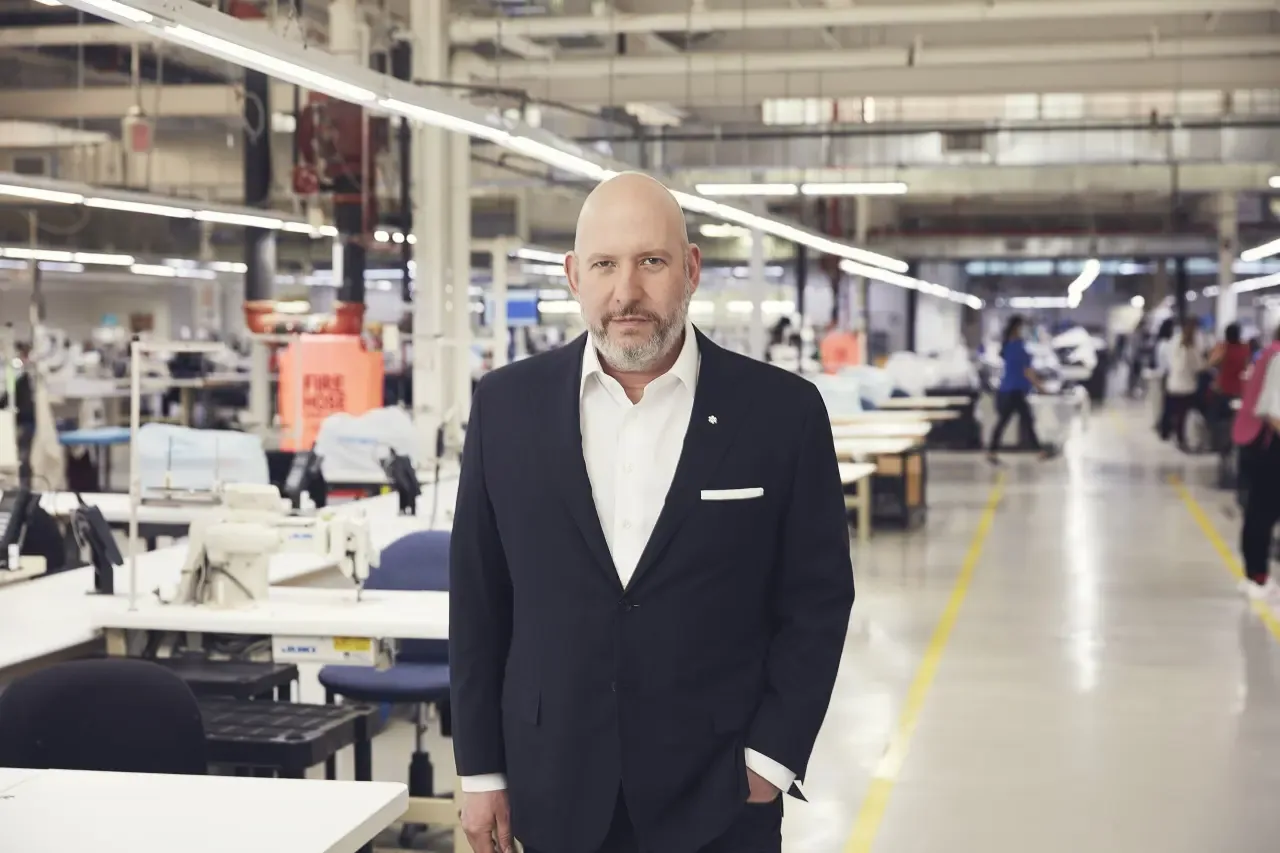
Dani Reiss joined his family's outerwear company in 1997 and became its President and CEO in 2001. Canada Goose's own history records the moment in one line: he "ignites the company's growth and pledges to remain 'Made in Canada.'"1 The company was then doing about $3 million in annual sales.2
The pledge meant something because of when it was made. Apparel makers were moving production out of Canada.3 Reiss later described the decision as a bet on being the last one left: "And we were small then, and we weren't even working 12 months a year in the factory, but we decided if we could stay made in Canada for call it five years while everybody else left, and if it's true that as we thought made in Canada was going to become more important in the future, then in five years from now, we're going to have this massive competitive advantage because there will be nobody left making apparel or outerwear like us in Canada."3
The lesson came from abroad
Reiss has said the value of the label was explained to him by customers outside Canada. Abroad, he told Entrepreneur, the origin was read the way a luxury buyer reads a watch: "For them a Canada Goose jacket made in Canada was like a watch made in Switzerland."2 He described seeing the brand's logo in a boutique between a Prada coat and a Gucci jacket, and taking from it how the world perceived his company.2
The comparison does the strategic work. A Swiss watch costs more partly because of where it is made, and the buyer pays for the place as much as for the object. Applied to a parka, it turns Canada from a production location into a quality claim, with the cold of the country as the evidence. A higher price stops needing an excuse. It becomes the expected consequence of the origin.
Reiss's own summary of what customers are paying for goes further than craftsmanship: "I think that when people buy Canada, they buy authenticity, they buy honesty, they buy the perception which is true, of the great expanses of wilderness and natural resources and imagery of the North and the Northern lights."3 In that sentence the country is not a label on the inside seam. It is the brand's whole imagery, and the factory is what makes the imagery honest.
A claim built factory by factory
A country of origin is only as believable as the capacity behind it, and Canada Goose built that capacity in its own name. It acquired a plant in Winnipeg in 2011, moved to a larger one in 2013, added a second factory in Scarborough and another in Winnipeg in 2015, opened its first Quebec facility in Boisbriand in 2017 and a third Winnipeg plant in 2018, which brought its Winnipeg workforce to 1,700.4 In February 2019 it opened a 115,000 square foot factory in Montreal's Chabanel district, its eighth wholly owned Canadian facility, and said it employed about 20 percent of the country's cut-and-sew workforce.5
"We continue to raise the bar for what it means to be a leader in Canadian apparel manufacturing," Reiss said at that opening.5 Owning the factories rather than contracting them matters for the brand. A claim made through a supplier can only be asserted. A claim made through owned plants can be shown, visited, photographed and announced, and every new plant is a press release about the brand's origin.
What the pledge costs
Domestic manufacturing is the expensive way to make a parka, and it ties growth to a labour pool the industry had been shrinking. The 2019 announcement notes that more than 800 people had completed the company's national sewing training programme.5 To keep the promise, Canada Goose has had to train the workforce its competitors let go.
The pledge also removes an option. A brand that has made its country the proof cannot quietly move its core production without moving the brand with it. That is the constraint, and it is also the reason the claim is worth anything. A competitor can copy a parka. It cannot go back and stay.
Its sales rose from $3 million in 2001 to $200 million by 2014.4 Reiss's prediction of a field with nobody else in it was a marketing strategy written as a production decision, made while the company was still small enough that the factory did not run all year.3
Written with AI assistance, edited by a human. Find out more about our Use of AI.
1. Canada Goose, "Our History", read 5 October 2026, for Dani Reiss joining the company in 1997, becoming President and CEO in 2001, and the quoted pledge to remain "Made in Canada". https://www.canadagoose.com/en-us/pages/our-history
2. Laura Entis, "How Canada Goose Went From Small Outerwear Company to International Luxury Brand", Entrepreneur, 29 December 2014, read 5 October 2026, for annual sales of about $3 million when Reiss took over, the quotation comparing a jacket made in Canada to a watch made in Switzerland, and Reiss seeing the logo between a Prada coat and a Gucci jacket in a boutique. https://www.entrepreneur.com/growing-a-business/how-canada-goose-went-from-small-outerwear-company-to/241286
3. The Business Council of Canada, "When people buy Canada, they buy authenticity", podcast episode with Dani Reiss, 19 May 2022, transcript read 5 October 2026, for both quotations from Dani Reiss, President and CEO, reproduced from the transcript. https://www.thebusinesscouncil.ca/podcasts/when-people-buy-canada-they-buy-authenticity-dani-reiss-canada-goose/
4. Wikipedia, "Canada Goose Inc.", read 5 October 2026, for the Winnipeg plant acquired in 2011 and the larger facility in 2013, the Scarborough facility in January 2015 and the second Winnipeg factory in November 2015, the Boisbriand facility in June 2017, the third Winnipeg plant in September 2018 bringing Winnipeg employees to 1,700, and sales growth from $3 million to $200 million between 2001 and 2014. https://en.wikipedia.org/wiki/Canada_Goose_Inc.
5. Canada Goose, "Canada Goose Deepens Roots in Montreal with Opening of New Manufacturing Facility", press release via PR Newswire, 14 February 2019, read 5 October 2026, for the 115,000 square foot facility in Montreal's Chabanel area as the eighth wholly owned Canadian facility, the company employing about 20 percent of the national cut-and-sew labour force, more than 800 people having completed its national sewing training programme, and the quotation from Dani Reiss, President and CEO. https://www.prnewswire.com/news-releases/canada-goose-deepens-roots-in-montreal-with-opening-of-new-manufacturing-facility-300795645.html