
Chapter 02Part 1: The phenomenon
How brands came to be
People have marked their goods for thousands of years. The brand as we know it is only a few generations old. Seven eras show how it grew up.
Era 1, until c. 500
Long before factories, logos or advertising, people were already marking their goods. Not to look good, but to say where something came from.
The era
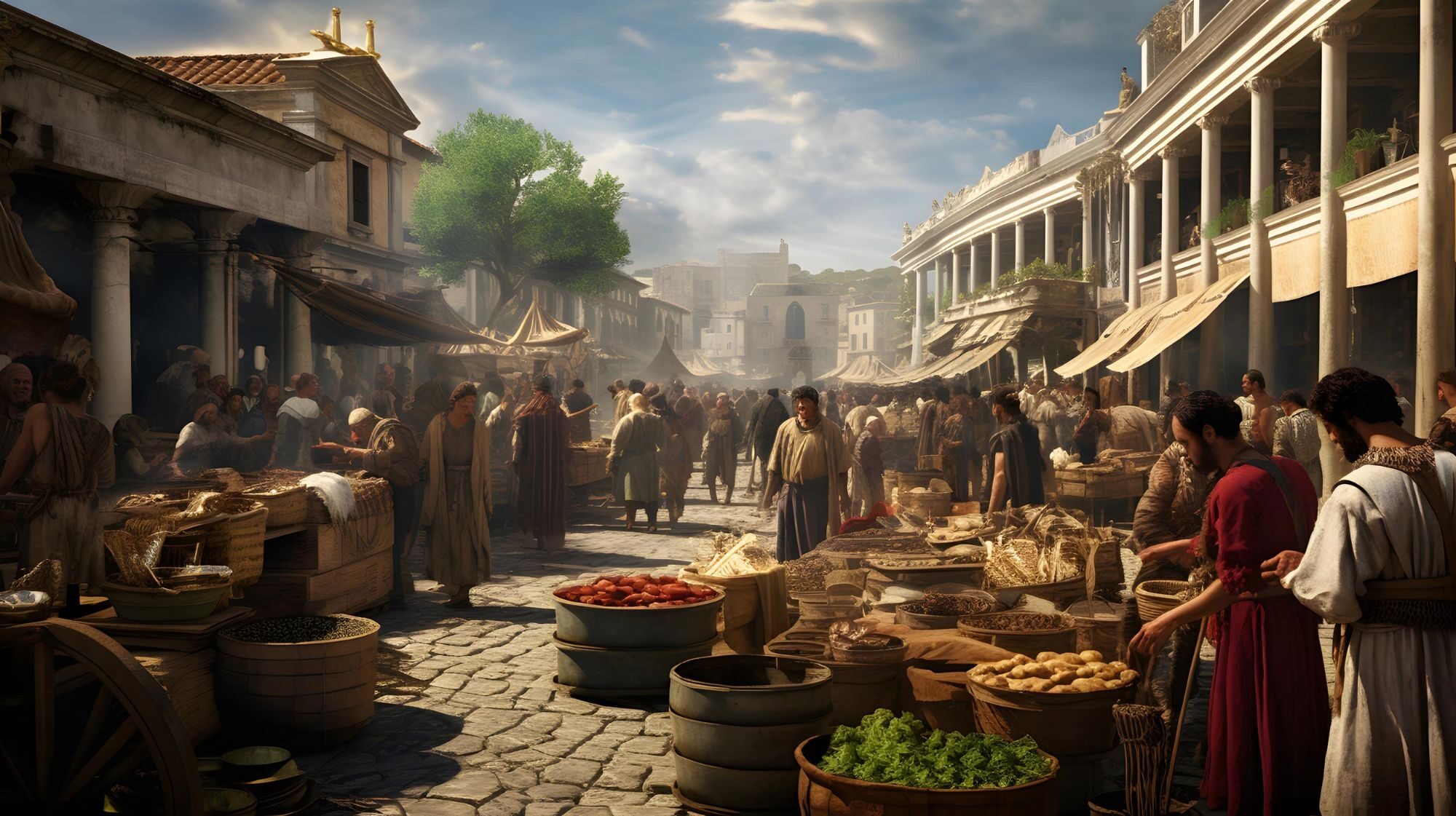
Trade is older than most people think. More than 2,300 years ago, trade, crafts and art were already part of everyday life.1 For most of that time, though, there were no brands. Richard Shear, author of A History of Brands, calls the oldest form of trade, around since at least 3000 BC, Commerce 1.0: raw materials turned into goods and sold face to face, as they still are in bazaars, souks and weekly markets. For thousands of years, people bought simply on trust in the farmer, the baker or the butcher they knew.2
Then trade began to travel. Greek cities held fairs and markets from very early on, and goods from the Greek world crossed the Mediterranean as far as northern Europe. Rome went further still. Its merchants traded with Britain and Ireland, and after the conquest of Egypt their contacts reached all the way to East India. By the standards of its time, this was the first global economy.3
Key developments
- Markets and fairs. When many sellers stand side by side, each needs a way to set their goods apart.4
- Long distance trade. Goods now travelled far from their maker, so their origin had to be visible on the object itself.5
- A first global economy. Rome linked Britain, Egypt and East India in one trading network.6
What it meant for brands
This is where the story of the brand begins. Brands are older than factories, and older than money in its modern form. Almost every early civilisation marked objects, mainly to show where they came from.7 Such a mark made a simple promise: this comes from here, and this maker stands behind it. Oliver Errichiello, a German brand sociologist, points out that traders in the Greek world also knew how to set their goods clearly apart from the competition.8
Era 2, 500 to 1440
Trade collapsed, then came back. And with the arrival of guilds, a mark began to stand for more than ownership: it promised quality.
The era
In the early Middle Ages, the markets of antiquity fell away. Regions supplied themselves, and weekly markets were the sad remains of a once thriving economy. At the same time, the Church, funded by alms and donations, became the institution that held society together.1 Europe was not the only stage, though. Around the year 1000, there were already established trade routes across America: mother of pearl from the Gulf of Mexico turned up in Manitoba, and copper from Lake Superior in Louisiana.2
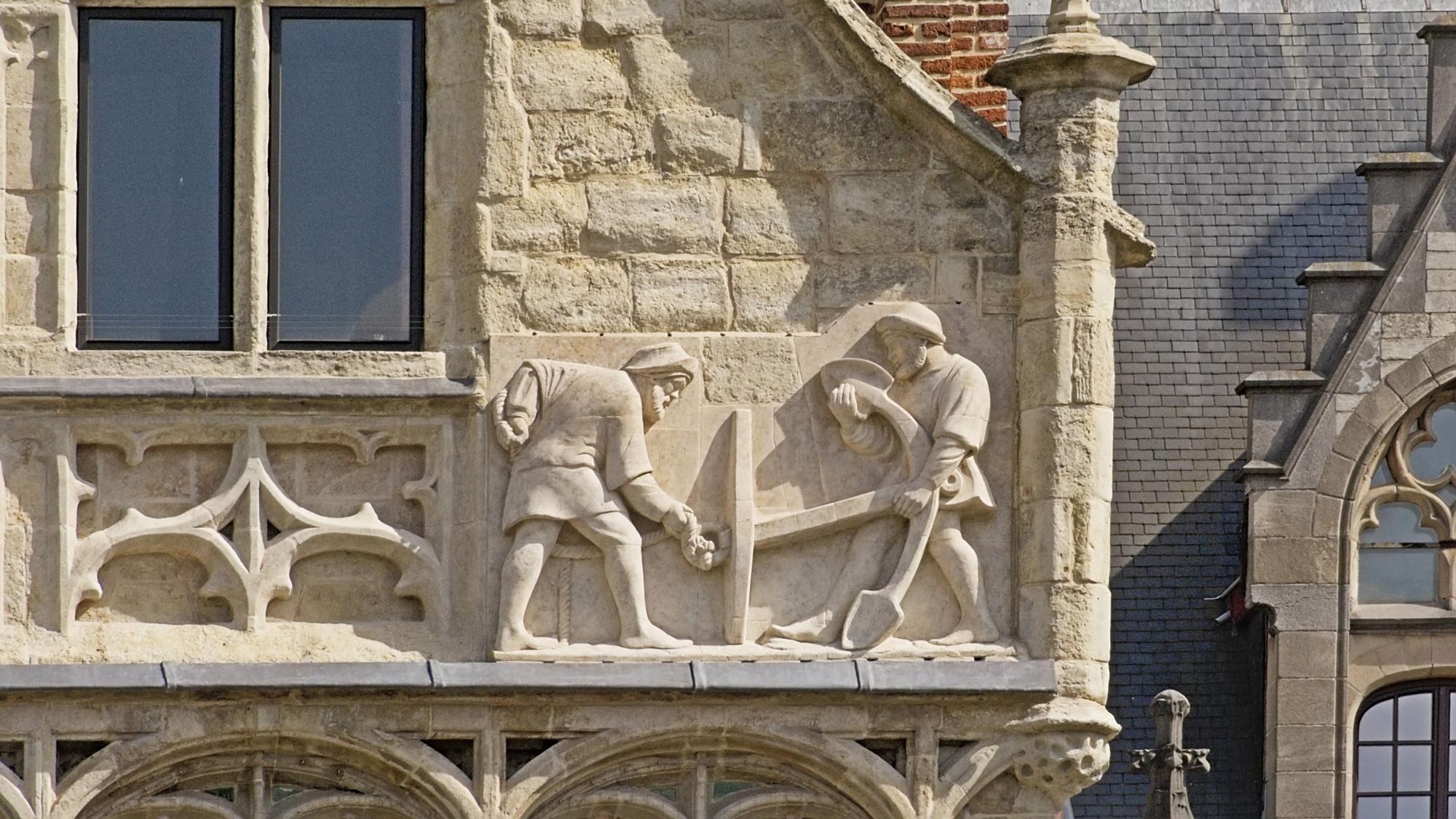
Only in the late Middle Ages did the trade routes to India and China open up again. The Crusades revived shipping, around 1400 Venice alone had 44 banks, and the Italian city states dominated trade across the Mediterranean. The emerging nation states encouraged commerce, the Hanseatic merchants grew into powerful trading companies, and in the thirteenth century travelling traders and craftsmen joined together in the first guilds, bound by an oath of mutual help.3
Key developments
- Long distance trade returns. Profits grew with distance and rarity, so goods travelled far again, and their origin had to be shown.4
- Guilds. For the first time, fixed rules for production and quality existed, and a shared mark could stand for them.5
- Marking becomes a duty. Rulers and laws demanded marks, in England on merchants' houses as well as on bakers' bread.6
- Trade gains respect. Making money gradually lost its stigma as something ungodly.7
What it meant for brands
From the fifth century onwards, house marks, portrait seals and heraldic seals appeared to protect property. Such individual marks made it possible to assign objects to particular people or communities.8 For a long time, the brand was mainly the answer to two questions: who owns this, and where does it come from?
Guilds were associations of craftsmen and merchants, bound by an oath of mutual help, that set the rules of their trade. They added a third question: is it any good? They set rules for how goods sold under their sign had to be made, and guaranteed work done by all the rules of the craft. The first trademarks in the narrower sense were the signs of crafts and guilds.9 Only goods made by masters who had completed an apprenticeship, years as a journeyman and an examination counted as guild work. These signs had a far reaching side effect. They protected buyers even beyond the city walls, without any direct contact with the maker, and so made trade over long distances possible.10
Era 3, 1440 to 1850
Printing made it possible to produce identical copies of texts and images, world trade filled Europe with new goods, and for the first time new mattered more than old.
The era
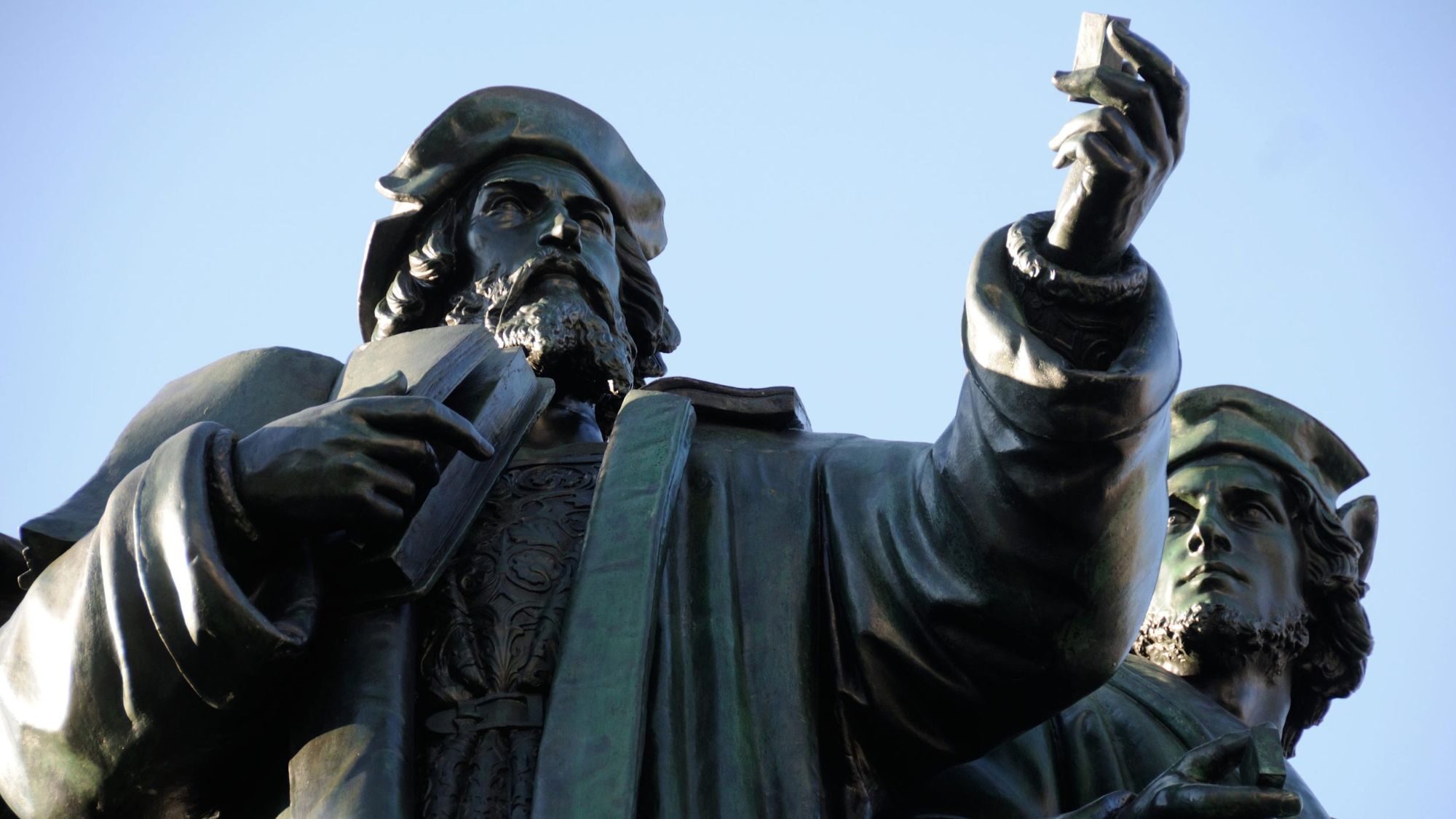
Around 1440, Johannes Gutenberg, a craftsman from Mainz, invented printing with movable type.1 For the cultural anthropologist Grant McCracken, this period marks the start of a consumer revolution. Until then, the Church and the old order of rank had largely decided how people lived and how they saw one another. Now goods and fashion began to do so too, and McCracken sees this as perhaps the first time a society willingly let something other than religion drive social change. With the English East India Company, founded by royal charter in 1600, and the Dutch East India Company of 1602, the age of state backed world trade began.2
At the court of Elizabeth I, competition for prestige intensified, and under Louis XIV the nobility at Versailles fought over rank, while outside a new social and economic order took shape. The medieval order of crown, clergy and everyone else dissolved, and a more open and prosperous Europe produced a new consumer society. It grew rapidly in America too: at sites in New York State from 1600 to 1620, only 10 to 15 percent of objects came from Europe, while by 1650 it was 75 percent.3 Economically, however, an old principle held for a long time. Only as much was to be produced as people needed to get by, and selling beyond that was left to travelling merchants with dubious wares.4
Key developments
- Printing. It was the first technique to produce exactly identical objects, and it gave people beyond the clergy and the nobility access to media for the first time.5
- World trade. Thanks to the East India companies, goods from all over the world became a normal sight in Europe.6
- Fashion instead of patina. Value no longer came from age and lineage but from novelty, and things increasingly counted for their short term use.7
- A new middle class. By the early eighteenth century, consumption was firmly rooted in a middle class with more money to spend, and had turned from necessity into fashion.8
What it meant for brands
The brand remained a sign of origin and quality in this period.9 But something new emerged. The sociologist Chandra Mukerji calls printing the first mass production technique that created exactly identical objects. This is a basic condition of the brand: modern brands rest on a promise of consistency, and makers have to produce identical objects and be able to promise that sameness.10
At the same time, people began to look not only at what an object was good for, but at what it was worth on the market. The uniqueness of a design and the question of who had made something became a source of value for a broad public, and out of this grew, step by step, what we now call consumer brands.11 In the eighteenth century, McCracken writes, goods became status symbols, and their cultural meaning became the means by which an anonymous society of complete strangers held together.12
What it meant for advertising
With printing, a technical invention paved the way for advertising to become a mass medium, even if mass meant something very different then.13 Posters and leaflets are among the oldest forms of commercial advertising, and printing was used to promote sales very early on.14 Despite such efforts, advertising in this period was widely seen as trickery and dishonesty.15
Examples

Soon after the invention of printing, Gutenberg's former partners Fust and Schöffer printed catalogues and advertisements and sent them to likely buyers, an early form of mail order and retail book trade.16 In the seventeenth and eighteenth centuries, paper and tobacco makers and wine merchants marked their barrels and bales with their name and elaborate signs. In 1802, the first book on advertising theory appeared in Weimar, with advice on how to structure and write advertisements.17
The East India Company created one of the first global brand systems. In the eighteenth century, its merchant's mark developed into a heart shape topped by a mystical four or a sail, known internally as the chop, after the Hindi word for stamp. It was struck into coins and stamped onto packaging, it stood for quality as well as origin, and it was the best known logo of its time.18 Josiah Wedgwood learned from it. He was one of the first potters to mark his ware consistently, probably from 1759, and he advertised his maker's mark as well.19
Era 4, 1850 to 1945
Factories made goods for millions of strangers. Makers and buyers no longer knew each other, and the brand stepped into the gap.
The era
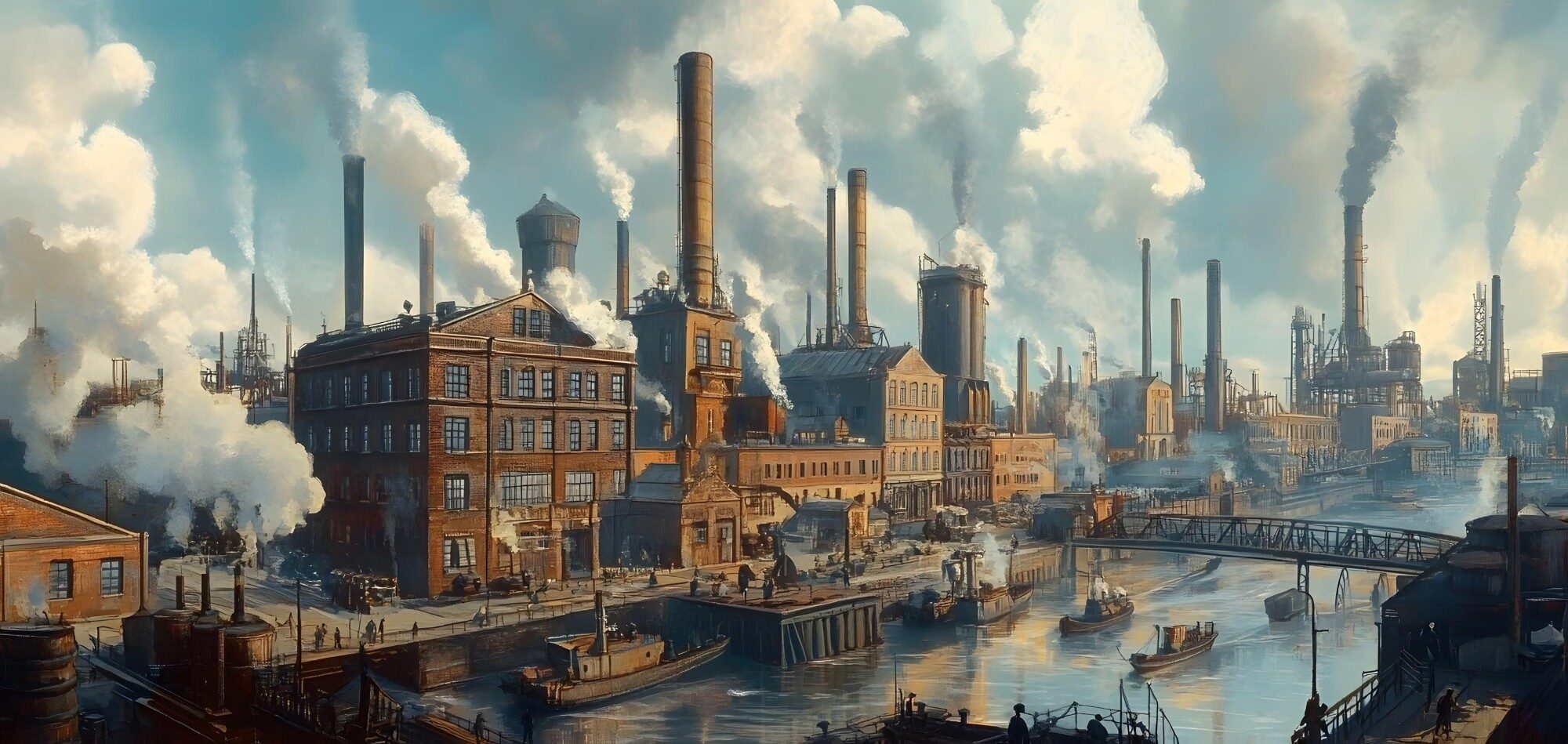
From the middle of the nineteenth century, growing world trade, industrialisation and the desire for luxury among ever larger parts of the population changed how goods were made and sold.1 Mass production followed the logic of falling unit costs and put standards first, because special requests would have ruined the calculation.2
In the United States after the Civil War, the historian William Leach describes the rise of a secular, market driven culture. Its features were buying and consuming as the path to happiness, the cult of the new, the democratisation of desire and money as the measure of all value. At the heart of its new commercial look stood what he calls the visual materials of desire: colour, glass and light.3
Key developments
- Mass production. New technology made it possible to produce large quantities in a short time, and buyers no longer knew who had made their goods.4
- Transport and cities. Faster transport widened distribution, and growing cities concentrated demand.5
- Purchasing power. For the first time, the middle classes could also afford a more luxurious life.6
- Production and packaging. Continuous production of food and consumer goods and cheap machine made glass turned the packaged branded product into the norm.7
- New ways to shop. Department stores, chain stores and mail order appeared, and from 1916 self service, where customers picked up the packages themselves.8
What it meant for brands
The first branded goods in today's sense only appeared in the nineteenth century, among consumer goods. Until then, very few products carried a brand name, only marks of origin and quality. As prosperity grew, so did demand for better everyday goods, and companies realised that branded goods and advertising belong together. But as soon as a product succeeded, it was copied, because comprehensive legal protection did not yet exist.9
With mass production, makers and buyers drifted apart. Oliver Errichiello, author of Philosophie und kleine Geschichte der Marke, sees this as a core task of the brand. It closes the gap by giving products meaning and placing them in a region, a history or a style. It takes on the traits of an individual, becomes recognisable among countless offers and replaces the lost relationship between maker and consumer.10 The more anonymous the maker, the more effort it puts into showing closeness in its communication.11
To see why brands became so powerful, it helps to look at a world in which nothing could be relied on. Seth Godin recalls that in 1906 the forerunner of the US Food and Drug Administration was founded to fight extremely dangerous products, among them a mascara that blinded more than a dozen people.12 Fifty years later, product quality was still a matter of luck, and nobody could say when their car would break down.13 In such a world, a well known name is a kind of insurance. Buying the same mark again means buying the experience that it went well last time.
What it meant for advertising
Advertising changed its sender. Until the middle of the nineteenth century, almost all advertising came from retailers. With mass production, many manufacturers saw a chance to drive demand themselves and advertised directly to potential customers.14 By the beginning of the twentieth century, everything that defines advertising today was in place: mass produced goods, a mass market reached through mass publications that lived mainly on advertising, and a professional advertising trade handling all major accounts.15
The media changed radically too. By the end of the century, packaging did far more than protect the product. It became the most important way for national brands to communicate and the visible expression of their identity.16 Merchants' signs grew into electric signs several storeys high, and the shop window became a stage. Advertising developed from a carrier of information into an influence on lifestyle, from an observer of culture into a shaper of it.17
Examples
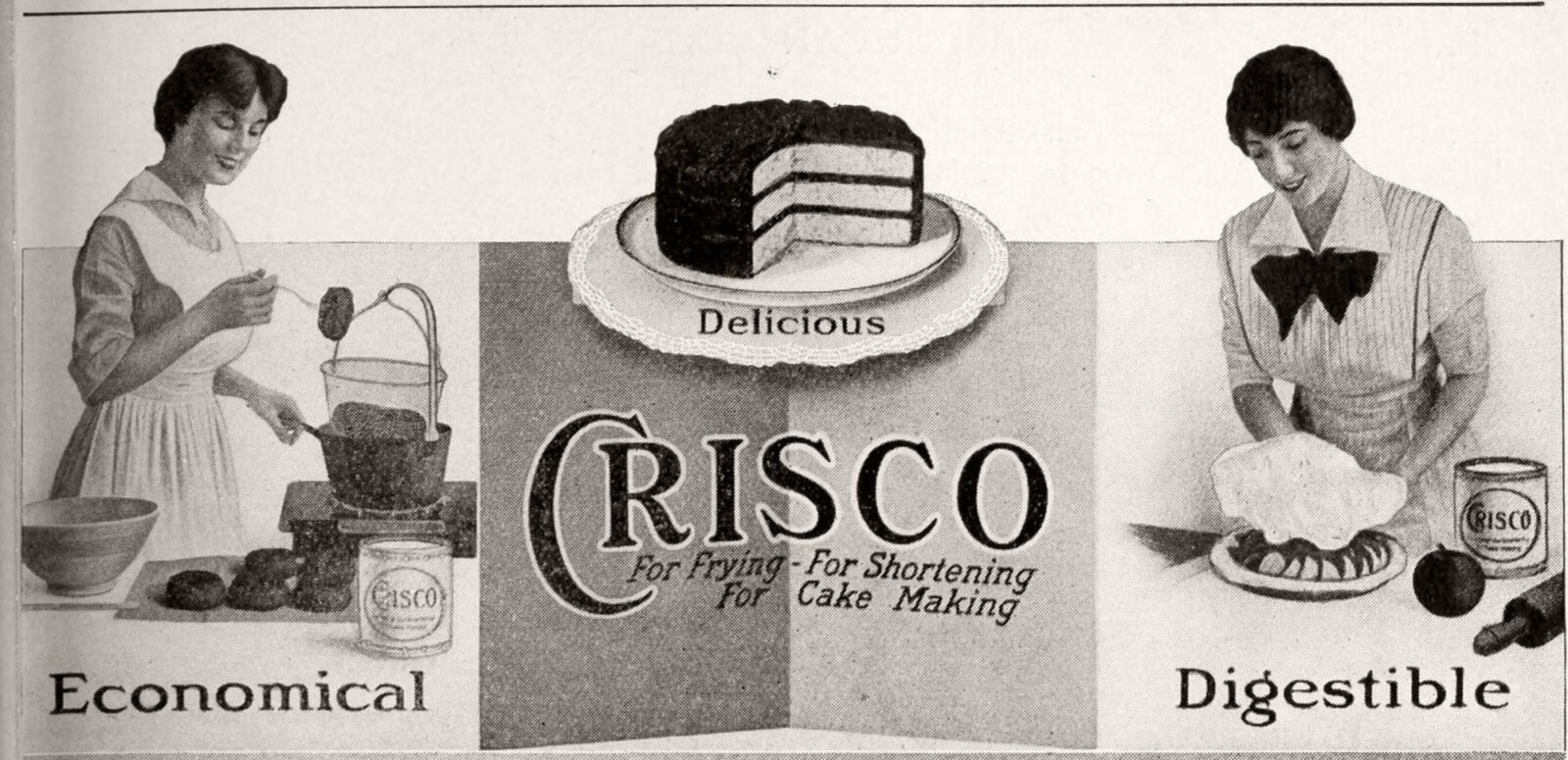
The department store created a new relationship between buyer and seller, with fixed prices, the right to browse without buying and shopping on credit.18 The Sears, Roebuck catalogue started in 1888 as a small brochure for jewellery and watches and had 532 pages by 1895. The first self service shop opened in Memphis in 1916.19 People who had never bought cornflakes had to learn that they needed them, and Campbell's first had to sell the idea of soup.20
The clearest example is Crisco, launched by Procter and Gamble in 1912 after five years of development. It was the first coordinated brand launch that combined all the modern tools of its time: consumer research, mass production, distribution, a wide range of retailers, mass media and large scale advertising.21 In 1908, Peter Behrens designed a hexagonal trademark for AEG, a house typeface and rules for all printed matter, a system that reached from the smallest type to products and factory buildings.22

Era 5, 1945 to 1970Product eraImage era
After the war, mass consumption took off in America and Europe rebuilt. For the first time, brands were protected by law and known to almost everyone.
The era
In 1945, much of Europe lay in ruins, and in Germany, land and industry were destroyed.1 The United States had the opposite problem. Three decades of depression and war had left a huge pent up demand, and the market was driven by mass production, mass marketing and mass consumption. National income rose by 50 percent between 1935 and 1950, and by another 60 percent in the 1950s. In the five years after the war, consumer spending grew by 60 percent, and spending on furniture and household appliances by 240 percent.2
Why did a country with a long unease about spending money embrace all this? The historian Elaine Tyler May has an answer: buying a home made it acceptable. Everything that belonged to the home fitted the old ideal of being practical and decent rather than showy.3
Key developments
- Free markets and trademark protection. In West Germany, as elsewhere in Western Europe, a free market economy laid the ground for new growth, and the law protected brands against imitation.4
- Few sellers, few channels. Each market had only a handful of suppliers, and in West Germany, for example, there were only three TV channels until 1983, a few radio stations and print media with millions of readers.5
- Television. Within a single decade, it moved into most American homes.6
- New places to shop. Suburban shopping centres offered parking, covered walkways and air conditioning.7
What it meant for brands
Branded goods took over in every rising industrial nation.8 What had been missing before the First World War was now in place: brands could be legally owned and protected, and companies set themselves apart by what they delivered.9 Some brands grew so strong that their name became the everyday word for the whole category.10
In the 1960s, almost half of the American population was under 25, and for the first time brands had to win over the baby boomers. At the same time, large corporate brands looked more and more uniform. This uniformity became the visual expression of modern society, in what is now called midcentury design: abstract and symbolic, rooted in the simplicity of the Bauhaus.11
At the same time, the ground under the brand began to move. Al Ries and Jack Trout, authors of Positioning, describe two phases. In the product era of the 1950s, a brand rested on a better product and what made it unique. But technology made such features ever harder to defend, and a wave of copycat products caught up. So value moved from the product to the reputation of the company, and in the image era, the image sold more than any product feature.12
What it meant for advertising
With so few channels, one advert could reach large parts of the population.13 In the United States, advertising spending tripled between 1945 and 1959, and television changed advertising within a few years. In 1950, 10 percent of homes had a TV set, five years later it was 67 percent, and by the end of the decade 87 percent.14
In the product era, a better product and some advertising budget were enough, and what everyone looked for was the unique selling proposition.15 Todd Irwin, a brand strategist, dates the term to the American advertising executive Rosser Reeves in 1961. It asked brands to define one clearly different idea they could own in the market, and it remained a cornerstone of marketing for decades. Looking back, Irwin sees a basic flaw in it: it puts the brand at the centre, not the customer, and asks what makes a brand unique rather than what makes it valuable.16
In the image era of the 1960s, every advert became a long term investment in the brand's image. Its architect was the advertising pioneer David Ogilvy, who created campaigns for Hathaway, Rolls-Royce and Schweppes.17
Examples
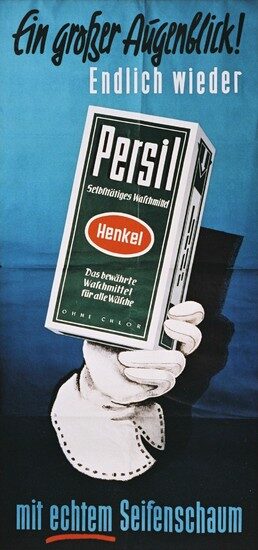
In Europe, many companies first tried to bring back their well known products in pre-war quality and to phase out the nameless substitutes of the war years. In Germany, on 1 September 1950, Persil advertised with the line "Ein großer Augenblick! Endlich wieder", a great moment, at last again.18 Those words do not sell washing powder. They sell the return of a familiar order.
German brands such as Tempo for tissues and Uhu for glue became everyday words.19 In America, the designers Paul Rand and Lester Beall became pioneers of midcentury design.20 In 1958, Mr. Clean launched in the United States with a national TV campaign, was the best selling household cleaner six months later and has been carried by its character for more than 65 years.21
Era 6, 1970 to 1994Positioning era
Markets were full, products looked alike. Brands stopped telling the market what they offered and started asking what it wanted.
The era
What it meant for brands
For the brand, this reversed the guiding question. Before, the founder's will had driven the brand. Now companies first asked what the market wanted and how to respond. The brand no longer set its own offer, but reacted as far ahead as possible to the wishes of its target groups.6 Errichiello sees a danger in this. A brand lives on independence and originality, and if it only looks outward, it loses itself and merely mirrors the market.7 Other authors see the outside view as the very strength of modern brand management, as chapter 06 shows.
For Ries and Trout, this was the third stage of modern marketing, after the product era and the image era. Because the image era also ended in a mass of imitators, from the 1980s onwards a brand had to occupy a position in the customer's mind that took account of its own strengths and weaknesses as well as those of its competitors. To do so, it first needed an empty slot in the mind that no other brand had taken yet.8

Era 7, since 1994Why eraSaturation era
The alternative is now one click away, and everyone talks to everyone. Quality is taken for granted, and the brand has to earn trust in public.
The era
Amazon was founded in 1994, eBay a year later, and by around 2005 traditional retailers were opening their own online shops too.1 Production has moved to low wage countries and can be copied at will.2 Shear describes the present as Commerce 4.0, in which brand experiences become communities. Consumers, influencers, retailers, manufacturers and brand owners all speak and listen, in the shop and beyond it, in an almost constant exchange.3
What it meant for brands
The original craft, once the foundation of every brand, becomes little more than a story. The real value of a brand in the digital economy is still the collective trust in a name, and technology and channels are secondary. What matters is how a brand wins and strengthens public trust online, where the alternative is always one click away.7
At the same time, the way people use brands has changed. Annette Bruce and Christoph Jeromin, authors of Agile Markenführung, observe that brands are no longer the sole stars. People choose them selectively as part of a personal campaign to create the image they want. Brands thus move from status symbol to lifestyle accessory, and the relationship between brand and customer has become less hierarchical.8 Reviews take away one of the oldest tasks of the brand, its role as a signal of quality.9
Is the brand in retreat, then? Other findings point the other way. A 2011 study on the importance of brands in Germany found that most brands had grown stronger in the preceding years, mainly because low prices were no longer the deciding factor for many people, and quality and innovation mattered more again.10 Either way, the brand today means much more than information about origin and quality.
Conclusion
So how did brands come to be? They began as marks of origin on bricks, pottery and seals, and advertising began as the call of the town crier. In the Middle Ages, guild marks promised a quality that buyers could rely on far from the workshop, and with printing and world trade an early consumer culture emerged in which new counted for more than old. With industrialisation, makers and buyers no longer knew each other, the brand took over that lost relationship, and with self service it began to speak to customers directly at the shelf.
After 1945, brands were protected by law and became known to everyone through a few large media, until saturated markets made advertising and emotion the real difference. Today everyone talks to everyone, quality is taken for granted, and the role of the brand is shifting from what a product has to who we are. Oliver Errichiello stresses what has stayed the same: early brands looked very different from today's, but they already had all of their structural features.1
Key takeaways
-
01
Brands began as marks of origin, long before factories and modern money.
-
02
With mass production, makers and buyers lost touch, and the brand took over that relationship.
-
03
Today quality is taken for granted, and brands are less about what a product has than about who we are.
Frequently asked questions
Mass production separated makers from buyers. People no longer knew who had made what they bought, so a name and a recognisable package had to take over the trust that personal contact once provided. Branded goods, packaging, department stores and national advertising all grew in this period, and manufacturers began to speak to customers directly instead of through shopkeepers.
After the war, many markets had only a few suppliers and only a handful of media channels. A single advertisement could reach large parts of the population, and trademark law protected names against imitation. In Germany, many companies brought back their well known pre-war products, and some brand names became so familiar that people used them as the everyday word for the whole product.
A generic brand name is a brand that has become the everyday word for a whole product category. In Germany, Tempo stands for paper tissues and Uhu for glue, regardless of who made them. It shows how strong a brand has become, but it can also be a risk, because the name may lose its power to set one product apart from the others.
Online shopping puts the alternative only a click away, and reviews let customers judge quality for themselves. As a result, the brand has lost part of its old role as a signal of quality. At the same time, people use brands more selectively to express who they are, and companies have to earn public trust in a space where everyone can speak about them.
Books on this topic






Sources
01 Antiquity
1. Oliver Errichiello: Philosophie und kleine Geschichte der Marke. Marken als individuelle und kollektive Sinnstifter. Wiesbaden, Springer Gabler, 2017, p. 22.
2. Richard Shear: A History of Brands. Origins of Consumer Markets. Beverly, Rockport Publishers, 2025, pp. 215, 218.
3. Errichiello 2017, pp. 25, 26.
4. Ibid., pp. 23, 24.
5. Ibid., p. 24.
6. Ibid., pp. 25, 26.
7. Tanja Martin, Sandra Mitterhauser, Franziska Pointner: Geschichte der Marke. Blog Marken-Management, 2012.
8. Errichiello 2017, p. 24.
02 Middle Ages
1. Oliver Errichiello: Philosophie und kleine Geschichte der Marke. Marken als individuelle und kollektive Sinnstifter. Wiesbaden, Springer Gabler, 2017, p. 26.
2. Richard Shear: A History of Brands. Origins of Consumer Markets. Beverly, Rockport Publishers, 2025, p. 22.
3. Errichiello 2017, pp. 27, 30.
4. Ibid., p. 27.
5. Ibid., p. 30.
6. Ibid.
7. Ibid., p. 28.
8. Tanja Martin, Sandra Mitterhauser, Franziska Pointner: Geschichte der Marke. Blog Marken-Management, 2012.
9. Errichiello 2017, p. 30.
10. Ibid., p. 31.
03 Early modern period
1. Oliver Errichiello: Philosophie und kleine Geschichte der Marke. Marken als individuelle und kollektive Sinnstifter. Wiesbaden, Springer Gabler, 2017, p. 31.
2. Richard Shear: A History of Brands. Origins of Consumer Markets. Beverly, Rockport Publishers, 2025, pp. 13, 44.
3. Ibid., pp. 23, 34, 52.
4. Errichiello 2017, p. 34.
5. Shear 2025, pp. 13, 17.
6. Ibid., p. 44.
7. Ibid., p. 35.
8. Ibid., p. 25.
9. Errichiello 2017.
10. Shear 2025, p. 17.
11. Ibid., p. 19.
12. Ibid., p. 56.
04 Industrial age
1. Oliver Errichiello: Philosophie und kleine Geschichte der Marke. Marken als individuelle und kollektive Sinnstifter. Wiesbaden, Springer Gabler, 2017, p. 34.
2. Ibid., p. 40.
3. Richard Shear: A History of Brands. Origins of Consumer Markets. Beverly, Rockport Publishers, 2025, pp. 72, 73.
4. Errichiello 2017, p. 36.
5. Ibid.
6. Ibid., pp. 36, 37.
7. Shear 2025, pp. 88, 115.
8. Ibid., pp. 71, 219.
9. Tanja Martin, Sandra Mitterhauser, Franziska Pointner: Geschichte der Marke. Blog Marken-Management, 2012.
10. Errichiello 2017, pp. 73, 74.
11. Ibid., p. 81.
12. Seth Godin: Das ist Marketing! So wird man wirklich sichtbar. München, Redline, 2019, p. 83.
13. Ibid.
05 Post-war boom
1. Tanja Martin, Sandra Mitterhauser, Franziska Pointner: Geschichte der Marke. Blog Marken-Management, 2012.
2. Richard Shear: A History of Brands. Origins of Consumer Markets. Beverly, Rockport Publishers, 2025, pp. 181, 184.
3. Ibid., p. 184.
4. Martin, Mitterhauser, Pointner 2012.
5. Oliver Errichiello: Philosophie und kleine Geschichte der Marke. Marken als individuelle und kollektive Sinnstifter. Wiesbaden, Springer Gabler, 2017, p. 44.
6. Shear 2025, p. 184.
7. Ibid., p. 193.
8. Martin, Mitterhauser, Pointner 2012.
9. Errichiello 2017, p. 44.
10. Martin, Mitterhauser, Pointner 2012.
11. Shear 2025, pp. 205, 206.
12. Al Ries, Jack Trout: Positioning. Wie Marken und Unternehmen in übersättigten Märkten überleben. München, Vahlen, 2012, p. 37.
06 Post-industrial era
1. Oliver Errichiello: Philosophie und kleine Geschichte der Marke. Marken als individuelle und kollektive Sinnstifter. Wiesbaden, Springer Gabler, 2017, p. 45.
2. Richard Shear: A History of Brands. Origins of Consumer Markets. Beverly, Rockport Publishers, 2025, p. 111.
3. Errichiello 2017, p. 45.
4. Ibid., p. 46.
5. Ibid., p. 47.
6. Ibid., pp. 45, 46.
7. Ibid., pp. 46, 47.
8. Al Ries, Jack Trout: Positioning. Wie Marken und Unternehmen in übersättigten Märkten überleben. München, Vahlen, 2012, pp. 33, 38.
07 Digital age
1. Oliver Errichiello: Philosophie und kleine Geschichte der Marke. Marken als individuelle und kollektive Sinnstifter. Wiesbaden, Springer Gabler, 2017, p. 48.
2. Ibid., p. 49.
3. Richard Shear: A History of Brands. Origins of Consumer Markets. Beverly, Rockport Publishers, 2025, p. 220.
4. Errichiello 2017, p. 51.
5. Ibid., p. 48.
6. Annette Bruce, Christoph Jeromin: Agile Markenführung. Wie Sie Ihre Marke stark machen für dynamische Märkte. Wiesbaden, Springer Gabler, 2016, p. 49.
7. Errichiello 2017, pp. 49, 51.
8. Bruce, Jeromin 2016, pp. 55, 56.
9. Ibid., p. 49.
10. Thomas Bauer, Carl Dominik Klepper, Jesko Perrey, Thomas Tochtermann: Die Marke macht’s. Die Bedeutung der Marke und Markenindustrie in Deutschland. Düsseldorf, McKinsey & Company, 2011, p. 3.
Conclusion
1. Oliver Errichiello: Philosophie und kleine Geschichte der Marke. Marken als individuelle und kollektive Sinnstifter. Wiesbaden, Springer Gabler, 2017, p. 54.