
Walmart
The world's largest retailer, built on everyday low prices and expanding from discount retail into an omnichannel, digital-first platform.
- Founded
- 1945
- Industry
- Retail
- Headquarters
- USA
- Ownership
- Public company
Key Facts
“Save Money. Live Better.”

Saving people money so they can live better
Walmart – PurposeBrand Chronology
Walmart Unveils Modern Redesign of Great Value, Its Flagship Private Brand
2026
Walmart's Biggest Brand Update in Nearly Two Decades
2025
Logo Redesign
2008
In 2008, Walmart introduced a new logo that marked a significant shift in its visual identity. The redesign, developed by the agency Lippincott, adopted a more modern and approachable look through the use of an updated typeface and the addition of the “spark” symbol. The new branding was rolled out in the fall of that year.
Logo Redesign
1992
The Wal-Mart logo introduced in 1992 became a notable example of how visual elements can reinforce a brand’s values and cultural associations. Replacing the hyphen between “Wal” and “Mart,” a five-pointed star was added, drawing on familiar American symbolism and lending the logo a subtle patriotic tone. This star functioned both as a separator and a focal accent, adding visual energy while creating a stronger sense of cohesion within the wordmark.
Logo Redesign
1981
In the early 1980s, Wal-Mart implemented a major update to its logo. Following the acquisition of the southeastern retail chain Kuhn’s Big K, a transitional text-based design was introduced, moving away from earlier slab-serif styling. First appearing on July 22, 1981, the logo was, in some locations, accompanied by the addition of “BIG K” beneath the main name.
By the end of 1981, this design—often placed within a blue rectangular background—began to roll out more broadly, gradually replacing the previous identity across markets. As part of the update, the typography became more straightforward and block-like, eliminating decorative details. The hyphen between “Wal” and “Mart” was also positioned closer to the letters, visually tightening the wordmark and reinforcing the connection between the two parts of the name.
Logo Redesign
1975
The 1975 Wal-Mart logo represented a key milestone in the company’s development. It introduced a completely new visual style, adopting a distinctly Western-inspired aesthetic that reflected the cultural mood of the time and echoed traditional American roots.
This version of the emblem emerged when Wal-Mart was still operating as a regional chain but was already positioning itself for rapid expansion. The “Wild West” styling reinforced associations with straightforward, down-to-earth American values—principles that played a central role in shaping the company’s long-term strategy.
Logo Redesign
1967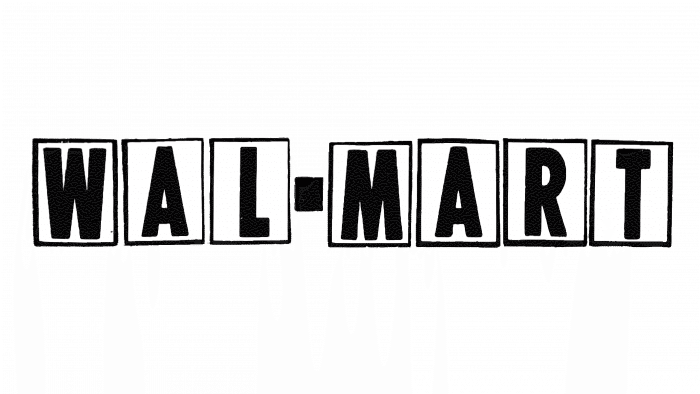
That year, the store introduced its own distinctive branding, reportedly inspired by a concept observed at Ann & Hope. The design was relatively simple, consisting of the name set with each letter placed inside an individual rectangle. Compared to the previous version, this iteration featured more white space, reversing the earlier visual balance.
Logo Redesign
1964
Walmart’s mid-1960s logo, often referred to as the “medallion,” offers a glimpse into the brand’s early visual identity. The design combined a circular form with a horizontal rectangle, creating the look of a badge or emblem of distinction. This composition conveyed a sense of credibility and importance, helping the company project reliability while standing out in an increasingly competitive retail landscape.
Logo Redesign
1962
After the lease on the previous premises expired, Walton was compelled to open a new store under the name Walmart. The signage displayed the name in a variety of styles and typefaces, though the most common version featured blue lettering in a sans-serif style.
Logo Design
1950
In 1945, businessman Sam Walton, a former JCPenney employee, purchased a Ben Franklin store from Butler Brothers to establish his low-cost retail model. When the store’s lease ended, Walton opened a new location, Walton’s Five and Dime, in Bentonville. This store is now a museum that chronicles the brand’s history. The logo of Walton’s Five and Dime reflected the simplicity and practicality typical of mid-20th-century retail design.
The store name, “Walton’s,” served as the central element of the signage, emphasizing a direct link between the business and its founder. This straightforward presentation reinforced the personal and accessible nature of the brand at its origin