
The stainless-steel pickup
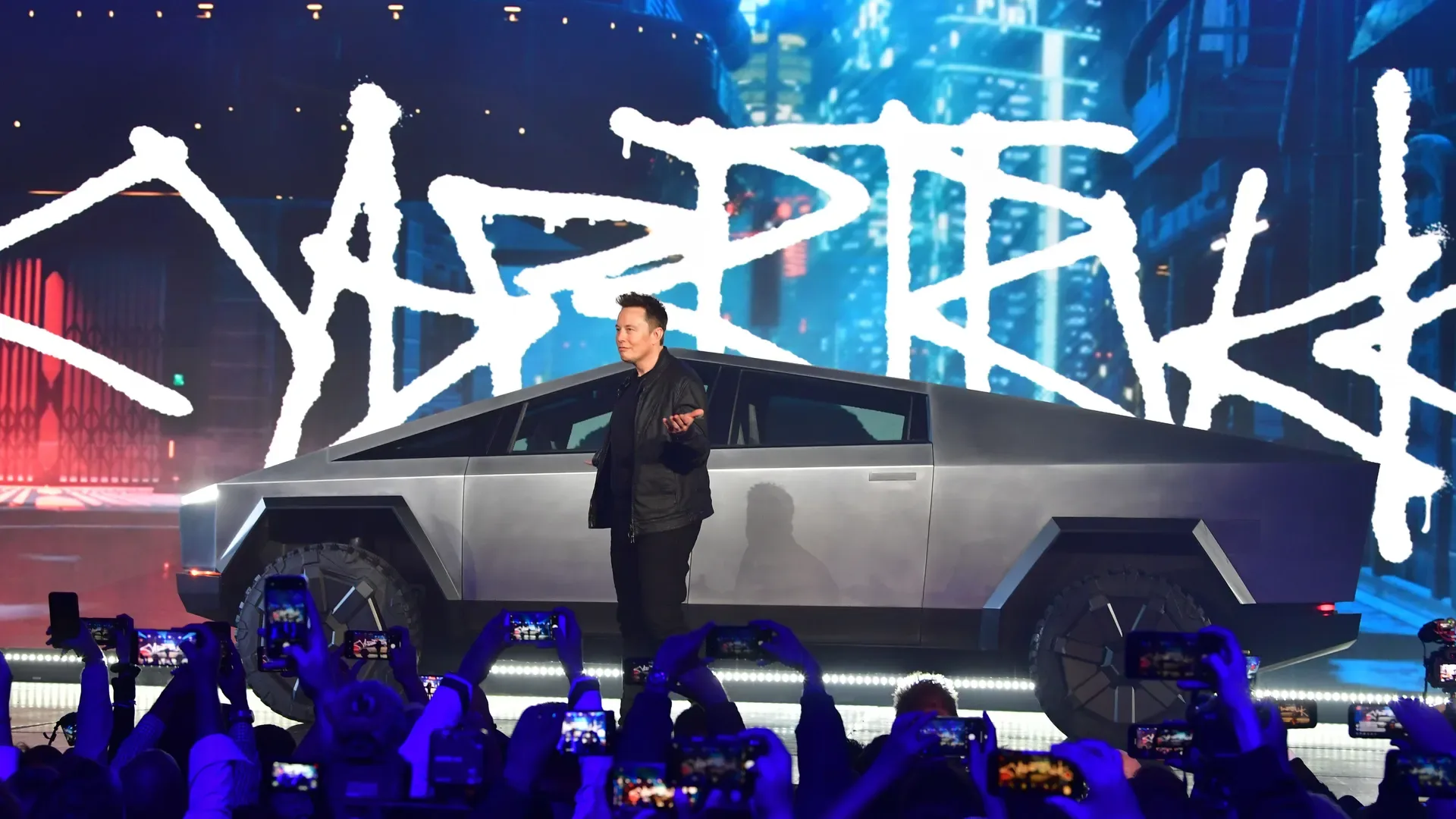
On the evening of 21 November 2019 Tesla introduced the Cybertruck at the company's design studio in Hawthorne, California. The vehicle was the marque's first entry into the full size pickup truck segment, the largest single category in the American automotive market. The reveal departed from every established convention of the American pickup launch. The body was a faceted, low angled stainless steel exoskeleton with no curved surfaces and no painted exterior panels. The roof and the side glazing were specified as a polycarbonate composite that Tesla branded Tesla Armor Glass. The truck was elevated on stage under a single low angle key light, with no automotive showroom dressing.
The choreography of the reveal
The presentation followed a sequence that Tesla had used at previous product launches but had refined for the Cybertruck. CEO Elon Musk introduced the vehicle in a series of slides that compared the truck against the Ford F-150 on a small set of headline specifications: bed length, towing capacity, ground clearance and zero to 60 miles per hour acceleration. The slide deck closed with a comparison of the body construction. The truck's stainless steel exoskeleton was specified at 3 millimetres of cold rolled 30X stainless steel, the same alloy Musk attributed to the SpaceX Starship body. The slides argued that the panel thickness would resist the impact of a 9 millimetre handgun round.
The choreographed demonstration that followed unfolded in two stages. Musk first swung a sledgehammer at the driver's door. The panel did not deform. He then invited the company's chief designer, Franz von Holzhausen, on stage with a steel sphere. Von Holzhausen had joined Tesla in 2008 from Mazda, where he had been director of design for the North American studio, and had overseen the exterior design of every Tesla production vehicle from the Model S onward. He threw the steel sphere at the front side window. The glass cracked from corner to corner but did not penetrate. A second attempt at the rear window produced an identical crack pattern. The cracks remained visible for the rest of the presentation, and the truck was driven on stage and off stage with the two damaged windows on full display.
Why the moment registered
The armor glass demonstration registered for a specific reason. The audience had been told moments earlier that the glass would withstand the impact, and the demonstration directly contradicted the claim. The contradiction was not edited out of the broadcast. The presentation continued, the unveiling ran to its scheduled conclusion, and the truck was returned to the stage with visible cracks in both side windows. The image of the cracked Tesla Cybertruck became the single most circulated photograph from the launch and was reproduced across every major automotive and consumer technology publication within twenty four hours.
The post launch commentary divided sharply. Industry analysts at Bernstein, at JD Power and at the Detroit Free Press described the moment as a brand setback that would limit the truck's order intake. Trade press in advertising and brand strategy interpreted the moment more positively, on the grounds that the absence of conventional polish reinforced Tesla's positioning as a marque that did not behave like an incumbent automaker. Both interpretations contained a piece of the eventual outcome. Reservation intake reached 250,000 units in the first three days, a figure Musk announced on his Twitter account on 24 November 2019.
Source: Tesla Youtube
The brand grammar of the launch
The Cybertruck reveal carried four pieces of brand grammar that distinguished it from established automotive industry practice. The truck was presented with an unfinished body surface. The body was a single piece of structural stainless steel rather than a clad chassis. The presentation included a live demonstration that introduced operational risk. And the design language broke with every prior pickup truck silhouette in the segment, including Tesla's own Model X and Model Y body shapes.
Each of those moves was strategically deliberate. The unfinished surface placed the truck outside the paint and chrome conventions that the existing American pickup segment relied on, which removed Ford, General Motors and Stellantis from the comparison set the truck would be measured against. The structural body removed the question of panel quality that the established American pickup buyer was trained to ask. The live demonstration positioned the truck as a working object rather than as a styling exercise. The silhouette gave the marque a recognisable shape that did not depend on the existing Tesla design language and could therefore be extended into adjacent categories without confusing the parent identity.
The aftermath and the long tail
Franz von Holzhausen returned to the armor glass moment publicly in 2025. In an interview reported by Fortune, he described the broken windows as a great marketing moment and confirmed that the team had not anticipated the failure on stage. The retrospective acknowledgement that the moment had been unplanned was unusual for an automotive marque, which would more typically retreat behind a managed silence after a high visibility public mistake. The decision to claim the moment instead, several years after the event, reinforced the brand position that the launch had established.
The Cybertruck eventually entered production in November 2023, with the first customer deliveries on 30 November 2023, four years after the Hawthorne reveal. The production silhouette retained the angular stainless steel body and the polycarbonate composite roof. Tesla revised the side glazing specification before production, and the production windows met the original demonstration claim. The launch image that the public retained, however, was the 21 November 2019 reveal with the cracked side windows, which continued to circulate in retrospectives, in trade rankings of the decade's most memorable product launches and in the marque's own subsequent communication.
The reveal therefore established two pieces of brand memory at once. It introduced a new automotive silhouette to the global market, and it gave Tesla a single image that would carry the launch story for the rest of the decade. The unplanned failure became a planned reference. Subsequent Tesla launches, including the Optimus humanoid prototype reveal in 2022 and the Robotaxi reveal in 2024, retained the same staging vocabulary and the same willingness to leave the unedited moment on the broadcast.
Source: The Guardian Youtube
Written with AI assistance, edited by a human. Find out more about our Use of AI.