
A skyscraper caught by its tower
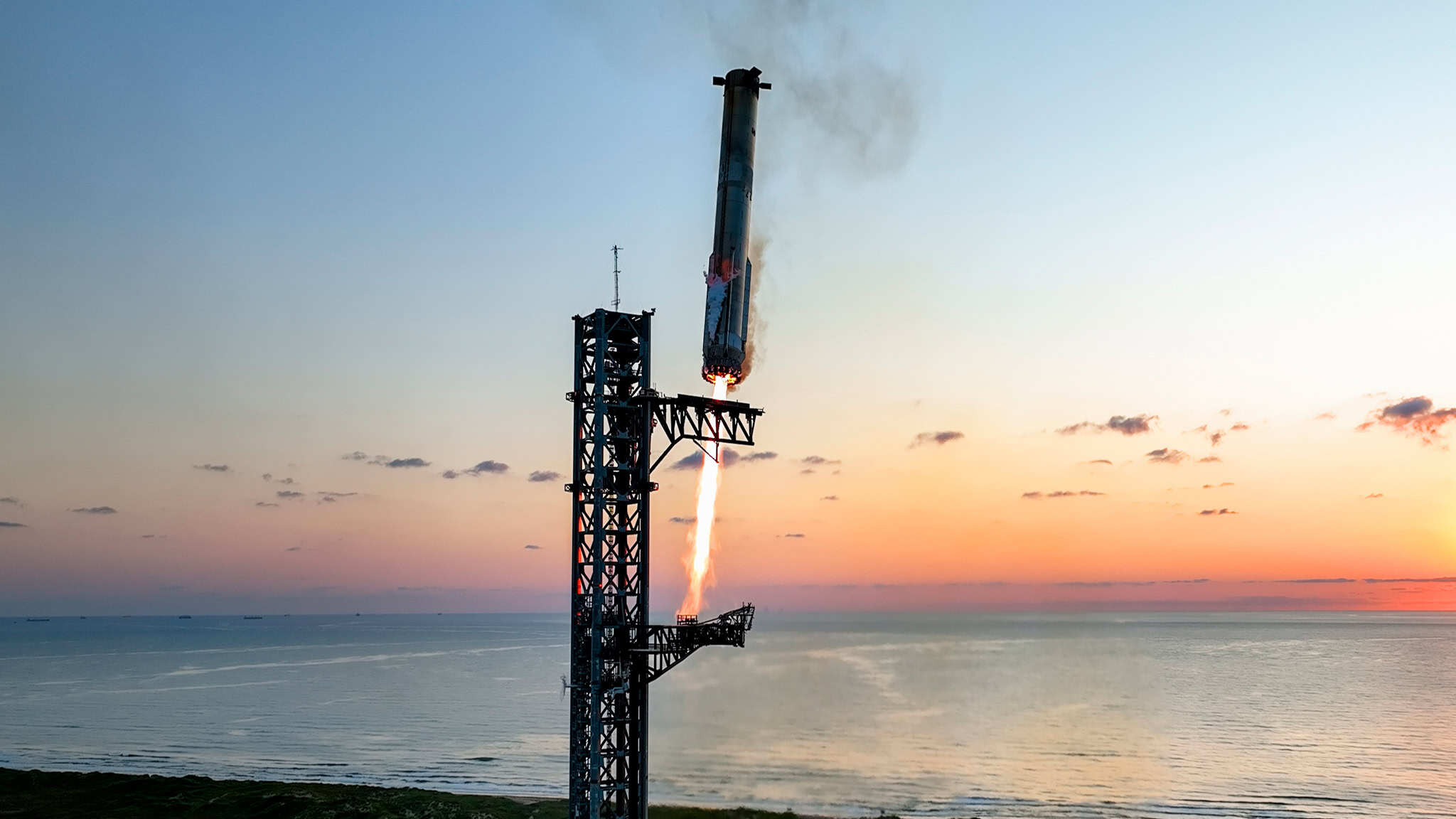
On 13 October 2024, SpaceX attempts something that has never been tried in spaceflight.1 During the fifth test flight of its Starship system, launched from the Starbase site at Boca Chica, Texas, the company brings the returning first stage, the Super Heavy booster, back to the same tower it launched from and catches it in mid-air with a pair of mechanical arms.2 The roughly 70 metre booster slows on a final engine burn, hovers alongside the structure the company nicknames Mechazilla, and settles into the arms that observers have long called the chopsticks.2, 3 It works on the first attempt.1
The manoeuvre is as much a piece of theatre as a piece of engineering. The booster descends from the edge of space, reignites its engines for a precise landing burn, and comes to rest held by the launch tower while flames and vapour still surround it. The live broadcast captures the moment SpaceX staff erupt in disbelief, and the footage spreads across the world within minutes.1
"Thousands of distinct vehicle and pad criteria had to be met prior to the catch attempt, and thanks to the tireless work of SpaceX engineers, we succeeded with catch on our first attempt."4
Why catching a rocket matters
The engineering logic is straightforward even if the execution is not. Landing a booster on legs, as SpaceX already does routinely with its Falcon 9, adds weight to the vehicle and still requires the stage to be lifted, inspected and moved before it can fly again.5 Catching the booster at the tower removes the landing legs, returns the stage directly to the mount, and is intended to allow the kind of rapid turnaround the company describes as essential to its long term goals.1 The catch is therefore not a stunt bolted onto a test, it is the test, the central thing Flight 5 sets out to prove.
The upper stage, the Ship, continues on its own path after separation and makes a controlled splashdown in the Indian Ocean, completing the flight's other major objective.3 But it is the booster catch that defines how the day is remembered. A complex, high risk engineering demonstration becomes, in the space of seconds, an image that audiences with no background in rocketry can immediately understand.
Spectacle as the brand's medium
SpaceX does not advertise in the conventional sense. It builds its public profile through the launches it stages, the live streams it produces and the imagery it releases, and the booster catch is the most concentrated example of that approach to date. The company has spent years training audiences to watch its attempts in real time, treating each flight as a broadcast with its own countdown, commentary and branded mission identity. The catch rewards that audience with a single, unrepeatable image that belongs unmistakably to one company.
The nicknames matter here. Mechazilla and the chopsticks are informal, almost playful terms for a piece of industrial infrastructure, and they give the public an easy, memorable way to talk about a structure that would otherwise be an anonymous tower. By letting that language take hold, SpaceX turns its hardware into characters in an ongoing story, much as a brand builds recognition around a name or a mark. The tower becomes part of the company's identity rather than a background object.
There is a clear line back to the company's first reusability milestone. A decade earlier, in 2014, SpaceX softly lands a Falcon 9 boost stage in the Atlantic for the first time and frames reusability as a goal the public is invited to follow.6 The 2024 catch is the moment that goal arrives in its most spectacular form, the returning rocket made into a piece of live theatre. The proposition has not changed, only its scale and its visibility.
An image the company now owns
For a brand, the value of the catch lies in its singularity. No other organisation has produced a comparable image, and the sight of a skyscraper sized booster held by the arms of its own launch tower is now associated with SpaceX alone. The company repeats the feat on later flights, turning a world first into a recurring demonstration, but the first catch remains the reference point, the moment that fixes the picture in the public mind.7
The episode shows how an engineering programme can function as a branding programme at the same time. SpaceX does not need a campaign to communicate ambition, capability and a willingness to attempt what others avoid. The catch does that work on its own, broadcast live and shared freely, and it leaves the company with something most brands spend heavily to manufacture, a moment audiences choose to watch and remember.
Source: Bloomberg Technology Youtube
Written with AI assistance, edited by a human. Find out more about our Use of AI.
1. Space.com, Mike Wall, "SpaceX catches giant Starship booster with 'Chopsticks' on historic Flight 5 rocket launch and landing (video)", 13 October 2024, off whitelist and the article's primary source rather than corroboration, for the 13 October 2024 attempt being without precedent and reported there as a first of its kind, for the catch succeeding on the first attempt about seven minutes after liftoff, for SpaceX employees screaming and cheering at the company's Hawthorne headquarters while the live webcast ran, and for the launch mount landing being designed to slash the time needed between flights, which is the rapid turnaround the body attributes to the company. https://www.space.com/spacex-starship-flight-5-launch-super-heavy-booster-catch-success-video
2. CNN, "Starship flight 5: SpaceX achieves 'chopstick' landing", a live report of 13 October 2024 that now carries the headline "Relive SpaceX Starship's fifth test flight here as it happened" and no single byline, off whitelist, for the fifth test flight lifting off at 7:25 a.m. Central from SpaceX's Starbase facility at Boca Chica, Texas, for the returning first stage being caught in mid-air roughly seven minutes later by the pair of metal pincers SpaceX calls the chopsticks on the tower known as Mechazilla, and for the booster measuring 232 feet, which is the roughly 70 metres given in the body. The listed www.cnn.com address refuses automated requests under its robots.txt, so the same article was read on 18 September 2026 at CNN's international mirror, which carries the identical text. https://www.cnn.com/2024/10/13/science/spacex-starship-test-flight-5-launch https://edition.cnn.com/2024/10/13/science/spacex-starship-test-flight-5-launch
3. Wikipedia, "Starship flight test 5", for the flight profile the body describes: the landing burn of Super Heavy Booster 12 and the chopstick arms of the tower called Mechazilla closing around it before the engines shut down, and the upper stage continuing after separation to a splashdown in the Indian Ocean at 8:30 a.m. Central on 13 October 2024. https://en.wikipedia.org/wiki/Starship_flight_test_5
4. SpaceX, "Starship's Fifth Flight Test", spacex.com, 13 October 2024, for the company statement quoted in the body in full: "Thousands of distinct vehicle and pad criteria had to be met prior to the catch attempt, and thanks to the tireless work of SpaceX engineers, we succeeded with catch on our first attempt." The spacex.com pages listed in the sources return no machine readable body text to automated requests on 18 September 2026, so the wording was verified word for word against Smithsonian Magazine, Margherita Bassi, "SpaceX Launches Starship Mega-Rocket and Catches Its Booster in Midair on First Try", 15 October 2024, which reproduces the statement and attributes it to the SpaceX mission page; that title is off whitelist and used for corroboration only. https://www.spacex.com/launches/starship-flight-5 https://www.smithsonianmag.com/smart-news/spacex-launches-starship-mega-rocket-and-catches-its-booster-in-midair-on-first-try-180985268/
5. Wikipedia, "SpaceX", for the Falcon 9 first stage being designed to land retropropulsively, be recovered and fly again, for the first successful landing and recovery of a first stage in December 2015, and for reuse having become routine practice thereafter, which is the established Falcon 9 leg landing the body contrasts with the tower catch. https://en.wikipedia.org/wiki/SpaceX
6. Wikipedia, "Falcon 9 first-stage landing tests", added during the footnote retrofit because no listed source covered the 2014 milestone, for the April 2014 controlled descent test that ended in the Atlantic and is described there as the first successful controlled ocean soft touchdown of a liquid rocket engine orbital first stage. https://en.wikipedia.org/wiki/Falcon_9_first-stage_landing_tests
7. Wikipedia, "List of Starship launches", added during the footnote retrofit because no listed source covered the later flights, for the tower catch being repeated on Flight 7 of 16 January 2025 and on Flight 8 of 6 March 2025, the two subsequent flights on which the booster was caught by the arms of OLP-1. https://en.wikipedia.org/wiki/List_of_Starship_launches